

If you use a broker app or stock screener, you’ve probably seen an alert like: “Stock Is Trading 100% Above Its Weekly Average Volume.”
It sounds technical, but the idea is simple: the stock is trading at roughly double its normal weekly activity. That surge in trading can signal something important is happening — good or bad.
For Indian retail investors looking at both NSE/BSE stocks and US markets, understanding this alert helps you decide whether to pay attention, act, or stay away. This guide breaks it down in plain English, with a focus on how you can use it in your own trading and investing.
What Is Trading Volume and Weekly Average Volume?
Trading Volume in Plain Terms
Trading volume is the total number of shares that changed hands in a given period.
- If one buyer purchases 500 shares from one seller, the volume is 500, not 1,000.
- Daily volume = total shares traded from market open to close.
- Weekly volume = total shares traded from Monday to Friday.
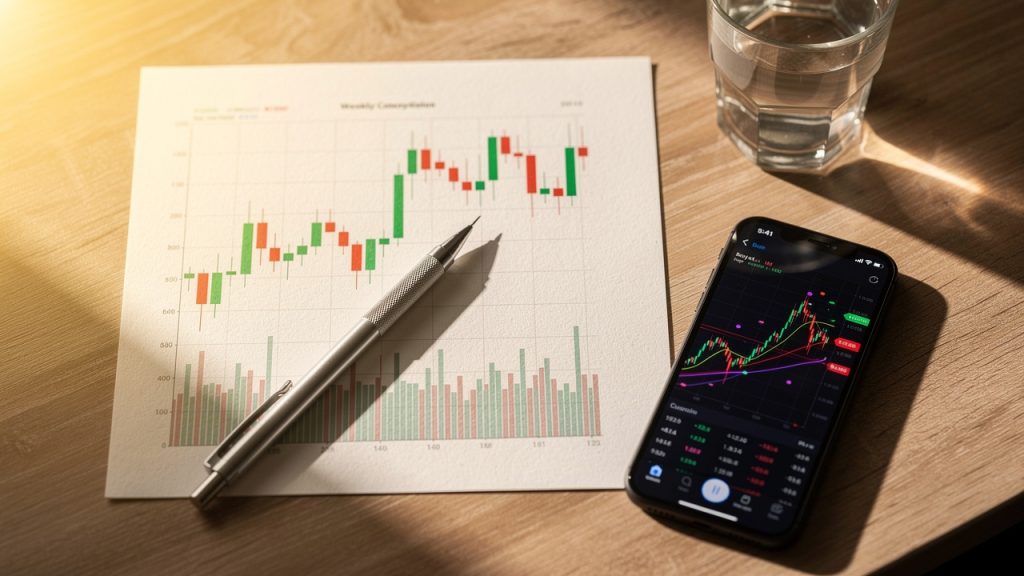
On charts, volume usually appears as vertical bars at the bottom, under the price candles.
What Is Weekly Average Volume?
Looking at just one week can be noisy. That’s why traders look at average volume over several weeks to see what’s “normal.”
Weekly average volume =
Average number of shares traded per week over a chosen lookback period (for example, the last 4, 10, or 20 weeks).
Here’s a simple example for one week:
| Day | Shares Traded |
|---|---|
| Monday | 500,000 |
| Tuesday | 550,000 |
| Wednesday | 520,000 |
| Thursday | 510,000 |
| Friday | 520,000 |
| Weekly Average | 520,000 |
If you calculated this over many weeks, you’d get a baseline for what’s typical.
Traders also talk about relative volume (RVOL) — how current volume compares to that average. An RVOL of 2.0 means the stock is trading at twice its usual volume for that period.
“Volume precedes price.” – Joseph Granville
This classic idea in technical analysis is why many traders watch volume spikes so closely before making a move.
What Does “Stock Is Trading 100% Above Its Weekly Average Volume” Mean?
Mathematically, “100% above” simply means double.
- If the weekly average volume is 520,000 shares…
- And this week the stock trades 1,040,000 shares or more…
- Then the stock is trading 100% above its weekly average volume.
In charting terms, the current weekly volume bar will be about twice as tall as the average volume line.
Why This Matters
When a stock is trading 100% above its weekly average volume, it usually means:
- Unusual interest – far more traders and investors are active than normal.
- Fresh information – news, results, policy changes, sector moves, or rumors.
- Higher liquidity – it is easier to buy and sell without moving the price too much.
- Higher volatility risk – larger and faster price swings are very common.
You don’t buy or sell just because of a volume spike. But it’s a strong “pay attention” signal that tells you: “Something is going on here; now find out what.”
If you’re also building a long-term ETF portfolio, volume around major events can matter for your fund holdings too. For more perspective, see 9 Powerful Tips for Investing in ETFs for Long-Term Wealth.
Why Volume Spikes Like This Happen
A stock rarely trades at double its weekly average volume by accident. Usually, there is a clear trigger.

1. Company News and Events
Some common company-specific reasons:
- Earnings results – big beat or big miss versus expectations.
- Guidance changes – management raises or cuts future profit outlook.
- Mergers and acquisitions – being bought, buying another company, or deal rumors.
- Product or regulatory news – drug trial results, new licenses, big contract wins, or rejections.
- Management changes – a respected new CEO joining, or a sudden resignation.
Each of these can change how the market values the company, leading to heavy buying or selling.
2. Sector and Theme Moves
Sometimes the whole sector is in focus:
- Policy shifts (for example, EV incentives, import duties, tax changes).
- Commodity price swings (crude oil, metals, etc.).
- Technology themes (AI, renewable energy, semiconductors).
If the auto sector, banking sector, or IT sector is in the news, many related stocks can show weekly volume far above average.
3. Macro and Policy Events
Big economic or policy news can move the entire market:
- RBI or US Federal Reserve interest rate decisions.
- Inflation, GDP, or unemployment data.
- Budget announcements or major reforms.
These events often drive broad volume surges on the Nifty, Sensex, and US indices, a phenomenon examined in A Look at the mechanics of high-frequency and event-driven trading activity. To understand one big macro driver better, read Are Fed Rate Cuts Good for the Stock Market?.
4. Technical Breakouts and Breakdowns
Even without fresh news, pure chart action can trigger huge volume:
- Breakout above resistance – price moves above a level where it has repeatedly failed earlier.
- Breakdown below support – price falls below a level where buyers previously stepped in.
- Pattern completion – triangles, flags, head-and-shoulders, “cup and handle,” etc.
These levels often trigger stop-losses, algo trades, and entries from technical traders around the world, all at once.
5. Institutional and Retail Flows
- Institutional orders – mutual funds, pension funds, and FIIs buying or selling in bulk.
- Index changes – stock added to or removed from indices like Nifty 50 or S&P 500.
- Social Media Buzz / “Meme” Stocks – heavy interest from retail traders coordinating on forums and social platforms.
All of these can push volume to several times the weekly average.
How to Read a 100% Weekly Volume Spike: Bullish or Bearish?
A spike in volume is neutral by itself. The price direction alongside that volume is what gives you a signal.
1. Price Up on High Volume – Often Bullish
If price rises sharply while the stock is trading 100% above its weekly average volume:
- Buyers are showing strong conviction.
- A breakout above resistance on such volume is far more reliable than one on low volume.
- Multiple “accumulation” days/weeks (gains on above-average volume) often point to institutional buying.
This setup is often used by momentum and swing traders looking for continuation of an uptrend.
2. Price Down on High Volume – Often Bearish
If price falls hard while weekly volume is double the average:
- Sellers are clearly in control.
- A breakdown below a major support level on very high volume can confirm the start of a deeper downtrend.
- Repeated “distribution” days/weeks (declines on high volume) warn that big players may be exiting.
3. After a Long Uptrend – Possible Exhaustion
If a stock has run up for months and suddenly:
- Has its biggest weekly volume ever, and
- Price barely moves higher, or even closes lower…
…that can be an exhaustion move or blow-off top. Late buyers are rushing in while early investors quietly book profits.
4. After a Long Downtrend – Possible Capitulation
After a steep fall over many weeks:
- A final sharp drop on very high weekly volume can mark a selling climax.
- Price may close well above the weekly low, showing that buyers stepped in strongly.
This can be the first sign that the downtrend is near its end — but it still needs confirmation before you buy.
5. High Volume, Little Price Change – Big Battle Zone
If the stock is trading 100% above its weekly average volume, but closes near flat:
- Bulls and bears are fighting at an important level.
- After a downtrend, this can signal quiet accumulation by institutions.
- After an uptrend, it can signal distribution, with big players selling to eager latecomers.
In such zones, the next breakout or breakdown often sets the direction for the next major move.
Trading Strategies When Volume Doubles Versus the Weekly Average
High weekly volume creates opportunity — and risk. If you trade actively, here are ways to use it more sensibly.
1. Confirmation for Breakout Trades
For breakout traders, one of the strongest filters is:
Only trade breakouts that happen with volume at least 50–100% above the weekly average.
Basic approach:
- Spot a base or range – the stock has been consolidating for weeks.
- Mark resistance – a clear level that price has failed to cross several times.
- Wait for a breakout candle where:
- Price closes above resistance, and
- Weekly volume is around 2× the weekly average or more.
You can then:
- Enter near the breakout level.
- Use a stop-loss just below the old resistance (now support).
- Trail your stop as the trend continues.
2. Watching for Reversals Around Climactic Volume
If a stock is in a long trend and suddenly:
- Volume is many times the weekly average, and
- The candle shows a long wick against the prior trend (e.g., long upper wick after an uptrend, long lower wick after a downtrend),
you may be seeing exhaustion (at the top) or capitulation (near the bottom).
Reversal trading is higher risk and better suited to experienced traders, but the logic is:
- Wait for confirmation in the next candle (price moving in the opposite direction of the prior trend).
- Use tight stops below/above the climactic candle’s low/high.
3. Intraday or Short-Term Trading on “In-Play” Stocks
Day traders often focus only on stocks that are:
- Moving strongly on price and
- Showing volume far above their average (e.g., 2–5×).
If you trade intraday:
- Screen for stocks trading 100% above their weekly (or daily) average volume.
- Trade with the direction of the main move (up or down), instead of guessing tops and bottoms.
- Cut losing trades quickly; high-volume stocks can reverse very fast.
4. Risk Management Comes First
With any strategy based on high volume:
- Reduce position size if volatility is high.
- Prefer limit orders over market orders to control slippage.
- Always define your stop-loss before entering.
- Avoid trading just because Twitter, Telegram, or TV is excited.
For a deeper look at how individual stocks can behave over time, including multi-bagger potential, read Can Pradeep Metals Ltd Share Become a Multibagger.
How Long-Term Investors Should Use Volume Spikes
If you’re a long-term investor in stocks, mutual funds, or ETFs, you don’t need to react to every spike when a stock is trading 100% above its weekly average volume. But you should use it as extra context.
1. Validating Entry and Exit Points
Volume can help you:
- Confirm breakouts when buying quality companies for the long term.
- Avoid chasing thin, illiquid stocks where a few trades can distort price.
- Watch for heavy distribution in a stock you already own, especially if there is negative news plus repeated high-volume down weeks.
2. Separating Noise From Signal
Remember:
- Volume without a solid reason (news, results, announcements) can be pure speculation.
- One or two high-volume weeks may not change the long-term story if fundamentals stay strong.
- High volume around earnings or policy news is normal; focus on whether the story has actually changed.
3. Combining Volume With Other Tools
Use weekly volume spikes with:
- Price trends and key support/resistance levels.
- Fundamentals (earnings growth, balance sheet, management quality).
- Broader macro backdrop (interest rates, inflation, sector outlook).
If you’re mainly building wealth through diversified funds, you’ll find it helpful to pair this with guidance like 9 Powerful Tips for Investing in ETFs for Long-Term Wealth.
How to Find Stocks Trading 100% Above Their Weekly Average Volume
You don’t need to scan hundreds of charts by hand. Most platforms let you screen for relative volume.
1. Use Stock Screeners
Set filters such as:
- Relative Volume (RVOL):
- For “100% above,” look for RVOL ≥ 2.0 on daily or weekly data.
- Minimum Average Volume:
- For example, > 500,000 shares, to avoid illiquid counters.
- Price Filter:
- For example, > ₹100 in India, or > $5 in US markets.
- Price Change:
- Up > +3% for bullish scans, Down < -3% for bearish scans.
Popular options include:
- StocksInfo.ai for research, ideas, and educational tools that help you interpret price–volume action.
- Global platforms such as TradingView, Finviz, and broker platforms.
- India-focused screeners like Screener.in, Moneycontrol, Tickertape, plus tools from brokers such as Zerodha and Upstox.
2. Set Alerts and Watchlists
Most platforms allow you to:
- Create a “High Relative Volume” watchlist.
- Set alerts like: “Notify me when this stock’s volume is 2× its 20-day average.”
That way you get notified when a stock becomes “in play” without staring at the screen all day.
Common Mistakes and Risks When Chasing High Volume
Volume spikes can tempt you into trades you shouldn’t take. Be careful of these common errors.
1. Jumping In Purely From FOMO
Seeing a stock all over social media with price and volume exploding can trigger fear of missing out.
Risk:
- You often buy late, near the peak of the move.
- Early traders may already be selling to you.
Solution:
- Never buy just because “everyone is talking about it.”
- Stick to your entry rules and risk limits.
2. Falling For False Breakouts (“Fakeouts”)
Sometimes a stock:
- Breaks above resistance on high volume,
- Then quickly reverses and falls back below it.
This can happen when:
- Big players push the price just above a known level to trigger breakout buying and short covering, then sell into that demand.
Reduce the damage by:
- Waiting for a close above resistance, not just an intraday spike.
- Looking for a retest of the breakout level that holds as support.
- Keeping your stop-loss just below that level.
3. Underestimating Volatility and Slippage
When a stock is trading 100% above its weekly average volume:
- Spreads can widen during fast moves.
- Prices can jump between ticks, especially around news.
To manage this:
- Use limit orders instead of blind market orders.
- Trade smaller size than usual.
- Accept that stops may be filled at worse prices than expected during extreme moves.
4. Ignoring Fundamentals and Context
A volume spike driven by:
- Strong earnings, big contracts, or real structural change
is very different from a spike driven by:
- Rumors, vague social media buzz, or “no real news.”
Always ask:
“What specific information is the market reacting to, and does it justify a lasting change in value?”
If you don’t have a clear answer, be conservative.
FAQs
What Does It Mean When a Stock Is Trading 100% Above Its Weekly Average Volume?
It means the current weekly trading volume is about double the average weekly volume over a chosen period. In other words, the stock is seeing far more activity than usual, which often signals that new information or a key technical level is in play.
Is a 100% Weekly Volume Spike Always Bullish?
No. It can be bullish or bearish:
- Bullish if price is breaking out or trending up strongly on high volume.
- Bearish if price is breaking down or falling sharply on high volume.
You must interpret volume together with price direction and context.
How Is Weekly Average Volume Different From Daily Average Volume?
- Daily average volume looks at the average per trading day.
- Weekly average volume looks at total shares traded in a week and averages that across several weeks.
The weekly view smooths out day-to-day noise and highlights sustained shifts in participation.
Should Long-Term Investors React to Every High-Volume Week?
Not necessarily. Long-term investors should:
- Note high-volume weeks around important events (earnings, policy changes, big news).
- Check whether the fundamental story has changed.
- Avoid making decisions solely on short-term volume unless it reflects a clear, lasting shift in outlook.
Can a Small-Cap Stock Show 500% or 1000% Above Weekly Average Volume?
Yes. Small and micro-cap stocks often have low base volume, so a relatively modest amount of money can create huge percentage spikes. That’s why you must be extra careful with:
- Liquidity risk (hard to exit).
- Price manipulation risk (pump-and-dump type activity).
Final Thoughts
When a stock is trading 100% above its weekly average volume, the market is telling you something: this stock is no longer in “normal mode.” There is fresh interest, new information, or an important technical level in play.
On its own, this signal doesn’t say buy or sell. It simply says “look closer”:
- Check why volume spiked.
- Read it together with price action.
- Factor in fundamentals, macro conditions, and your own risk profile.
Used with discipline, volume can help you spot genuine breakouts, avoid weak moves, and understand when big money is entering or exiting a stock — in India or abroad. Combine it with sound research, risk control, and a clear plan, and it becomes a valuable part of how you read the market. Resources on StocksInfo.ai can support this by giving you structured ways to study charts, volume, and news together before you commit real capital.
You may also like:
- Hero MotoCorp Stock: Buy, Hold, or Wait
- Is the Stock Market Like Gambling or Investing?
- Tips for Investing in ETFs for Long-Term Wealth

Ramesh Iyer is the founder of StocksInfo.AI, a Bengaluru-based investor with two decades of market experience, writing plain-language content on stocks, mutual funds, and ETFs for everyday Indian investors. Read more