
Most Indian investors begin with a Demat account, a digital account that holds shares, and a trading account, which lets them buy and sell shares on the NSE or BSE. I remember starting the same way: looking at a few popular large-cap names, hearing friends talk about SIPs, and wondering how people actually build wealth for retirement or a child’s education.
A mutual fund SIP—a Systematic Investment Plan where you invest a fixed amount regularly—remains a simple starting point. But once you understand the basics, a carefully selected basket of manufacturing stocks can add long-term growth potential to your portfolio. Manufacturing benefits from India’s infrastructure build-out, import substitution, electrification, defence spending, railways, consumer demand, and export opportunity.
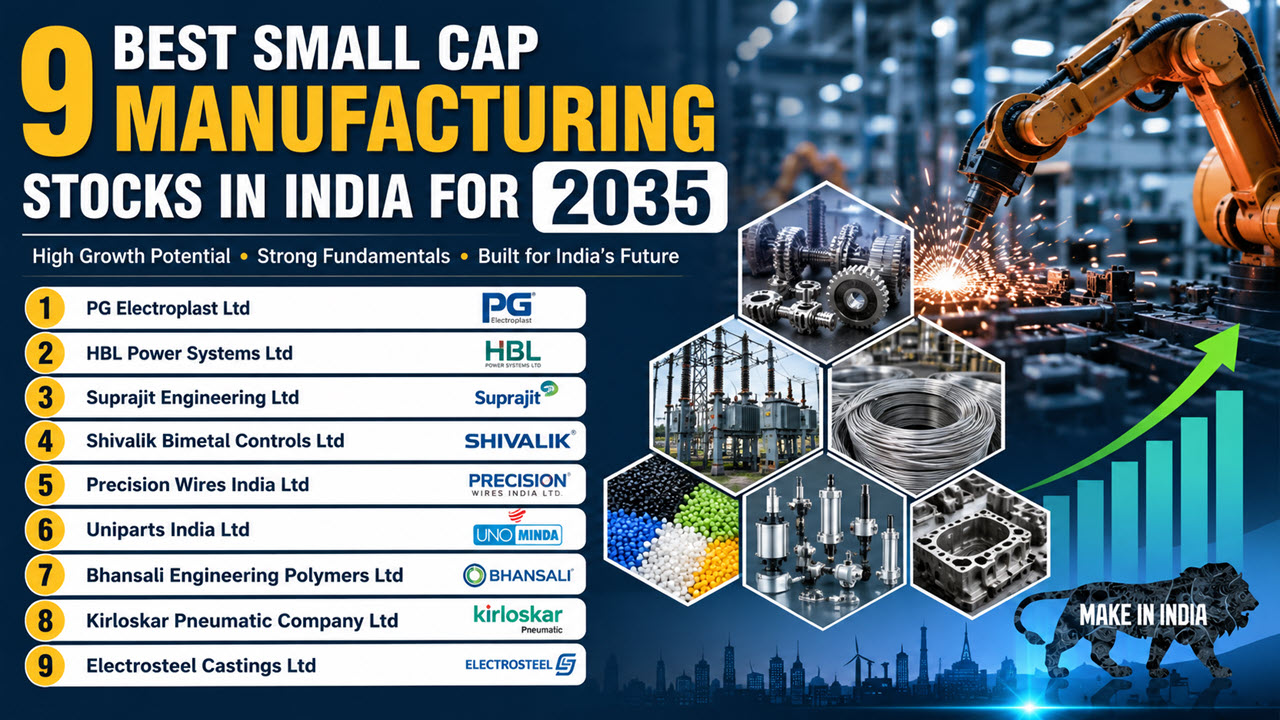
Here are nine small cap manufacturing stocks in India for 2035 that deserve a place on a long-term research watchlist, along with a practical way to approach them.
Why Small Cap Manufacturing Stocks Matter for 2035
Small-cap companies are generally smaller listed businesses with a lower market value than large-cap and mid-cap companies. A large-cap company is usually a well-established market leader, while a mid-cap company sits in the middle and a small-cap company is earlier in its scale-up journey.
The attraction is clear. A company selling a specialized industrial product today may have room to multiply revenue over the next decade if it expands capacity, gains new customers, protects margins, and controls debt. That upside is why small caps can outperform in strong business cycles.
The risk is equally real. Small-cap shares can fall 30% to 50% during a market correction even when the underlying business remains decent. Liquidity can also be lower, meaning you may not always buy or sell large quantities at the price you want.
For someone like Suresh, a 30-year-old salaried professional investing ₹10,000 every month, I would not put the full amount into direct small-cap shares. He could keep ₹6,000 in diversified equity mutual funds or index funds, ₹2,000 in a quality ETF—an exchange-traded fund bought and sold like a share—and use the remaining ₹2,000 to build a direct-stock watchlist slowly.
Pro Tip: In my experience, the biggest mistake with small caps is buying a good story after the share price has already run up sharply. I prefer to study earnings, debt, capacity expansion, and customer demand before I look at short-term price targets.
How I Selected These Small Cap Manufacturing Stocks in India for 2035
I would not call any stock a guaranteed winner for 2035. Instead, I look for businesses that have a reasonable chance of growing through several economic cycles.
What I Look For
- Clear manufacturing capability: The company should make products that solve a real industrial or consumer need.
- Long-term demand tailwind: Infrastructure, electrification, auto components, railways, defence, power equipment, water supply, and electronics are useful themes.
- Financial discipline: Debt, working-capital requirements, operating cash flow, and return on capital matter more than exciting presentations.
- Competitive position: A company with specialised products, customer approvals, export relationships, or a difficult manufacturing process can defend its margins better.
- Valuation sanity: Even an excellent business can become a poor investment if you buy it at an unreasonable price. Learn how to use the PE ratio before buying a stock instead of blindly following momentum.
- Management execution: Promoters must deliver on expansion plans without excessive dilution, related-party issues, or unplanned borrowing.
These businesses operate in different segments. That matters because diversification means spreading your money across industries so one weak sector does not damage your entire portfolio.
9 Best Small Cap Manufacturing Stocks in India for 2035
1. PG Electroplast Ltd
PG Electroplast stands out in India’s electronics manufacturing services space. It manufactures and assembles products across categories such as consumer electronics, home appliances, plastic components, and related product lines.
The long-term opportunity comes from India’s push to manufacture more electronics and appliances locally. Companies that build scale, win brand partnerships, maintain quality, and manage working capital well can benefit as domestic demand rises.
This is not a low-risk stock. Electronics manufacturing often needs heavy capital expenditure, and margins can remain thin. Investors should track capacity utilization, customer concentration, receivables, debt levels, and whether revenue growth converts into cash flow.
For a 2035 view, I like the broad manufacturing theme. Still, I would buy in stages rather than chase a sharp rally. If you are exploring technology-linked manufacturing opportunities, also review this guide to semiconductor manufacturing stocks.
2. HBL Power Systems Ltd
HBL Power Systems operates across industrial batteries, electronics, railways, defence-linked products, and energy-storage-related applications. Its business mix gives it exposure to sectors where product reliability and approvals matter.
Railways and defence can create long order cycles. That can support visibility when the company wins credible orders, but investors must remember that project execution and tender timing can make quarterly numbers uneven.
I would focus on order book quality, repeat business, operating margins, and the cash conversion cycle. A large order announcement looks attractive, but it only becomes valuable when the company executes it profitably and collects payment on time.
The stock suits investors who can tolerate volatility and follow quarterly developments. Do not treat it like a fixed deposit simply because its products serve strategic sectors.
3. Suprajit Engineering Ltd
Suprajit Engineering is an auto-component manufacturer known for control cables and related automotive products. It supplies two-wheelers, passenger vehicles, commercial vehicles, and selected non-automotive applications.
Auto components can offer a powerful long-term compounding story when a company earns strong customer relationships, expands product categories, and grows exports. Suprajit’s broader opportunity lies in moving beyond one product category and serving changing vehicle platforms.
The key risk is the auto cycle. Vehicle demand can slow because of interest rates, fuel prices, rural demand weakness, or a broader economic slowdown. Electric vehicles also change component demand, so investors should watch how the company adapts its product portfolio.
For direct equity investors, this is a useful example of why business quality matters more than the latest quarterly price movement. Read long-term investment strategies before building a position based only on past returns.
4. Shivalik Bimetal Controls Ltd
Shivalik Bimetal Controls makes specialized bimetal and shunt-resistor products used in energy meters, electrical equipment, industrial applications, and other precision uses. Its niche positioning makes it different from a typical commodity manufacturer.
I like specialized manufacturing businesses because customers often value product quality, testing standards, and long-term reliability. These factors can create a stronger competitive moat than simple scale alone.
The growth case depends on demand for smart meters, electrical equipment, renewable-energy infrastructure, and measurement devices. However, a niche company can face customer concentration risk, so investors should study its major customer profile and whether new segments are genuinely contributing.
A small allocation may make sense for someone who wants exposure to precision electrical components. But I would still diversify across industries rather than make it my largest manufacturing bet.
5. Precision Wires India Ltd
Precision Wires India manufactures insulated winding wires used in motors, transformers, fans, compressors, appliances, and electrical equipment. You may not notice these products as a consumer, but they sit inside many products that use electricity.
The long-term growth driver is electrification. India needs more motors, transformers, air conditioners, consumer appliances, industrial equipment, renewable-energy systems, and electric mobility infrastructure. Each trend can support demand for winding wires.
At the same time, copper prices can move sharply. The company may pass through a part of the raw-material cost, but investors should understand that revenue growth can sometimes reflect commodity prices rather than volume growth.
I would monitor volume expansion, value-added products, operating margin stability, and return on capital. For investors interested in broader power-sector themes, this article on energy stocks with high dividends offers another angle, although dividend yield should never replace business analysis.
6. Uniparts India Ltd
Uniparts India makes engineered systems and components for agricultural machinery, construction equipment, and off-highway vehicles. It has meaningful exposure to global customers, which gives it an export-oriented manufacturing profile.
Exports can help an Indian manufacturer diversify beyond local demand. But they also introduce currency risk, overseas economic cycles, freight costs, and customer-order volatility. A slowdown in the US or European farm-equipment cycle can affect order flow.
The business becomes more attractive if it keeps winning long-term customer programmes, adds higher-value engineered products, and protects margins despite global competition. I would review export mix, customer concentration, inventory trends, and free cash flow every year.
This stock fits investors looking for a company that connects Indian manufacturing with global industrial demand. Avoid assuming that export exposure automatically means predictable growth.
7. Bhansali Engineering Polymers Ltd
Bhansali Engineering Polymers manufactures ABS, a plastic engineering material used in automobiles, appliances, electronics, and consumer products. The company benefits when India produces more vehicles, white goods, and locally manufactured consumer electronics.
The opportunity lies in import substitution and growing domestic consumption. As India adds manufacturing capacity, demand for specialized polymers can rise alongside it.
But this is a cyclical business. Polymer pricing depends on raw-material trends, industry supply, demand from key customers, and global commodity conditions. Profit can move far more than revenue, especially when spreads expand or contract.
I would not value this type of business using just one year’s peak earnings. Instead, look at profits across a full cycle, debt reduction, capacity additions, and the company’s ability to maintain utilization.
8. Kirloskar Pneumatic Company Ltd
Kirloskar Pneumatic manufactures industrial air-compression, refrigeration, gas-compression, and related systems. It benefits from industrial investment because factories, cold chains, logistics facilities, process plants, and infrastructure projects need reliable equipment.
Industrial capital goods can reward patient investors. When private-sector capital expenditure rises, established suppliers often receive more enquiries, better order flow, and operating leverage. Operating leverage means profit can grow faster than sales after fixed costs get covered.
The risk is that industrial demand does not move in a straight line. A delayed project cycle can postpone orders, while competitive bidding can pressure margins. Track the company’s order book, new product development, margin movement, and working capital.
This is a practical stock to research if you believe India’s industrial cycle will remain strong through the next decade.
9. Electrosteel Castings Ltd
Electrosteel Castings manufactures ductile iron pipes and fittings used in water-supply and infrastructure projects. India’s need for water distribution, sanitation, urban infrastructure, and replacement of aging networks gives this sector a clear long-term purpose.
The company’s business can benefit from public infrastructure spending, especially water-related projects. However, it remains exposed to project delays, government spending cycles, raw-material costs, and tender execution. Recent operating performance also highlights how quickly demand delays and margin pressure can affect profits.
I would treat this as an infrastructure-cycle stock rather than a buy-and-forget compounder. The right approach is to watch order inflow, dispatch volumes, receivable days, debt, export mix, and management guidance before adding more capital.
For a broader look at identifying value candidates, see undervalued stocks for long-term investing.
How to Build a Small Cap Manufacturing Portfolio
Suresh has ₹10,000 a month available for long-term investing. Rather than putting ₹10,000 into one promising manufacturing share, he can build exposure gradually.
A balanced approach could look like this:
- ₹5,000 in a diversified equity mutual fund SIP, where the fund manager invests across many companies.
- ₹2,000 in an index fund, a mutual fund designed to track an index such as the Nifty 50.
- ₹1,000 in an ETF, which trades on the exchange like a share and offers low-cost diversified exposure.
- ₹2,000 reserved for direct stocks, split across two or three carefully researched purchases.
The NAV, or Net Asset Value, is the per-unit price of a mutual fund. In a SIP, Suresh buys more units when the NAV falls and fewer units when the NAV rises. That is useful for regular investing, but it does not remove market risk.
For direct small-cap shares, I would keep any single company position limited. If Suresh builds a ₹5 lakh equity portfolio over time, putting ₹25,000 to ₹40,000 in one small-cap stock feels more sensible than investing ₹1 lakh in a single idea.
You can also use ETF investing tips to understand how diversified exchange-traded products can reduce the pressure to pick every winner yourself.
Things to Keep in Mind
- Treat this as a watchlist, not a buy list: Share prices and financial results change quickly, so always review the latest annual report, quarterly numbers, valuation, and business updates.
- Limit your exposure: Small-cap manufacturing stocks should form only one part of your equity portfolio, not your entire retirement plan.
- Avoid borrowing to invest: Never use personal loans, credit cards, or margin funding to buy volatile stocks.
- Check cash flow, not only profit: A company can report accounting profit while customers delay payments and working capital rises sharply.
- Buy over time: Spread purchases across several months or quarters instead of investing all your money after a sudden rally.
- Keep a long horizon: Give quality manufacturing businesses at least five to ten years, but review the business every year.
Frequently Asked Questions
Are small cap manufacturing stocks good for long-term investing in India?
They can offer strong long-term growth, especially when the company has a durable product, healthy finances, and a growing market. They also carry higher price volatility and business risk than large-cap stocks, so diversification matters.
How many small cap stocks should I hold in my portfolio?
A beginner can start with five to eight well-researched direct stocks over time, while keeping most money in diversified mutual funds or index funds. Holding too many small caps makes tracking difficult, while holding only one or two creates concentration risk.
Should I invest through SIP or buy manufacturing stocks directly?
A mutual fund SIP works better for most beginners because it offers diversification and discipline. Direct stocks need more research, annual review, and emotional control during market corrections.
Is a Demat account required to buy these shares?
Yes, you need a Demat account to hold listed shares digitally and a trading account to place buy or sell orders on the NSE or BSE. Mutual fund SIPs may not require a trading account, depending on how you invest.
Can small cap stocks double by 2035?
Some companies may multiply in value over a decade, but no one can predict that with certainty. Focus on earnings growth, debt control, cash flow, competitive advantage, and reasonable purchase valuation instead of expecting a fixed return.
Are unlisted shares better than listed manufacturing stocks?
Unlisted shares are not automatically better. They often carry lower liquidity, limited public information, uncertain pricing, and delayed exits, so beginners should understand the risks of investing in unlisted shares before allocating money.
The best small cap manufacturing stocks in India for 2035 combine a strong sector opportunity with disciplined execution, manageable debt, sensible valuation, and patient investors. Start simple, invest consistently, diversify across products and sectors, and give your long-term investments enough time to work. I hope you found this article helpful.
You May Also Like
- Best ETFs in India for long-term investors
- Best small-cap mutual funds in India
- ETF vs mutual fund: Which is better for you?
- How to maintain discipline in the stock market
- How to check the value of unlisted shares

Ramesh Iyer is the founder of StocksInfo.AI, a Bengaluru-based investor with two decades of market experience, writing plain-language content on stocks, mutual funds, and ETFs for everyday Indian investors. Read more