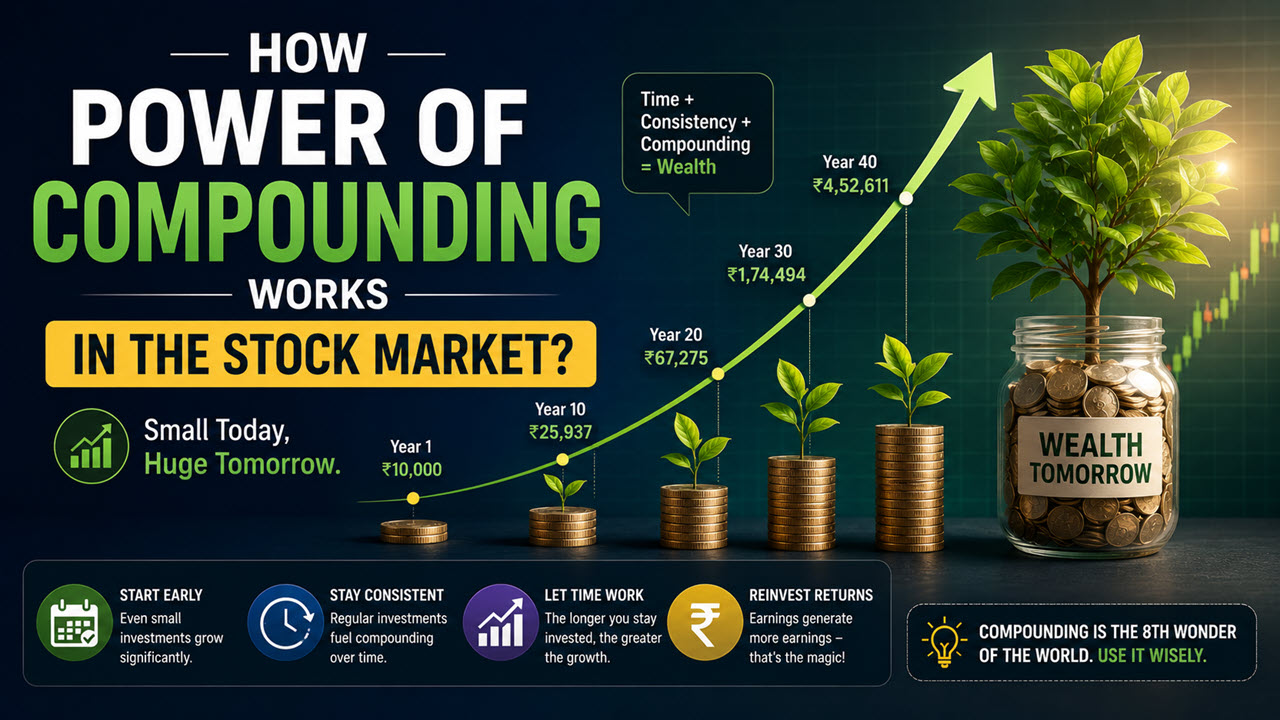
Compounding means your returns start earning returns of their own, so money grows faster the longer it stays invested. Time matters more than the amount you start with: at an assumed 12% a year, a ₹10,000 monthly SIP grows to about ₹1 crore in 20 years but about ₹3.5 crore in 30.
This guide shows the formulas, a precise SIP table, what starting ten years earlier is worth, the Rule of 72, how fund costs and inflation eat into the result, and the habits that quietly break compounding. Every number has its working shown so you can check it.
The compounding formula
For a one-time (lumpsum) investment, the future value is:
FV = P × (1 + r)n
Here P is the amount invested, r is the return per period and n is the number of periods. Suppose Ananya invests ₹1 lakh at 12% a year. After 10 years she has ₹1,00,000 × 1.1210 = ₹3,10,585. After 20 years she has ₹1,00,000 × 1.1220 = ₹9,64,629.
Notice the second decade added about ₹6.5 lakh, while the first added only ₹2.1 lakh. Same money, same rate. The difference is that in the second decade the base being compounded was three times larger. You can try your own figures in our lumpsum calculator.
The SIP formula (annuity due)
A SIP (systematic investment plan) puts in a fixed amount every month. Because each instalment goes in at the start of the month, it earns a full month’s return straight away. In finance this is called an annuity due, and its future value is:
FV = P × [((1 + i)n − 1) ÷ i] × (1 + i)
P is the monthly instalment, i is the monthly rate and n is the number of months. Most Indian SIP calculators, including ours, convert an annual 12% to a monthly 1% (12 ÷ 12). Strictly, 1% a month compounds to about 12.68% a year, so this convention is slightly generous. We use it here because it is what you will see on most calculators.
₹10,000 a month at 12%: the SIP table
A clear warning first: 12% is an assumption, not a guarantee. Equity returns arrive unevenly, some years are negative, and long stretches can fall well short of 12%. For context, the Nifty 50 Total Return Index (which includes reinvested dividends) has compounded at 12.12% a year since its base date of 3 November 1995, but only 6.38% a year over the last five years and −7.09% over the last one year (as of September 2026, NSE Indices factsheet).
With that caveat, here is a ₹10,000 monthly SIP at 1% a month, invested at the start of each month:
| Years | Months (n) | Total invested | Value at end | Gain |
|---|---|---|---|---|
| 10 | 120 | ₹12,00,000 | ₹23,23,391 | ₹11,23,391 |
| 15 | 180 | ₹18,00,000 | ₹50,45,760 | ₹32,45,760 |
| 20 | 240 | ₹24,00,000 | ₹99,91,479 | ₹75,91,479 |
| 25 | 300 | ₹30,00,000 | ₹1,89,76,351 | ₹1,59,76,351 |
| 30 | 360 | ₹36,00,000 | ₹3,52,99,138 | ₹3,16,99,138 |
Working for the 20-year row: 1.01240 = 10.8926. Then (10.8926 − 1) ÷ 0.01 = 989.26. Multiply by 1.01 to get 999.15, and by ₹10,000 to get ₹99,91,479.
Look at the last two rows. Going from 25 to 30 years adds only ₹6 lakh of your own money but about ₹1.63 crore of value. That is the back-loaded shape of compounding: most of the growth turns up at the end. Plug in your own amount and rate with the StocksInfo SIP calculator, or work backwards from a target with the SIP goal calculator.
Starting at 25 vs starting at 35
Suppose Priya and Rahul each invest ₹10,000 a month at an assumed 12% (1% a month) and both stop at 60. Priya starts at 25; Rahul starts at 35.
| Priya (starts at 25) | Rahul (starts at 35) | |
|---|---|---|
| Years invested | 35 (420 months) | 25 (300 months) |
| Total invested | ₹42,00,000 | ₹30,00,000 |
| Value at 60 | ₹6,49,52,691 | ₹1,89,76,351 |
| Gain | ₹6,07,52,691 | ₹1,59,76,351 |
Priya puts in just ₹12 lakh more, yet ends with about ₹4.6 crore more, roughly 3.4 times Rahul’s corpus. Rahul would need to invest about ₹34,200 a month from 35 to reach the same ₹6.5 crore by 60. Those extra ten years at the start are worth more than almost any increase in the monthly amount later.
The Rule of 72
To estimate how long money takes to double, divide 72 by the annual return in per cent. It is a mental shortcut, close enough for rates between about 6% and 12%.
| Annual return | Rule of 72 estimate | Exact doubling time |
|---|---|---|
| 6% | 12 years | 11.9 years |
| 8% | 9 years | 9.0 years |
| 12% | 6 years | 6.1 years |
Run it the other way and it is just as useful. At 12%, money doubles roughly every six years, so over 30 years it doubles about five times: 2 × 2 × 2 × 2 × 2 = 32 times. That is why the ₹1 lakh in Ananya’s example becomes close to ₹30 lakh in three decades.
Costs compound too: 0.5% vs 1.5% TER
A mutual fund’s TER (total expense ratio) is its annual fee, taken out of the NAV daily. A 1% difference sounds tiny, but it compounds against you every year, exactly as returns compound for you.
Suppose ₹10 lakh is invested for 20 years in two funds that each earn 12% a year before costs. One charges 0.5%, the other 1.5%:
| Fund A (TER 0.5%) | Fund B (TER 1.5%) | |
|---|---|---|
| Net annual return | 11.5% | 10.5% |
| Working | ₹10,00,000 × 1.11520 | ₹10,00,000 × 1.10520 |
| Value after 20 years | ₹88,20,584 | ₹73,66,235 |
The extra 1% a year costs ₹14,54,349, which is more than the original ₹10 lakh invested. This is the main reason direct plans and low-cost index funds or ETFs suit long holding periods. Our comparison of ETFs vs mutual funds covers the cost side in more detail.
Real returns: what inflation leaves you
A crore in 2046 will not buy what a crore buys today. The real return, meaning the return after inflation, is:
Real return = (1 + nominal return) ÷ (1 + inflation) − 1
With 12% nominal returns and 6% inflation, the real return is 1.12 ÷ 1.06 − 1 = 5.66%, not 6%. For reference, the RBI’s inflation target is 4% CPI with a band of 2% to 6%, set for April 2026 to March 2031.
Apply this to the 20-year SIP above. The ₹99,91,479 corpus, deflated at 6% a year, is worth about ₹31.2 lakh in today’s money (₹99,91,479 ÷ 1.0620). At 4% inflation it is worth about ₹45.6 lakh (÷ 1.0420). Still well above the ₹24 lakh invested, but far from the headline figure. Plan goals in today’s rupees, then inflate the target, or step up your SIP each year to keep pace.
What breaks compounding
Stopping SIPs when markets fall
Falls are exactly when a SIP buys more units for the same ₹10,000. Stopping during a slump means you miss the cheapest instalments and often restart only after prices have recovered. Falls of 10–20% are routine for equities; as of September 2026 the Nifty 50 TRI was down 12.61% for the year so far. Our explainer on what counts as a stock market crash puts these moves in context.
Frequent switching between funds
Every switch is a sale. It can trigger an exit load (often 1% if redeemed within a year, depending on the scheme), resets your holding period, and moves money into whatever did well recently, which is often near a peak. Chasing last year’s top fund tends to produce lower returns than the funds themselves delivered.
Taxes on frequent selling
For listed shares and equity mutual funds, gains on units held up to 12 months are short-term and taxed at 20%. Gains after 12 months are long-term and taxed at 12.5%, with the first ₹1.25 lakh of long-term gains each year exempt. Budget 2026 left these rates unchanged for FY 2026-27.
Take a ₹2 lakh gain. Sold within a year, tax is ₹2,00,000 × 20% = ₹40,000. Held beyond a year, tax is (₹2,00,000 − ₹1,25,000) × 12.5% = ₹9,375 (both before cess). The ₹30,625 saved stays invested and keeps compounding. See our guide on reducing capital gains tax on shares for legal ways to manage this.
A checklist to let compounding work
- Start now, even with a small amount. Ten extra years beat a bigger instalment later.
- Automate the SIP on the day after your salary credit so it never competes with spending.
- Choose direct plans or low-TER index funds and ETFs where they fit your goal.
- Step up the SIP by 5–10% a year as income rises, to stay ahead of inflation.
- Keep an emergency fund so a job loss or medical bill does not force you to redeem.
- Review once a year, not every week. Change course only if your goal or the fund’s mandate changes.
For a fuller plan built around these habits, read our guide to long-term investment strategies.
FAQ
Is a 12% return on SIPs guaranteed?
No. Equity funds have no guaranteed return, and 12% is only a planning assumption. Returns over any five- or ten-year stretch can be much lower or higher; the Nifty 50 TRI returned 6.38% a year over the five years to September 2026. Running your plan at 10% as well gives a more cautious picture.
How much will ₹10,000 a month become in 20 years?
At an assumed 12% a year (1% a month, invested at the start of each month), about ₹99.9 lakh, of which ₹24 lakh is your own money. At 10% a year the same SIP grows to roughly ₹76.6 lakh. Inflation will reduce what either figure buys.
Does compounding work in a fixed deposit?
Yes, if you choose the cumulative option so interest is reinvested. But FD interest is taxed at your slab rate every year, which slows compounding, and after tax and inflation the real return can be close to zero for higher-bracket taxpayers.
Is it better to invest a lumpsum or through a SIP?
Mathematically, money invested earlier has longer to compound, so a lumpsum often ends higher in rising markets. A SIP spreads your entry price and is easier to stick with when markets fall. Most people use SIPs from monthly income and stagger large windfalls over a few months.
What is the Rule of 72 used for?
It quickly estimates doubling time: 72 divided by the annual return. At 8% money doubles in about 9 years; at 12% in about 6. It is handy for comparing options, such as an FD versus an equity fund, without a calculator.

Ramesh Iyer is the pen name of the founder and editor of StocksInfo.AI, an independent investor in Indian equities, mutual funds and ETFs since 2020. Every article is researched from primary sources such as SEBI, AMFI, NSE and the Income Tax Department, and fact-checked before publishing. About us