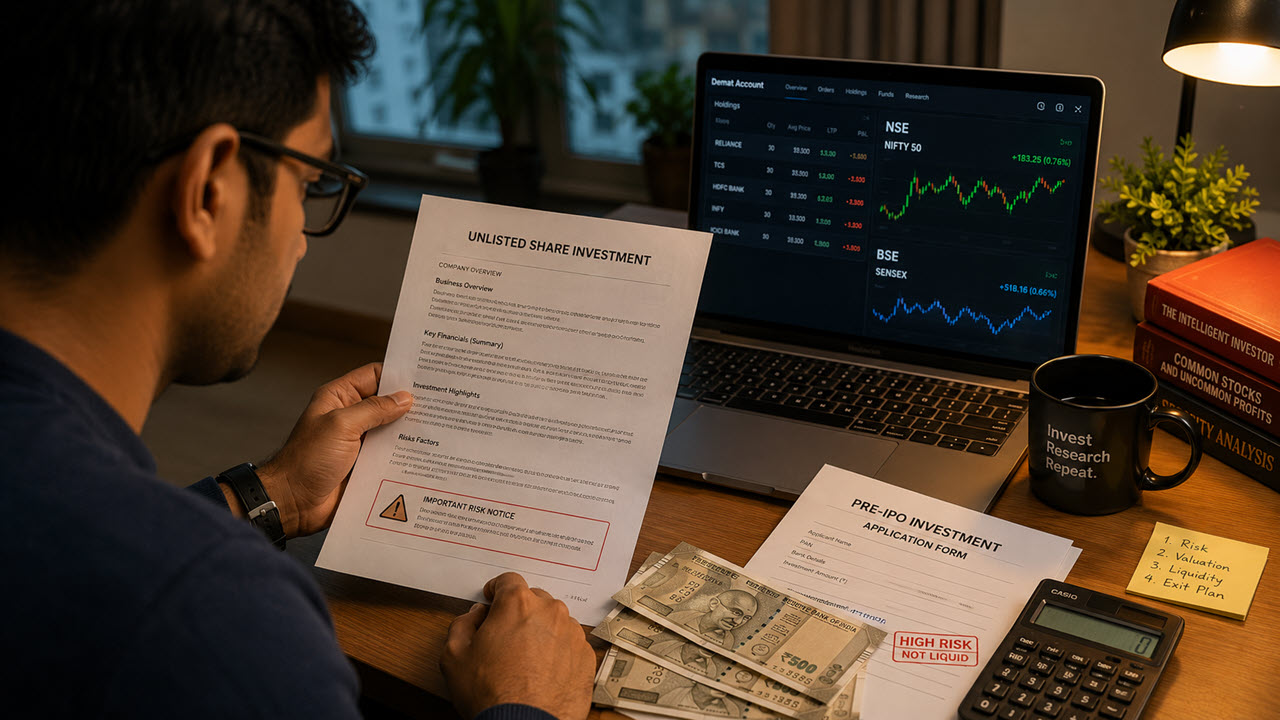
The biggest risks in unlisted shares are that you may not be able to sell when you want, and that the price you pay may have little to do with what the company is worth. On top of that come thin disclosure, dealer risk, a lock-in after any IPO, the absence of regulatory protection and less favourable tax.
This article takes each risk in turn, with a real case where an IPO was priced far below the unlisted price, and ends with a checklist to reduce your exposure. If you are new to the topic, start with our guide to unlisted shares, which covers how buying and transfer work.
1. Liquidity risk: getting out is the hard part
On an exchange, a large company’s shares can be sold in seconds. With unlisted shares there is no order book. You have to find a buyer yourself or sell back to a dealer, and the dealer is under no obligation to buy.
Liquidity tends to vanish exactly when you need it: when the market falls, when an IPO is postponed, or when bad news about the company comes out. Dealers may stop quoting, or quote a bid far below their last selling price. Money you might need within a few years should not go into unlisted shares.
2. Valuation and pricing opacity
Unlisted prices come from dealer quotes and a small number of private trades, not from a public auction. Different platforms can quote the same share at noticeably different prices on the same day. There is no way to see how many shares actually changed hands at a quoted price.
Two costs follow. First, the spread between a dealer’s buying and selling price can run to several percent or more, which you lose the moment you buy. Second, prices of companies tipped for IPO often run well ahead of fundamentals. A simple test: multiply the quoted price by the total number of shares to get the implied market value, then compare its price-to-earnings multiple with listed peers. Our articles on the P/E ratio and spotting an overvalued stock explain the method.
3. Information risk: no quarterly results
Listed companies must publish quarterly results and disclose material events to the exchange promptly. Unlisted companies have no such duty. Their main public disclosure is the annual financial statements and annual return filed with the Ministry of Corporate Affairs (MCA), which you can download from the MCA portal for a fee.
Those filings arrive months after the year ends, and they contain far less detail than a listed company’s annual report. You may not learn about a big customer loss, a legal dispute or a fresh fundraise at a lower valuation until long after it has happened. If the company has filed a draft red herring prospectus with SEBI, read it: it is the most detailed public document you will get, including its risk factors section.
4. Counterparty and dealer risk
An exchange trade is guaranteed by a clearing corporation. An unlisted deal is guaranteed by nobody. If you pay first and the seller never transfers the shares, your only remedy is to chase them, possibly through the courts.
Watch for warning signs: requests to pay into a personal bank account, pressure to “lock the price today”, shares that never arrive, or a deal note that does not name a legal entity. Prefer arrangements where shares are transferred to your demat before you pay, or where payment sits in escrow until the transfer is confirmed.
5. The IPO may be priced below the grey-market price
Many buyers assume the unlisted price is a floor for the IPO. It is not. IPO prices are set through book-building with institutional investors, who often value the company more conservatively than retail buyers in the unlisted market.
Case study: HDB Financial Services
HDB Financial Services, the non-banking finance arm of HDFC Bank, was a popular pre-IPO name. Its unlisted shares were reported to have traded at ₹1,400 to ₹1,550 at their peak in 2024. When the IPO opened on 25 June 2025, the price band was ₹700 to ₹740, and the issue was priced at ₹740. The shares listed on 2 July 2025 and opened at ₹835, a gain of about 12.8% for IPO applicants.
For unlisted buyers the picture was very different. Suppose Rahul had bought 100 shares at ₹1,450 in 2024:
- Cost: 100 × ₹1,450 = ₹1,45,000
- Value at the listing-day open: 100 × ₹835 = ₹83,500
- Paper loss: ₹1,45,000 − ₹83,500 = ₹61,500, or 42.4% of his money
And because his shares were part of pre-issue capital, he could not even sell on listing day (see the lock-in section below). NSDL showed the same pattern on a smaller scale: reported unlisted prices of about ₹1,025 near the IPO, and a peak near ₹1,275, against an IPO price of ₹800 in August 2025.
6. Lock-in after listing
Under Regulation 17 of the SEBI (Issue of Capital and Disclosure Requirements) Regulations, 2018, all pre-issue capital held by anyone other than promoters is locked in for six months from the date of IPO allotment on the main board. On SME platforms the period is one year. A few holders, such as employees with ESOP shares and certain registered venture and alternative investment funds, are treated differently, but individual buyers should assume the full lock-in.
The practical effect is that your exit price is set by where the stock trades six months after listing. A strong debut can fade by then. Lock-in expiry dates are public, and the release of a large block of shares can itself weigh on the price.
7. Regulatory risk and SEBI warnings
SEBI has warned investors about unlisted share platforms more than once. In Press Release 32/2026, dated 17 June 2026, it cautioned against buying or selling shares of unlisted public companies on electronic platforms and websites that it has not recognised or authorised. It said such platforms operate in violation of the Securities Contracts (Regulation) Act, 1956 and the SEBI Act, 1992, and that only recognised stock exchanges may provide a platform for trading securities.
The key consequence for investors: anyone dealing on such platforms gets no SEBI investor protection, no access to exchange grievance redressal and no exchange or depository online dispute resolution. SEBI also advised against sharing sensitive personal details on them. This was its third advisory on the subject, after August 2016 and December 2024.
A private sale between two people, completed by an off-market transfer, is not illegal in itself. But if a dispute arises, you are on your own. There is also a risk that tighter rules in future could make some platforms shut down, leaving holders with fewer ways to sell.
8. Tax risk
Unlisted shares need to be held for more than 24 months to count as long-term. Long-term gains are taxed at 12.5% without indexation (for transfers on or after 23 July 2024), with no ₹1.25 lakh exemption. Short-term gains are taxed at your slab rate. Budget 2026 did not change these rates.
Two less obvious traps exist. If you buy below fair market value as calculated under Rule 11UA and the gap exceeds ₹50,000, the gap is taxed as your income (Section 56(2)(x) of the 1961 Act, now Section 92(2)(m) of the Income-tax Act, 2025). And holding unlisted shares at any point in the year rules out the simple ITR-1 form. Our guide on reducing capital gains tax covers legal ways to plan around these rules.
Risk summary table
| Risk | What can go wrong | How to reduce it |
|---|---|---|
| Liquidity | No buyer when you need cash | Invest only money you can lock away for years |
| Pricing | Wide spreads, inflated quotes | Get buy and sell quotes; compare with listed peers |
| Information | Annual filings only, often late | Read MCA filings and any draft prospectus |
| Counterparty | Pay and never receive shares | Shares first or escrow; pay a company account |
| IPO pricing | IPO price far below what you paid | Never treat the unlisted price as a floor |
| Lock-in | Six months with no exit after listing | Plan for the lock-in from the start |
| Regulatory | No SEBI or exchange grievance route | Check documents yourself; keep records |
| Tax | Slab-rate tax under 24 months; FMV rules | Track purchase dates; take tax advice |
Risk-reduction checklist
- Cap unlisted shares at a small slice of your portfolio, sized so a total loss would not change your plans. See our note on asset allocation.
- Spread money across a few companies rather than one IPO story.
- Read the latest MCA financials and, if available, the draft prospectus filed with SEBI.
- Calculate the implied market value and compare its P/E with listed rivals.
- Ask the dealer for a buy-back price and work out the spread before you commit.
- Check the counterparty’s identity and complaint history; prefer shares-first or escrow settlement.
- Pay only by bank transfer to an account matching the name on the deal note.
- Confirm the shares in your demat and on your depository statement; keep the deal note, payment proof and transfer record.
- Assume a six-month lock-in if the company lists, and a holding period of at least 24 months for tax.
- Do not share PAN, Aadhaar or bank details on any platform you have not verified.
For a wider view of habits that protect your capital, read our guide on how to avoid losing money in the stock market.
FAQ
Are unlisted shares riskier than listed small caps?
In several ways, yes. Small caps can be volatile, but they trade on an exchange, publish quarterly results and settle through a clearing corporation. Unlisted shares add liquidity, disclosure and counterparty risks on top of business risk.
Has SEBI banned unlisted share platforms?
SEBI has not issued a ban notice naming individual platforms in the releases cited here, but in June 2026 it said that platforms trading unlisted public company shares are not recognised and operate in violation of securities law. Investors using them get no SEBI or exchange protection or dispute resolution.
Why do IPOs sometimes price below the unlisted price?
IPO prices are set by book-building with mutual funds, insurers and foreign investors, who apply their own valuation discipline. Unlisted prices are driven by limited supply and retail excitement. When the two disagree, the IPO price wins, as HDB Financial Services showed in 2025.
What happens if the company never lists?
You keep the shares and remain a shareholder, but your only exits are a private sale, a buy-back by the company or an acquisition. You may wait many years, and the eventual price could be lower than what you paid.
Can I lose all my money in unlisted shares?
Yes. A company can fail, a dealer can default on a transfer, or the shares can become practically unsellable. That is why position size is the single most important safeguard.

Ramesh Iyer is the pen name of the founder and editor of StocksInfo.AI, an independent investor in Indian equities, mutual funds and ETFs since 2020. Every article is researched from primary sources such as SEBI, AMFI, NSE and the Income Tax Department, and fact-checked before publishing. About us