
I still remember how confusing Indian stock investing felt at the start. One day I was hearing about a demat account, then SIPs, then NSE and BSE, and suddenly everyone sounded like they had already cracked wealth creation.
For a salaried investor, the real question is usually simple: should I put money into a business like Persistent Systems and hold it for years, or should I stay with mutual fund SIPs and other simpler products? If you have kids’ education, retirement, or early financial freedom on your mind, that question matters a lot.
Let’s break down whether Persistent Systems stocks make sense for the long term, in plain English and with a practical investor’s eye.
Persistent Systems Stocks: What Long Term Means
When people ask whether Persistent Systems stocks are a long term investment, they usually want a yes or no answer. I don’t think investing works that neatly. A stock can be a good long term candidate, but only if the business, valuation, and your own risk tolerance all line up.
Persistent Systems is a listed Indian IT company traded on NSE and BSE. If you buy it, you need a demat account to hold the shares digitally and a trading account to place the buy order on the exchange. That is different from a mutual fund, where you buy units at NAV and the fund manager runs the portfolio for you.
Long term investing usually means holding for at least 5 to 10 years, not 6 months or one earnings cycle. That time frame matters because good businesses can still go through sharp price swings in the short term. If you cannot sit through those swings, even a strong stock can become a bad investment for you.
Why Investors Look At Persistent Systems
The appeal is easy to understand. IT companies can scale without heavy factories, and good ones can grow profits faster than many old economy businesses. That is why many investors compare quality IT names with large cap compounders or even allocate alongside index funds and equity mutual funds.
A company like Persistent Systems also attracts investors because it plays in digital transformation, product engineering, cloud, data, and AI-linked enterprise services. Those are themes that can stay relevant for years. But themes alone do not make a stock good. You still need execution, pricing power, and sensible valuation.
Here is the simple way I think about it. If a business can keep growing revenue, protect margins, and convert profits into cash for many years, the stock can reward patient holders. If growth slows, competition rises, or the stock becomes too expensive, long term returns can disappoint even if the business stays decent.
What To Check Before Calling It A Long Term Buy
I always check four things before I treat any stock as a long term candidate.
1. Business quality
Ask whether the company has a real moat. In IT services, that usually means strong client relationships, delivery capability, skilled employees, and the ability to win repeat work. A company that keeps signing large projects and cross-selling services is in a better position than one depending on one-off deals.
2. Earnings consistency
A long term stock should not depend on one lucky quarter. Look for steady revenue growth, healthy margins, and reasonable profit growth over several years. If earnings jump around too much, your long term thesis becomes shaky.
3. Valuation
This is where many retail investors get hurt. A great business can still give poor returns if you pay too much. If a stock already prices in very high growth, you need perfection from the company just to get average returns.
4. Your holding period
This part is personal. If you plan to hold for 10 years, some volatility is fine. If you plan to check your portfolio every week, a quality stock can still make you panic sell. That is why long-term investing is not only about the company. It is also about your behavior.
A Simple Example With ₹10,000 A Month
Let’s say Suresh, a 30-year-old salaried professional, starts with ₹10,000 per month. He wants to build wealth for retirement and maybe his child’s education later. He has two choices.
He can put the full amount into one stock like Persistent Systems, or he can split it. For example, ₹7,000 can go into a broad index fund, and ₹3,000 can go into a stock idea he understands well. That way, one company does not decide his future.
If Persistent Systems grows well and the stock compounds at a strong rate, the result can be excellent. But if the business slows or the valuation compresses, the damage is limited because the rest of the portfolio still works for him. That is the real advantage of diversification.
This is also why many beginners should first understand mutual fund vs ETF investing basics before putting large money into single stocks. A SIP in a mutual fund also builds investing discipline without forcing you to guess one winner.
Is Persistent Systems Better Than Mutual Funds?
This depends on your style. A mutual fund gives you instant diversification, professional management, and lower decision stress. A single stock gives you higher upside potential, but also higher concentration risk.
If you are new to beginner investing in India, a SIP in a good equity fund or index fund often makes more sense than betting heavily on one IT stock. You can always add stocks later once you understand business quality, valuation, and volatility better. I like that approach because it keeps you in the game longer.
For many people, the best path is not “stocks or mutual funds.” It is usually “mutual funds first, stocks later, and stocks only with money you can afford to hold through rough patches.” That is especially true if you are still learning about long term investment strategies.
Where ETFs And Index Funds Fit
If you want equity exposure without stock-picking stress, ETFs and index funds are very useful. An ETF is an exchange-traded fund, so you buy it like a stock in your demat account. An index fund follows a market index and usually works well for disciplined long term investing.
I often think of ETFs and index funds as the boring part of the portfolio that quietly does the heavy lifting. They help you stay invested in the Indian market through different cycles, including corrections. If you want a simple route, benefits of ETF investing is worth understanding before you go deeper.
Persistent Systems can sit in the “active stock ideas” part of a portfolio. But for most investors, the core should still be broad exposure through mutual funds or ETFs. That balance reduces the chance that one mistake derails your plan.
Risks You Should Not Ignore
No honest long term discussion should skip risk. Persistent Systems faces the same broad risks that many IT companies face.
First, client spending can slow when global businesses cut budgets. Second, competition in IT services can pressure margins. Third, the stock may already trade at a premium because investors expect continued growth. Fourth, currency movements, hiring costs, and sector rotation can all affect performance.
This is why I never treat a stock like a fixed deposit. A business can stay good while the stock underperforms for years if the starting valuation is too rich. That is a painful lesson many investors learn only after buying at the wrong price.
Pro Tip
I’ve found that most investors do not lose money because they pick a bad business. They lose money because they buy a good business at a bad price and then panic when the stock corrects.
That is why I prefer a calm process. I study the business, compare valuation with growth, and then decide position size. If I cannot explain why I own the stock in one or two clear lines, I usually skip it.
So, Is It Good For The Long Term?
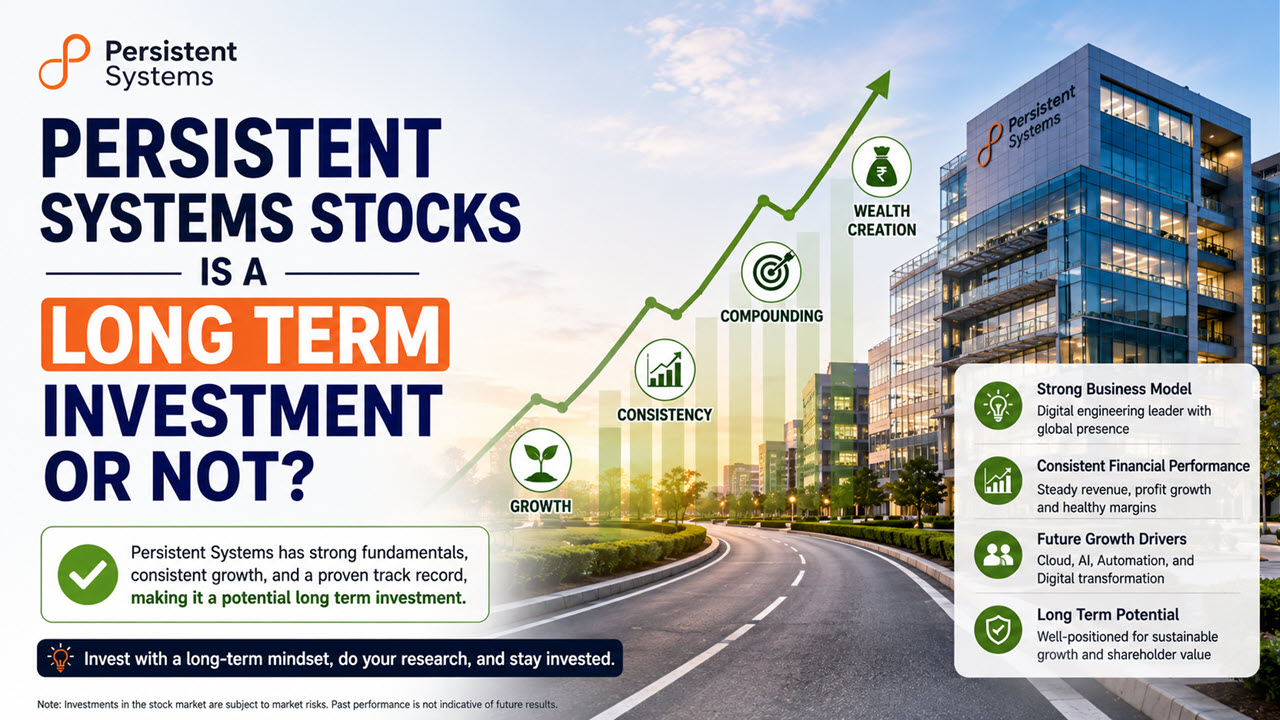
My practical answer is this: Persistent Systems stocks can be a long term investment for the right investor, but not blindly for everyone. If you believe in the company’s execution, understand the IT sector, and buy at a reasonable valuation, it can deserve a place in a long term portfolio.
If you are a beginner, I would not start with a large allocation. I would first build a base with mutual fund SIPs, maybe an index fund, and then use direct stocks for focused ideas. That gives you growth potential without taking too much single-stock risk.
If you want a deeper mindset check on whether you should even be in direct equities, read trading vs investing in India and how to be a good investor in the stock market. Those ideas matter more than a hot stock tip.
Things to Keep in Mind
- Valuation matters a lot. A strong business can still give weak returns if you buy it too expensive.
- Do not confuse quality with certainty. Even good IT stocks can face slowdowns, margin pressure, or multiple compression.
- Keep position size small at first. Start with a modest allocation if you are still learning how single stocks behave.
- Think in years, not weeks. If you cannot hold through corrections, a long term stock may still hurt you emotionally.
- Use diversification. Combine direct stocks with mutual fund SIPs, index funds, or ETFs so one mistake does not sink the plan.
- Avoid borrowed money. Long term investing works best with surplus cash, not emergency funds or loan money.
Frequently Asked Questions
Is Persistent Systems a good long term stock?
It can be, but only if you buy it with realistic expectations and proper position sizing. A good business does not always mean a good investment at every price. I would call it a candidate for long term investing, not a guaranteed winner.
Can beginners buy Persistent Systems shares?
Yes, beginners can buy it through a demat and trading account on NSE or BSE. But beginners should first understand the business, the valuation, and the risks of owning one stock. If you are unsure, start with mutual fund SIPs or an index fund first.
Should I invest in Persistent Systems or mutual funds?
If you want simplicity and diversification, mutual funds usually fit better. If you want focused exposure to one company and can handle volatility, a stock like Persistent Systems may work. Many investors use both together.
How much money should I put in one stock?
I prefer keeping single-stock bets limited, especially for beginners. A stock should not dominate your portfolio just because you like the story. Size it so that a bad result does not hurt your financial plan.
Is Persistent Systems better than an ETF?
Not really better or worse, just different. An ETF gives broad market exposure, while Persistent Systems gives company-specific exposure. ETFs suit steady long term investing, while a stock suits investors who can study and track businesses closely.
Can I hold Persistent Systems for 5 to 10 years?
Yes, if your thesis is based on business quality and not short-term price moves. Over that time frame, the main question is whether the company can keep growing and protecting margins. If you stay patient and disciplined, long term holding becomes much easier.
Persistent Systems can fit a long term portfolio, but only when you buy it with discipline, patience, and the right valuation mindset. For most people, the best path is to start simple, stay consistent, and build confidence with a mix of mutual funds, ETFs, and a few carefully chosen stocks. I hope you found this article helpful.
You May Also Like
- Best ETFs in India for long term investing
- ETF vs Mutual Fund: which one should you choose?
- Advantages of investing early in India
- Long term investment strategies for Indian investors
- How to avoid losing money in the stock market

Ramesh Iyer is the founder of StocksInfo.AI, a Bengaluru-based investor with two decades of market experience, writing plain-language content on stocks, mutual funds, and ETFs for everyday Indian investors. Read more