
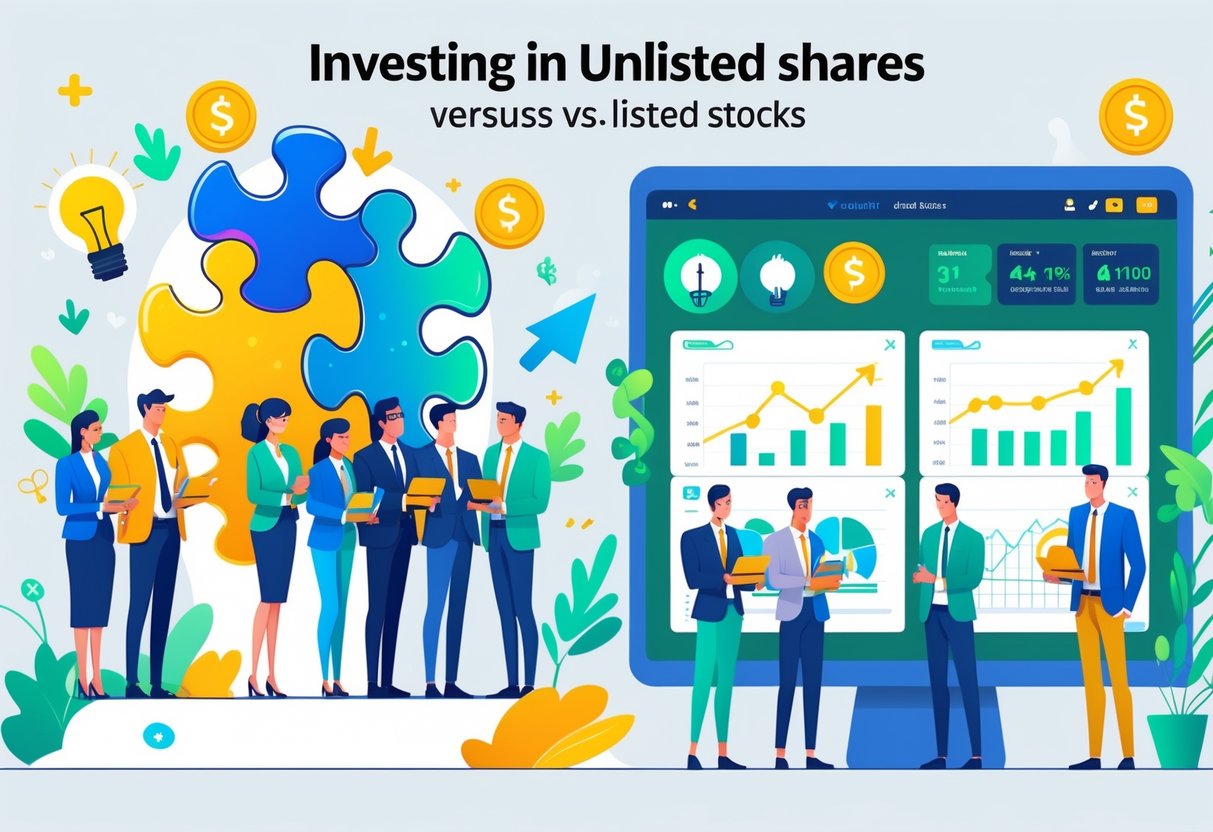
Most salaried investors begin with a Demat account—a digital account that holds shares electronically—then buy a few NSE or BSE stocks, start a ₹5,000 monthly SIP in mutual funds, and slowly learn the basics. That is exactly how many of us get comfortable with investing.
Then someone mentions that they bought shares in a well-known company before its IPO and made a strong listing gain. Suddenly, unlisted shares sound like a shortcut to wealth. They are not. They can offer early access to promising businesses, but they also come with risks that many first-time investors ignore.
This practical guide will help you understand the real pros and cons of buying unlisted shares, where they fit in a portfolio, and how to approach them without risking your financial goals.
What Are Unlisted Shares?
Unlisted shares are shares of companies that do not trade on the NSE or BSE. You cannot open your trading app during market hours and buy them like listed stocks.
A trading account lets you buy and sell listed shares on stock exchanges. Your Demat account stores those shares in electronic form. With unlisted shares, the final shares may still come to your Demat account, but the transaction happens privately through dealers, existing shareholders, employees, promoters, or specialist intermediaries.
For example, imagine Suresh, a 30-year-old salaried professional in Bengaluru. He invests ₹10,000 every month. He puts ₹6,000 into equity mutual funds, ₹2,000 into an index fund, and ₹2,000 into direct stocks. He hears about a company that may launch an IPO in the future and considers buying ₹50,000 worth of its unlisted shares.
That investment could work well if the business grows and later lists at a higher valuation. But Suresh must also accept that he may not find a buyer quickly if he needs cash before the IPO.
You should first understand what unlisted shares are and how they work before treating them as an investment opportunity.
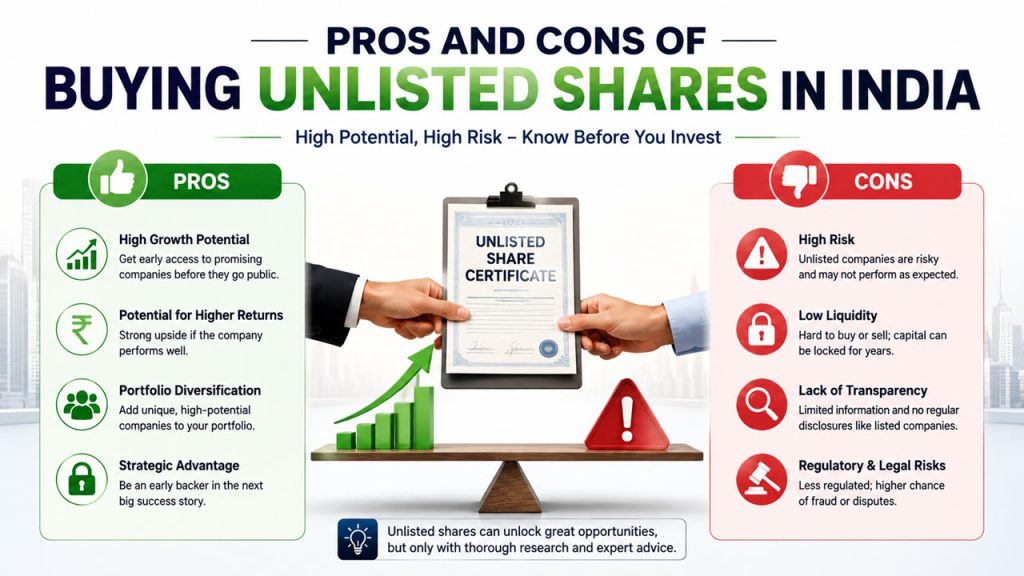
Pros of Buying Unlisted Shares
The biggest attraction of unlisted shares is simple: they may let you invest in a business before the wider market gets access. Still, early access alone does not guarantee profits.
1. You Can Invest Before an IPO
One major benefit of buying unlisted shares is the chance to own a company before it lists on the NSE or BSE. If the business performs well and the IPO receives strong demand, the market may value those shares higher after listing.
Suppose Suresh buys 100 unlisted shares at ₹800 each. His total investment is ₹80,000. If the company later lists at ₹1,100 and stays near that price, the value becomes ₹1.10 lakh before taxes and transaction costs.
That looks attractive, but it is only one possible outcome. The IPO price may come lower than expected, the IPO may get delayed, or the company may never list.
Many investors focus only on the potential listing gain. I look at the company’s business quality first. A strong business with growing revenue, sensible debt, and a realistic valuation matters more than an exciting IPO rumour.
2. You May Buy at a Lower Valuation
A company’s unlisted share price can sometimes trade below the valuation it may receive after a successful IPO. This happens because unlisted shares have lower liquidity and fewer buyers.
Liquidity means how easily you can sell an investment for cash without taking a large price cut. Listed large-cap shares usually offer high liquidity because thousands of buyers and sellers trade every day. Unlisted shares often have low liquidity.
Because investors accept this inconvenience, they may expect a lower purchase price. This difference is called an illiquidity discount.
However, do not assume that every unlisted share is cheap. Some popular pre-IPO companies trade at very high prices because buyers expect a blockbuster listing. In those situations, you may pay too much for a story rather than a solid business.
Learn how to check the value of unlisted shares before buying instead of relying on dealer quotes alone.
3. You Can Add Diversification
Diversification means spreading your money across different investments so one bad decision does not damage your entire portfolio. A sensible Indian portfolio may include direct equity, equity mutual funds, debt funds, gold, ETFs, and some cash for emergencies.
An ETF, or exchange-traded fund, is a basket of investments that trades on the exchange like a stock. Unlike a mutual fund, where you buy units at the day’s NAV—the price per mutual fund unit—an ETF trades during market hours like an NSE or BSE share.
Unlisted shares can add exposure to businesses that do not appear in listed indices or standard mutual fund portfolios. But diversification only helps when you keep allocation limits.
For Suresh, putting ₹50,000 into one unlisted company while his emergency fund remains incomplete would not count as smart diversification. It would count as concentration risk.
Pro Tip: In my experience, unlisted shares work best as a small satellite allocation, not the foundation of your wealth plan. I first build my core portfolio through mutual fund SIPs, index funds, and quality listed investments.
4. You May Benefit From Long-Term Growth
Some unlisted companies stay private for years while they build operations, customers, and profits. Patient investors may benefit if the company improves its earnings over that period.
This approach suits people with long financial horizons, such as investors building wealth for retirement or children’s education. It does not suit someone who may need the money next year for a home down payment, wedding, or emergency.
For long-term goals, consistency usually matters more than finding one hot pre-IPO idea. A ₹5,000 monthly SIP—or Systematic Investment Plan—into a diversified equity mutual fund can create discipline because you invest a fixed amount regularly through market ups and downs.
You can also explore the power of compounding in investing to see why steady investing often beats trying to find quick gains.
5. You May Access Growing Sectors Early
Some unlisted opportunities come from sectors with strong long-term themes, such as financial services, consumer businesses, digital infrastructure, logistics, manufacturing, or technology.
This can give investors exposure before a company becomes widely tracked by analysts and retail investors. But a good sector does not automatically make every company in it a good investment.
For example, a company may operate in a fast-growing industry but still have weak margins, high debt, poor governance, or aggressive expansion plans. Always study the business model, not just the sector name.
Cons of Buying Unlisted Shares
The cons of buying unlisted shares deserve more attention than the excitement around a future IPO. These risks can turn a promising investment into money that stays stuck for years.
1. Low Liquidity Can Trap Your Money
Low liquidity is the biggest problem with unlisted shares. There is no active exchange screen showing live buyers and sellers throughout the day.
If Suresh buys unlisted shares for ₹1 lakh and suddenly needs the money for a medical emergency, he cannot simply place a sell order like he could with an ETF or a listed stock. He must find a buyer through an intermediary, agree on a price, and complete the transfer process.
That buyer may offer ₹75,000 even if the last quoted price was ₹1 lakh. In a weak market, he may struggle to find a buyer at all.
This is why I treat unlisted shares as locked capital. Only invest money that you can leave untouched for several years.
2. Prices Lack Transparency
Listed stocks on NSE and BSE have visible market prices, daily volumes, corporate announcements, and broad analyst coverage. You can see the latest price instantly.
Unlisted shares do not offer that same transparency. Different dealers may quote different prices on the same day. One seller may ask ₹1,200 per share, while another buyer may only offer ₹950.
The quoted price may reflect limited deals rather than broad market demand. It may also include a dealer margin that a new investor does not notice.
Ask for clarity on:
- The exact company name and ISIN, if available
- The number of shares you will receive
- The price per share and total transaction cost
- The expected settlement timeline
- Whether shares will transfer to your Demat account
- The process for selling later
You should also understand the market for unlisted shares in India before assuming every quote reflects fair value.
3. IPO Plans Can Change
Many people buy unlisted shares mainly because they expect an IPO. That creates a dangerous mindset.
A company may postpone its IPO because market conditions turn weak. It may decide to raise private capital instead. It may change strategy, face regulatory issues, or simply decide that listing does not make sense yet.
Even when an IPO happens, the listing price may disappoint. The company’s valuation may fall before the issue, or investors may not bid aggressively.
Never buy unlisted shares solely because someone says, “IPO is coming soon.” Ask whether you would still be comfortable owning the business if no IPO happens for five years.
4. Information Can Be Limited
Publicly listed companies must follow regular disclosure requirements. Investors can review quarterly results, annual reports, exchange filings, shareholding patterns, and management commentary.
Private companies may share less information with retail investors. You may not easily find updated financial statements, debt details, promoter pledges, related-party transactions, or future fundraising plans.
Less information makes it harder to judge whether a company is fairly valued. It also increases the risk of relying on marketing messages instead of facts.
Before investing, review every available annual report, financial statement, credit rating, business update, and shareholder communication. If you cannot understand the business or verify key numbers, skip it.
5. Valuation Risk Is High
A good company can still become a bad investment when you buy at the wrong price. This problem becomes more serious in the unlisted space because popular names often attract heavy demand.
Let us say a company earns ₹10 per share. If you pay ₹1,000 per share, you pay a price-to-earnings ratio of 100. The P/E ratio compares the share price with earnings per share. A high P/E can make sense for a rapidly growing company, but it also leaves little room for disappointment.
If growth slows or the IPO valuation comes lower, the share price may drop even though the company remains decent.
Read this guide on how to know whether a stock is overvalued before buying and apply the same discipline to unlisted opportunities.
6. Transaction and Legal Risks Need Care
Unlisted share transactions need more due diligence than buying a listed stock through a normal trading account. You must verify the seller, the share transfer process, payment terms, and documentation.
Avoid cash transactions and vague WhatsApp promises. Keep written records of the deal, including price, quantity, seller details, payment proof, and confirmation of the share transfer.
You should carefully review the legal aspects of investing in unlisted shares in India before committing capital.
Tax treatment may also differ from what you expect. Do not make decisions based on informal tax advice. Track your purchase cost and holding period from day one, then consult a qualified tax professional when you sell.
Pros and Cons at a Glance
| Factor | Pros of Buying Unlisted Shares | Cons of Buying Unlisted Shares |
|---|---|---|
| Entry opportunity | You may invest before an IPO | The IPO may get delayed or never happen |
| Return potential | A successful listing may increase value | High expectations may already be priced in |
| Liquidity | Long-term investors can hold patiently | Selling quickly can be difficult |
| Pricing | You may find value at a discount | Dealer quotes may vary widely |
| Diversification | You can access businesses outside NSE/BSE | One company can create concentration risk |
| Information | You may discover businesses early | Financial and governance data may be limited |
How I Would Decide Before Buying
I use a simple filter before considering any unlisted company. It helps me separate a genuine long-term opportunity from IPO excitement.
Check Your Financial Base First
Do not put money into unlisted shares before building an emergency fund and getting basic insurance cover. A salary delay, job loss, or family emergency should not force you to sell investments at the wrong time.
Suresh should first keep at least several months of essential expenses in a safe option. Then he can continue his SIPs in equity mutual funds, build exposure through index funds or ETFs, and consider unlisted shares only with surplus money.
A large-cap company is generally a large, established business. Mid-cap and small-cap companies are smaller and often more volatile. For most beginners, diversified mutual funds give easier access to these categories than buying one unfamiliar unlisted company.
Study the Business Like an Owner
Ask basic owner-level questions:
- What does the company sell?
- Who are its customers?
- Is revenue growing consistently?
- Does the company make profits?
- How much debt does it carry?
- Who runs the business?
- What could go wrong in the next three years?
- Why is the company still unlisted?
Do not get distracted by a famous brand name. Strong brands can still have expensive valuations or weak financials.
Set a Strict Allocation Limit
For a beginner, I would keep unlisted shares to a very small part of the investable portfolio. Think of them as high-risk satellite investments, not your core wealth builder.
If Suresh has a ₹10 lakh investment portfolio, allocating ₹25,000 to ₹50,000 across carefully researched unlisted opportunities is very different from putting ₹4 lakh into one pre-IPO name.
A limited allocation protects your long-term plan if the company delays its IPO, faces trouble, or remains illiquid.
Plan Your Exit Before Entry
Before buying, decide what you will do under different outcomes. Will you hold after the IPO? Will you sell some shares if the listing price is much higher? What will you do if the IPO does not happen for three years?
This prevents emotional decisions later. Investors often buy with excitement but have no plan when prices move sharply.
A written plan does not guarantee profits, but it helps you stay disciplined. For more ideas, read about maintaining discipline in the stock market.
Things to Keep in Mind
- Invest only surplus money: Treat unlisted shares as long-term and illiquid; do not use emergency funds, loan money, or money meant for near-term goals.
- Avoid IPO rumours: Buy only when you understand the business, valuation, and risks; a possible IPO is not an investment thesis.
- Keep allocation small: Limit unlisted shares to a small percentage of your total portfolio until you gain experience and confidence.
- Verify every transaction: Confirm seller credibility, documentation, share quantity, price, settlement terms, and Demat transfer details before paying.
- Compare with simpler options: A diversified mutual fund, index fund, or ETF may suit beginners better when they need liquidity and lower complexity.
- Track records for taxes: Save purchase documents, bank proofs, and transfer confirmations from the first day.
Frequently Asked Questions
Are unlisted shares safe to buy in India?
Unlisted shares are legal investments, but they carry higher risk than many listed stocks and mutual funds. Safety depends on the company quality, valuation, documentation, seller verification, and your ability to hold for years.
Can I sell unlisted shares anytime?
No. Unlike NSE or BSE shares, unlisted shares do not have an active public exchange where you can sell instantly. You need to find a buyer, and the final price may differ sharply from the price you paid.
Do I need a Demat account for unlisted shares?
You generally need a Demat account to receive and hold shares electronically after the transaction. You do not use a normal exchange order to buy them, but the shares can still transfer into your Demat account.
Is buying unlisted shares better than investing in mutual funds?
For most beginners, a diversified mutual fund SIP is simpler and more suitable. Mutual funds offer professional diversification, easier liquidity, and clearer NAV-based pricing, while unlisted shares demand deeper research and patience.
How much should I invest in unlisted shares?
Start only after building your emergency fund and core investments. Keep the amount small enough that a long delay, price fall, or lack of buyers will not affect your financial goals.
What happens to unlisted shares after an IPO?
After listing, the shares may become tradable on the NSE or BSE once applicable conditions and lock-in rules allow. The market price can rise or fall from your purchase price, so an IPO does not guarantee a profit.
Buying unlisted shares can offer early access to promising businesses, but it also brings liquidity, valuation, information, and execution risks that listed investments avoid. Start simple, invest consistently through a diversified core portfolio, and treat unlisted shares as a small long-term allocation rather than a shortcut to wealth. I hope you found this article helpful.
You May Also Like
- Benefits of investing in unlisted shares over listed stocks
- Risks of investing in unlisted shares in India
- Best platforms to buy unlisted shares in India
- ETF vs mutual fund: Which is better for investors?
- Long-term investment strategies for Indian investors

Ramesh Iyer is the founder of StocksInfo.AI, a Bengaluru-based investor with two decades of market experience, writing plain-language content on stocks, mutual funds, and ETFs for everyday Indian investors. Read more