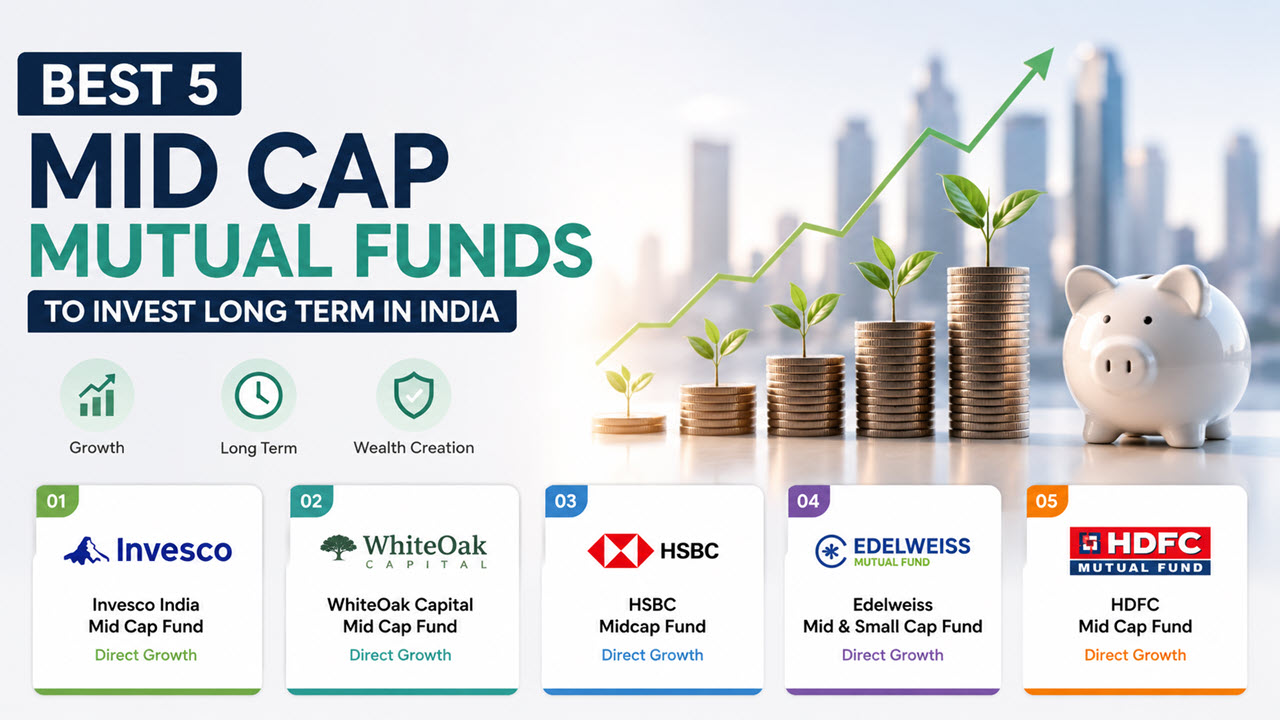
There is no single best mid cap mutual fund, but a handful of pure mid-cap funds have done well across 3, 5 and 10 years and through two big crashes. In this article we compare five of them: HDFC Mid Cap Fund, Kotak Mid Cap Fund, Nippon India Growth Mid Cap Fund, Invesco India Mid Cap Fund and Axis Midcap Fund. Treat them as funds worth shortlisting and researching further, not as recommendations.
We explain how we picked them, show the numbers side by side, and then cover who should invest in mid caps, how much of a portfolio to give them, how they are taxed, why the direct plan matters, and how to monitor or exit a fund.
What counts as a mid-cap fund
Under SEBI’s fund categories, a mid-cap company is ranked 101st to 250th by full market capitalisation, and a mid-cap fund must keep at least 65% of its assets in such stocks. The rest can go into large caps, small caps or cash. AMFI publishes the ranking list every six months, so a stock can move in or out of the mid-cap band.
This article covers only funds in the SEBI “Mid Cap Fund” category. “Mid & small cap” or “large & mid cap” funds are different products with different risk, so they are left out even when their names sound similar.
How we chose these five funds
Mid-cap rankings change every few months, and last year’s top fund is often next year’s laggard. So we screened for consistency rather than the highest recent return. All return figures below are for direct plans, calculated from AMFI’s daily NAV data up to 31 August 2026. For the 3- and 5-year numbers we checked them against Nippon India and HDFC Mutual Fund’s own published figures, and they match.
- Track record: at least 15 years of history as a mid-cap fund, so it has lived through 2008, the 2018–20 slump and the 2024–25 correction.
- Consistency across 3, 5 and 10 years: above-average returns in all three periods, not just one lucky stretch.
- Rolling returns: we looked at every 5-year holding period since the direct plans started in January 2013. The worst 5-year result shows what an unlucky investor would have earned.
- Downside: how far the NAV fell from its peak in the 2018–20 fall and in the 2024–25 correction.
- Size and cost: enough assets to be stable, and a direct-plan expense ratio below 1%.
Some popular funds missed the cut. Motilal Oswal Midcap Fund has the best 5-year return in this group (23.3% as of August 2026, AMFI NAV data), but it launched in 2014 and fell the most in 2024–25 (about 24%). Edelweiss Mid Cap Fund and HSBC Midcap Fund are also worth a look, but our NAV data for their direct plans didn’t cover the full 10 years.
Mid-cap funds worth shortlisting: comparison table
Returns are direct-plan CAGR (compound annual growth rate) as of 31 August 2026, calculated from AMFI NAV data. Expense ratio is the total direct-plan TER for August 2026 from AMFI. AUM is the average for April–June 2026 from AMFI, rounded.
| Fund (direct, growth) | 3Y CAGR | 5Y CAGR | 10Y CAGR | Worst 5Y rolling | Fall 2018–20 | Fall 2024–25 | TER | AUM (₹ cr) |
|---|---|---|---|---|---|---|---|---|
| HDFC Mid Cap | 19.1% | 20.3% | 17.7% | 2.1% | -39.5% | -16.8% | 0.74% | 96,040 |
| Kotak Mid Cap | 19.3% | 18.0% | 18.2% | 4.1% | -36.0% | -20.9% | 0.51% | 64,136 |
| Nippon India Growth Mid Cap | 20.3% | 19.5% | 18.6% | 2.0% | -35.3% | -19.9% | 0.78% | 46,445 |
| Invesco India Mid Cap | 25.3% | 21.4% | 19.9% | 4.5% | -34.1% | -20.1% | 0.76% | 12,160 |
| Axis Midcap | 17.8% | 14.3% | 17.9% | 6.9% | -29.4% | -19.5% | 0.82% | 32,454 |
| Nifty Midcap 150 index fund (Motilal Oswal, for reference) | 17.5% | 17.6% | n.a. | n.a. | n.a. | -21.0% | n.a. | n.a. |
Two things stand out. First, even the best funds had at least one 5-year window where they earned only 2–7% a year, and every one of them fell more than 29% from peak to trough in 2018–20. Second, mid caps had a bad September 2026: these five funds lost between 6.3% and 8.0% of NAV from 31 August to 1 October 2026 (AMFI NAV data). That fall isn’t in the table above.
The five funds in brief
HDFC Mid Cap Fund
Launched in June 2007 as HDFC Mid-Cap Opportunities Fund and managed by Chirag Setalvad, with Dhruv Muchhal handling overseas investments (as of October 2026, HDFC Mutual Fund). It is by far the largest fund in the category, with ₹1,08,325 crore at the end of August 2026 (HDFC Mutual Fund). It fell the least of the five in 2024–25. The catch is its size: running ₹1 lakh crore in mid caps makes it harder to buy or sell smaller stocks quickly.
Kotak Mid Cap Fund
Started on 30 March 2007 (formerly Kotak Emerging Equity, later Kotak Midcap) and managed by Atul Bhole since 22 January 2024 (Kotak Mutual Fund). It has the lowest direct-plan TER in this group at 0.51% (August 2026, AMFI). Note that its 10-year record was mostly built under the previous manager.
Nippon India Growth Mid Cap Fund
The oldest fund here, launched on 8 October 1995, and managed by Rupesh Patel since January 2023 (Nippon India Mutual Fund). The AMC describes its style as growth at a reasonable price. Its exit load is unusually short: 1% only if you redeem within one month.
Invesco India Mid Cap Fund
Launched on 19 April 2007 and managed by Aditya Khemani since November 2023 (as of October 2026, Groww). It leads the group on 3-, 5- and 10-year returns. It is also the smallest of the five, which gives it more room to move in mid caps. Recent outperformance can fade, so it is worth tracking against the index over the next few years.
Axis Midcap Fund
Launched on 18 February 2011. It is co-managed by Shreyash Devalkar (since November 2016), Nitin Arora and Krishnaa N (as of October 2026, Groww). It fell the least in 2018–20 and has the best worst-case 5-year return in the table. But its 5-year CAGR of 14.3% trails the index fund, because its preference for expensive, high-quality companies has been out of favour since 2021. That makes it a good example of the trade-off between protecting the downside and keeping up with the market.
Who should and shouldn’t invest in mid-cap funds
Mid-cap funds suit investors with a goal at least 7 years away who already hold a core of large-cap, flexi-cap or index funds and can sit through a 35–40% fall without selling. A SIP (systematic investment plan) works well here, because regular buying during falls lowers your average cost.
They are a poor fit if you need the money within 5 years, if this would be your first or only equity fund, or if a large paper loss would push you to redeem. If you mainly want mid-cap exposure at low cost, a Nifty Midcap 150 index fund is a reasonable alternative. Our comparison of ETFs and mutual funds explains the passive options.
How much of your portfolio to put in mid caps
We’d suggest keeping mid caps to roughly 10–15% of your equity holdings if you are cautious, 15–25% for a balanced investor, and no more than about 30% even with a high risk appetite. Decide your equity-debt split first; our guide to asset allocation covers that step.
Worked example (hypothetical): Suppose Arjun has a ₹20 lakh portfolio, 70% in equity (₹14 lakh). He puts 20% of his equity in a mid-cap fund: 20% × ₹14 lakh = ₹2.8 lakh. If mid caps fall 40%, as they nearly did in 2018–20, he loses 40% × ₹2.8 lakh = ₹1.12 lakh. That is ₹1.12 lakh ÷ ₹20 lakh = 5.6% of his whole portfolio. Painful, but survivable. If the same ₹14 lakh were all in mid caps, a 40% fall would cost ₹5.6 lakh, or 28% of the portfolio.
Patience matters. A ₹10,000 monthly SIP in HDFC Mid Cap Fund’s direct plan from September 2016 to August 2026 (120 instalments, ₹12 lakh invested) was worth about ₹34.99 lakh on 31 August 2026, an XIRR (annualised return on SIP cash flows) of about 20.3%, based on AMFI NAV data. That period included the 2018–20 slump, when the same SIP was showing a loss. You can test your own numbers with our SIP calculator.
How mid-cap fund gains are taxed
Mid-cap funds are equity funds for tax purposes. Under the rules in force since 23 July 2024, which Budget 2026 left unchanged:
- Units held 12 months or less: short-term capital gains taxed at 20%.
- Units held more than 12 months: long-term gains above ₹1.25 lakh a year (across all your equity holdings) taxed at 12.5%, with no indexation.
- IDCW (dividend) payouts: added to your income and taxed at your slab rate, which is why most long-term investors pick the growth option.
Each SIP instalment has its own 12-month clock, and units are redeemed first-in, first-out. Example: Priya sells units bought three years ago for ₹4 lakh, now worth ₹6 lakh, and has no other equity gains this year. Gain = ₹2 lakh. Taxable = ₹2,00,000 − ₹1,25,000 = ₹75,000. Tax = 12.5% × ₹75,000 = ₹9,375, plus 4% cess (₹375), so ₹9,750 in total. Our guide on reducing capital gains tax covers how to use the ₹1.25 lakh exemption every year.
Direct vs regular plans
Every fund has a direct plan, bought straight from the AMC or a direct platform, and a regular plan sold through a distributor who earns a commission from the expense ratio. The portfolio is identical; only the cost differs. In August 2026, Invesco India Mid Cap’s TER was 0.76% for the direct plan and 1.88% for the regular plan (AMFI).
Over time that gap adds up. ₹5 lakh invested in Invesco India Mid Cap on 31 August 2016 would have grown to about ₹30.75 lakh in the direct plan but about ₹26.62 lakh in the regular plan by 31 August 2026, a difference of roughly ₹4.13 lakh (AMFI NAV data). A regular plan can still make sense if you value a distributor’s help, but you should know what it costs. For managed alternatives, see PMS vs mutual funds.
How to monitor a mid-cap fund, and when to exit
Review once or twice a year, not every month. Use this checklist:
- Compare with the benchmark over 3–5 years. Most of these funds use the Nifty Midcap 150 TRI. One weak year is normal; trailing the index for three years or more is a warning sign.
- Watch for a fund manager change. Past returns belong to whoever ran the fund. After a change, give the new manager a year or two before judging.
- Check that it stays mid-cap. The monthly factsheet shows the split between large, mid and small caps. A big drift toward small caps raises the risk.
- Read the stress test. Since 2024, AMCs publish monthly liquidity stress tests for mid-cap and small-cap funds, showing how many days it would take to sell part of the portfolio. Rising numbers mean the fund is getting harder to exit in a crisis.
- Track the TER and AUM. Rapid inflows can make a fund unwieldy.
Good reasons to exit: your goal is 2–3 years away (shift gradually to debt through an STP, a systematic transfer plan), mid caps have grown well above your target share and you need to rebalance, or the fund has lagged for several years for reasons the AMC can’t explain. A falling market alone is rarely a good reason. Check the exit load first: HDFC Mid Cap charges 1% within a year, Nippon India Growth Mid Cap 1% within a month. Most others charge about 1% within a year.
Common mistakes
- Picking the fund with the best 1-year return. Category leaders change often; look at rolling returns instead.
- Holding three or four mid-cap funds. Their portfolios overlap heavily. One or two is enough.
- Stopping SIPs during a crash. That skips the cheapest buying. Read what a stock market crash really means before reacting.
- Confusing categories. A “mid & small cap” fund carries more small-cap risk than a pure mid-cap fund.
FAQ
Which is the best mid cap mutual fund for the long term?
No fund stays on top every year. Funds like HDFC Mid Cap, Kotak Mid Cap, Nippon India Growth Mid Cap, Invesco India Mid Cap and Axis Midcap have long, consistent records, but they differ in size, cost and style. Shortlist one or two that fit your needs and check them against the Nifty Midcap 150 TRI.
How long should I stay invested in a mid-cap fund?
Plan for at least 7 years. Even top funds had 5-year stretches with returns of only 2–7% a year, and falls of 30–40% have happened in the last decade.
Is SIP or lump sum better for mid-cap funds?
For most people, a SIP. It spreads purchases across market cycles and lowers the risk of investing everything just before a fall. If you have a lump sum, an STP from a liquid fund over 6–12 months does a similar job.
Is a mid-cap index fund better than an active mid-cap fund?
It is cheaper and removes the risk of picking the wrong manager. Over the five years to August 2026, the Motilal Oswal Nifty Midcap 150 index fund returned 17.6% a year. Four of the five active funds here beat that, but many others in the category did not.
How is tax calculated on mid-cap mutual fund SIPs?
Each instalment is treated separately. Units held over 12 months are long-term (12.5% on gains above ₹1.25 lakh a year), and units held 12 months or less are short-term (20%).
Sources
- AMFI daily NAV file (historical NAVs used for returns, rolling returns and drawdowns)
- AMFI: Total expense ratio of mutual fund schemes

Ramesh Iyer is the pen name of the founder and editor of StocksInfo.AI, an independent investor in Indian equities, mutual funds and ETFs since 2020. Every article is researched from primary sources such as SEBI, AMFI, NSE and the Income Tax Department, and fact-checked before publishing. About us