
Most salaried investors start with a Demat account, a digital account that holds shares, then buy familiar companies on the NSE or BSE. I followed the same route: a few stocks, a ₹5,000 monthly SIP in a mutual fund, and plenty of questions about how wealth actually grows over time.
Then you hear someone mention buying shares of a company before its IPO. It sounds exciting because early entry can create wealth, but the market for unlisted shares works very differently from buying a listed stock at the click of a button.
This guide explains what the market for unlisted shares is, how it works in India, how prices are decided, and what you should check before putting your money at risk.
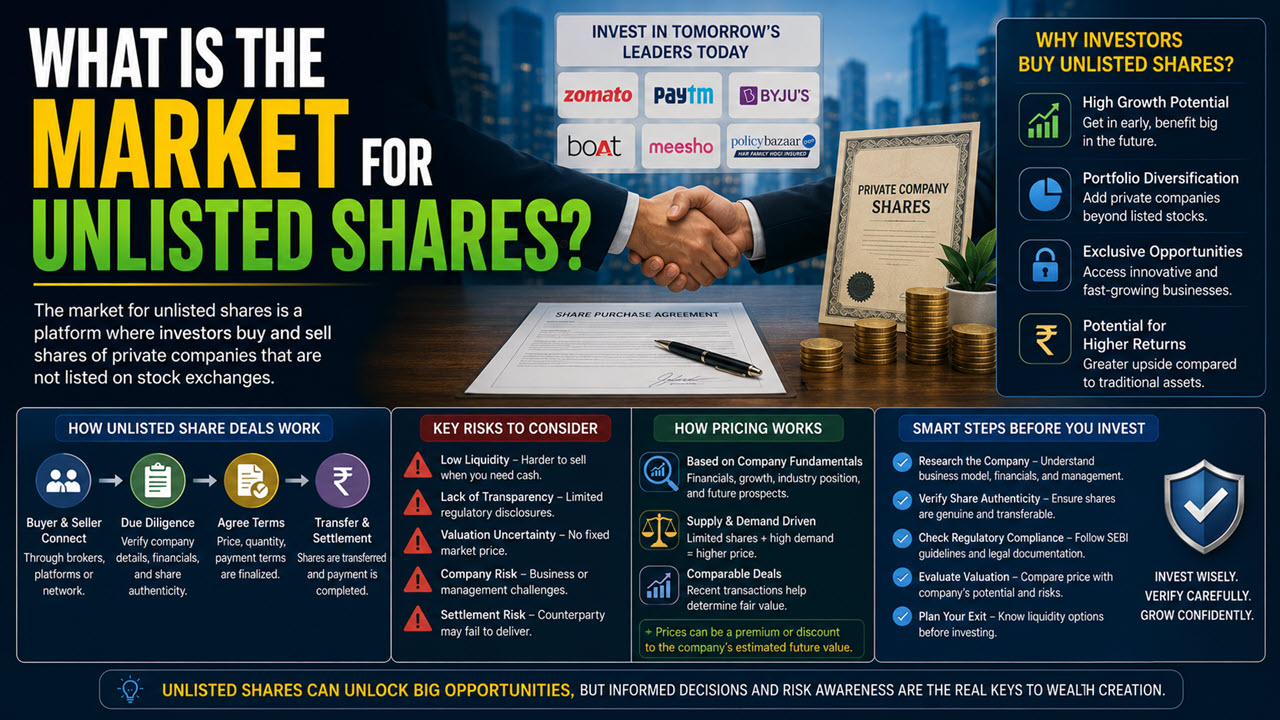
What Is the Market for Unlisted Shares?
The market for unlisted shares is an off-market space where investors buy and sell equity shares of companies that do not trade on the NSE or BSE. These companies may be privately held, planning an IPO, subsidiaries of listed businesses, or companies that simply do not want to list yet.
An unlisted share represents ownership in a company, just like a listed share. The big difference is liquidity. You can buy and sell listed shares during market hours through a trading account, but unlisted shares require you to find a buyer or seller through an intermediary or a direct transaction.
A trading account lets you place buy and sell orders on an exchange. A Demat account holds the shares electronically after settlement. In unlisted transactions, the shares still generally move into your Demat account, but the deal itself does not happen through the normal NSE/BSE order book.
For example, Suresh is a 30-year-old IT professional in Bengaluru. He invests ₹10,000 each month: ₹6,000 through a mutual fund SIP, ₹3,000 in an index fund, and ₹1,000 in direct stocks. He then hears about a private company that may launch an IPO in two years. If he buys its shares before the IPO, he enters the market for unlisted shares.
That does not make the investment automatically good. It only means he is investing before the company gets the price visibility, liquidity, and exchange-based trading available to listed stocks.
You should first understand what unlisted shares are and how they work before treating them as an alternative to regular equity investing.
Why Does the Market for Unlisted Shares Exist?
Companies do not always list on the stock exchange immediately. Many businesses raise money from founders, employees, venture capital funds, private equity investors, and strategic investors long before an IPO.
The market for unlisted shares gives existing shareholders a way to sell part of their holdings before the company lists. It also gives investors access to businesses that may have strong growth potential but are not yet available on NSE or BSE.
Early ownership opportunity
The biggest attraction is early ownership. If a business grows strongly and later lists at a higher valuation, early investors may earn a return.
Suppose Suresh buys 100 unlisted shares at ₹800 each. His total investment is ₹80,000. If the company later lists and the market values the shares at ₹1,200, the value becomes ₹1,20,000 before taxes and transaction costs.
That looks like a 50% gain, but it is only a paper gain until he can sell. The company may delay its IPO, list at a lower price, or face poor demand after listing. This is why investors should never assume an IPO will rescue a weak purchase decision.
Access beyond listed stocks
The Indian stock market offers thousands of listed companies, but some fast-growing businesses remain private for years. The market for unlisted shares opens access to selected private companies, depositories, financial-services firms, technology businesses, and pre-IPO opportunities.
Still, access alone is not an investment reason. A good company bought at an unreasonable price can produce weak returns. Learn how to identify whether a stock is overvalued before buying because valuation discipline matters even more when the share lacks a daily market price.
Employee and investor liquidity
Employees may receive stock options or equity compensation. Early investors may also want to book profits before an IPO. The unlisted market creates a route for these holders to transfer shares to another investor.
This is often called a secondary transaction. The company may not receive any money from that deal because one shareholder sells directly to another shareholder.
Pro Tip: In my experience, many first-time buyers focus only on the possible IPO listing price. I first ask a tougher question: “Who will buy these shares from me if the IPO does not happen for five years?” If there is no clear answer, I keep my allocation very small.
How the Market for Unlisted Shares Works
The market for unlisted shares does not operate like the live price screen you see for listed stocks. Prices come through quotes, negotiations, recent deals, company performance, and demand from buyers.
Step 1: Find a seller or intermediary
Most retail investors use a dealer, broker, wealth manager, or specialized intermediary to locate available shares. The intermediary may source shares from employees, early investors, promoters, or other existing shareholders.
Ask whether the seller owns the shares, whether the shares are free from any lock-in, and whether the intermediary will provide transaction documentation. Never send money only because someone shares an attractive WhatsApp message or a social-media tip.
If you are evaluating ways to transact, read this guide to platforms for buying unlisted shares in India.
Step 2: Check the company and price
Unlike listed shares, unlisted shares do not have a continuously visible market price. You need to study the company’s revenue, profit, debt, business model, growth plans, competitive position, and latest valuation.
Investors often compare the quoted share price with valuation measures such as P/E ratio, or price-to-earnings ratio. It shows how much investors pay for every ₹1 of company earnings. A high P/E may be acceptable for a fast-growing business, but only when earnings quality and future growth support it.
You should also check the share capital. A company may announce a bonus issue, stock split, or corporate action that changes the number of shares. Do not compare prices without adjusting for these events.
Use this practical guide to check the value of unlisted shares before accepting any quote.
Step 3: Agree on quantity and payment
Once you agree on a price, confirm the quantity, total amount, transfer process, expected settlement date, and all applicable charges in writing.
For example, if Suresh agrees to buy 50 shares at ₹1,500 each, his basic purchase value is ₹75,000. Before paying, he should understand whether brokerage, stamp duty, transfer fees, and other charges apply.
He should invest only surplus funds. Money required for rent, emergency expenses, insurance premiums, school fees, or short-term goals does not belong in unlisted shares.
Step 4: Transfer shares to Demat
The seller generally transfers shares to the buyer’s Demat account through an off-market transfer. This transfer usually uses depository systems rather than the normal exchange settlement process.
Verify the ISIN, company name, share quantity, and your Demat account details carefully. An ISIN is a unique identification number for a security. A wrong ISIN or account number can delay the transaction or create serious complications.
After the shares reflect in your Demat account, save contract notes, invoices, payment proof, and communications. You will need clean records for future sale and tax reporting.
Step 5: Hold or sell later
You may hold the shares until an IPO, a buyback, a private sale, or another liquidity event. But you should not expect daily liquidity.
A listed stock may have buyers and sellers every second during market hours. An unlisted share may take days or weeks to sell, especially when market sentiment weakens or the company loses its IPO appeal.
That is why unlisted shares suit investors with patience, research ability, and a long investment horizon.
Market for Unlisted Shares vs NSE and BSE
The table below shows why you should treat unlisted investing differently from normal stock-market investing.
| Factor | Market for unlisted shares | NSE/BSE listed shares |
|---|---|---|
| Where you trade | Private, off-market transactions | Regulated stock exchanges |
| Price visibility | Quotes vary across sellers and buyers | Live market price during trading hours |
| Liquidity | Often low; finding a buyer may take time | Usually higher, especially in large-cap stocks |
| Research availability | Limited public disclosures in many cases | Regular exchange filings and results |
| Minimum investment | Often depends on lot size and seller terms | You can often buy even one share |
| Exit route | Private buyer, buyback, IPO, or other event | Sell through your trading account |
| Risk level | High due to valuation and liquidity uncertainty | Varies, but price discovery is more transparent |
A large-cap company is typically a well-established business with a high market value. A mid-cap company sits in the middle range, while a small-cap company has a smaller market value and often carries more volatility. Unlisted companies can be even harder to classify because they lack a transparent daily market capitalisation.
For most beginners, diversified products should form the core of the portfolio. An index fund tracks an index such as the Nifty 50, while an ETF or exchange-traded fund also tracks an index or asset but trades on the exchange like a stock.
If you are deciding where to begin, compare ETFs and mutual funds before allocating money to higher-risk private-market opportunities.
How Unlisted Share Prices Are Decided
The market for unlisted shares has no single official price. Different buyers may receive different quotes on the same day because each deal reflects quantity, urgency, available supply, and investor demand.
Company performance
Start with fundamentals. Look at revenue growth, profitability, cash flows, debt, customer concentration, and the company’s ability to compete.
A company with growing sales but repeated losses may still justify a high valuation if it has a clear path to profitability. But a buyer must understand that growth projections can fail. Do not confuse a popular brand with a financially strong business.
Demand and supply
If many investors want a pre-IPO company and few shareholders want to sell, the price may rise quickly. The reverse happens when shareholders rush to sell or the IPO story loses momentum.
This can create sharp price differences. A quoted price does not guarantee that you can sell later at the same level.
IPO expectations
Investors often pay a premium for companies expected to list soon. This premium can be dangerous because IPO timelines change. Regulators, market conditions, business performance, and company decisions can all delay a listing.
Treat an expected IPO as a possible catalyst, not a promise. Your investment should still make sense even if the IPO takes longer than expected.
Valuation comparison
You can compare an unlisted company with listed peers in the same sector. For example, compare profitability, growth rate, debt, and valuation multiples against similar NSE/BSE companies.
However, do not copy listed-company valuations blindly. Listed companies benefit from better liquidity and more public information, so investors may reasonably demand a discount when buying an unlisted share.
Who Should Invest in Unlisted Shares?
The market for unlisted shares is not the right starting point for every investor. I would consider it only after building a stable base with emergency savings, insurance, and diversified long-term investments.
Suresh should first maintain an emergency fund, continue his ₹10,000 monthly investing habit, and build exposure through equity mutual funds, index funds, and selected listed shares. Only then should he consider putting a small amount into an unlisted opportunity.
A mutual fund pools money from many investors and invests according to a defined strategy. Its NAV, or Net Asset Value, is the per-unit value of the fund’s portfolio. A SIP, or Systematic Investment Plan, lets you invest a fixed amount regularly, such as ₹5,000 every month.
If Suresh invests ₹5,000 monthly for 10 years and earns an assumed 12% annual return, he may build roughly ₹11.6 lakh from total contributions of ₹6 lakh. Returns are never guaranteed, but the example shows why consistent investing in diversified products should come before chasing one exciting pre-IPO idea.
Investors who may consider unlisted shares usually have:
- A long holding period of at least three to five years.
- Sufficient surplus money after emergency and goal-based investing.
- Ability to study financial statements and business risks.
- Comfort with delayed exits and uncertain pricing.
- A small allocation mindset rather than an all-in bet.
For a stronger foundation, explore these long-term investment strategies before adding private-market exposure.
Things to Keep in Mind
- Liquidity comes first: You may not find a buyer quickly, even if the company looks strong or an IPO seems likely.
- Price is negotiable: A quote from one seller is not the official market value; compare offers and study valuation carefully.
- Do your own research: Read financial information, understand the business, and avoid buying only because a name is trending.
- Keep allocation limited: Treat unlisted shares as a satellite investment, not the core of your retirement or children’s education plan.
- Verify documentation: Check seller details, ISIN, share quantity, payment trail, and Demat transfer records before and after the deal.
- Understand the risks: Read about the risks of investing in unlisted shares in India before you commit money.
Frequently Asked Questions
Is it safe to invest in unlisted shares in India?
Unlisted shares carry higher risk than many listed investments because prices lack transparency and exits can take time. You can reduce avoidable risk through proper verification, documentation, research, and a limited allocation, but you cannot remove investment risk.
Can I buy unlisted shares without a Demat account?
You generally need a Demat account to receive and hold unlisted shares electronically. A Demat account stores your securities, while you may not need a regular exchange trading account for an off-market transfer.
What is the minimum amount required for unlisted shares?
There is no universal minimum because the required amount depends on the share price, available quantity, and seller’s minimum lot size. Some transactions may start around ₹10,000 to ₹25,000, while popular pre-IPO opportunities may require a much larger amount.
Can I sell unlisted shares anytime?
No. You need to find a willing buyer, agree on a price, and complete an off-market transfer. This is very different from selling an NSE or BSE stock during market hours.
Do unlisted shares always give good IPO returns?
No. An IPO may get delayed, list at a lower value, or deliver weak returns after listing. Buy only when the business quality and valuation make sense without relying completely on an IPO premium.
Are unlisted shares better than mutual fund SIPs?
They serve different purposes. A mutual fund SIP offers diversification and disciplined investing, while unlisted shares involve concentrated, high-risk ownership in one company. Most beginners should build their core portfolio through diversified funds first.
The market for unlisted shares gives you access to private and pre-IPO businesses, but it also demands stronger research, patience, and risk control than normal NSE/BSE investing. Start simple, invest consistently through diversified products, and use unlisted shares only as a small long-term allocation after you understand the downside. I hope you found this article helpful.
You May Also Like
- Benefits of investing in unlisted shares over listed stocks
- Legal aspects to consider before investing in unlisted shares
- Best ETFs for Indian investors
- Best mid-cap mutual funds for long-term investing
- How to become a good stock market investor

Ramesh Iyer is the founder of StocksInfo.AI, a Bengaluru-based investor with two decades of market experience, writing plain-language content on stocks, mutual funds, and ETFs for everyday Indian investors. Read more