A silver ETF can make sense for the long term, but only as a small part of a diversified portfolio, not as your main investment. Silver more than doubled in 2025, peaked in January 2026 and then gave back roughly half of that peak value within months, which shows both why people buy it and why it should stay a minor holding.
This guide explains how silver ETFs work in India, how they compare with silver fund of funds, physical silver and digital silver, what the main ETFs cost, how they are taxed after the April 2025 change, and how much of a portfolio to put in precious metals. We don’t forecast prices; the aim is to help you decide whether silver fits your plan.
How silver ETFs work in India
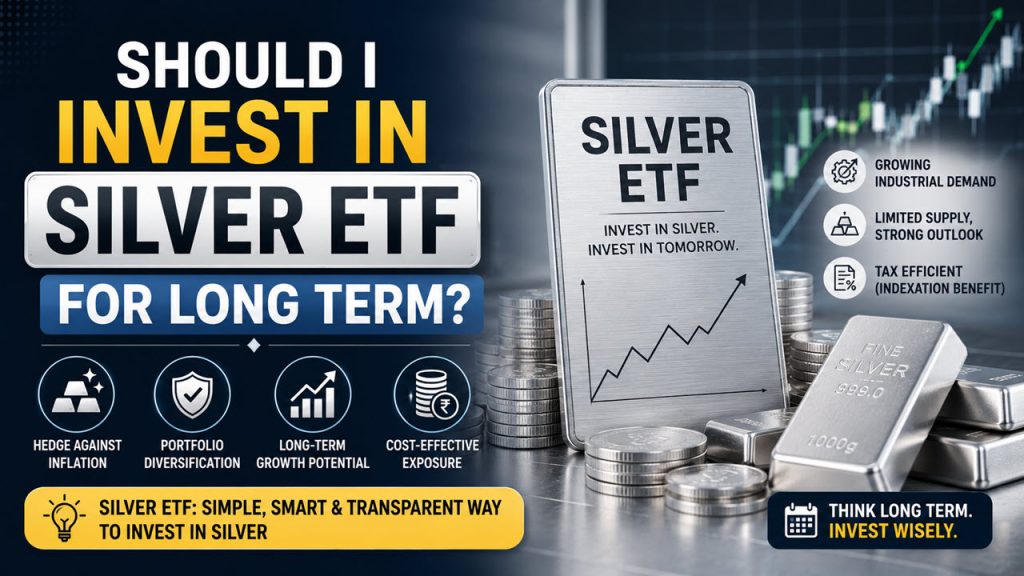
A silver ETF is a mutual fund scheme that buys physical silver and lists its units on the stock exchange. Each unit tracks the domestic price of silver, so if silver rises 5% in a day, the ETF’s net asset value (NAV, the value of its holdings per unit) should rise by about the same amount, less costs.
SEBI, the market regulator, issued the operating norms for silver ETFs in a circular dated 24 November 2021. The first scheme, ICICI Prudential Silver ETF, ran its new fund offer from 5 to 19 January 2022, and others followed within months. By 31 August 2026 there were 19 silver ETFs with about ₹85,488 crore in assets and 52.7 lakh investor folios, according to AMFI data.
The rules on what these funds hold are strict. Here is what a typical scheme document, such as SBI Silver ETF’s, requires:
- Purity: standard 30 kg bars of 99.9% purity (999 parts per thousand), conforming to London Bullion Market Association (LBMA) Good Delivery standards, a global benchmark for bar quality.
- Allocation: at least 95% of assets in silver and silver-related instruments. A small portion can sit in cash, government securities or liquid funds to manage redemptions.
- Pricing: the benchmark is the domestic price of silver, derived from the LBMA silver price and adjusted for the rupee exchange rate and Indian import costs.
- Safekeeping: the silver is held by a custodian in vaults, so you never handle storage, insurance or purity checks yourself.
You buy and sell units through a broker during market hours, just like a share. Prices of one unit are low (most trade between about ₹20 and ₹220 as of October 2026), so you can start with a small amount.
Silver ETF vs FoF vs physical vs digital silver
There are four common ways to own silver in India. They differ on cost, convenience, regulation and tax, which matters more than most investors expect.
| Feature | Silver ETF | Silver FoF | Physical silver (bars, coins) | Digital silver (apps) |
|---|---|---|---|---|
| What you own | Exchange-listed fund units backed by vaulted silver | Mutual fund units that invest in a silver ETF | The metal itself | A claim on silver held by a private vault provider |
| Demat account needed | Yes | No | No | No |
| SIP possible | Only via broker features | Yes, standard SIP | No | Yes, on most apps |
| Main costs | Expense ratio (about 0.35%–0.6% a year) plus brokerage | FoF expense ratio plus the underlying ETF’s | 3% GST, making charges, dealer spread, storage | 3% GST, buy-sell spread, storage fees after a period |
| Regulator | SEBI | SEBI | None for investment purposes | Not regulated by SEBI or RBI |
| Long-term tax threshold | More than 12 months | More than 24 months | More than 24 months | More than 24 months |
| Long-term tax rate | 12.5% | 12.5% | 12.5% | 12.5% |
Digital silver deserves a specific warning. In November 2025 SEBI cautioned investors that digital gold products sold by online platforms are not securities and fall outside its oversight, and the same structure applies to digital silver. If the provider fails, there is no regulator-backed grievance process.
For most people, the choice is between an ETF and a FoF. The ETF is cheaper and qualifies for long-term tax rates sooner; the FoF is convenient if you don’t have a demat account and want a monthly SIP. If you are unsure how listed funds differ from regular mutual funds, our guide to ETFs versus mutual funds covers it in detail.
Expense ratios of major silver ETFs
The expense ratio (TER) is the annual fee deducted from the fund’s assets. Since every silver ETF holds the same metal, cost and trading liquidity are the main differences between them.
| Silver ETF | NSE symbol | Expense ratio | AUM (₹ crore) |
|---|---|---|---|
| Nippon India Silver ETF | SILVERBEES | 0.58% | 32,223 |
| HDFC Silver ETF | HDFCSILVER | 0.58% | 8,313 |
| SBI Silver ETF | SBISILVER | 0.41% | 6,195 |
| Kotak Silver ETF | SILVER1 | 0.35% | 3,955 |
| Aditya Birla Sun Life Silver ETF | SILVER | 0.35% | 2,994 |
Figures are as of 1 October 2026, from Tickertape fund pages. ICICI Prudential Silver ETF (0.40%) and Tata Silver ETF (0.39%) are other widely held options. AMCs can change their TER, so check the latest factsheet before you invest.
The cost gap is small in rupees: on a ₹1 lakh holding, a 0.58% TER costs about ₹580 a year against ₹350 at 0.35%. A larger fund with heavy trading volume may still be the better pick if it lets you buy and sell closer to fair value, a point covered in our article on how to choose an ETF.
Silver’s volatility: what 2024 to 2026 showed
Silver is both a precious metal and an industrial input, used in solar panels, electronics and electric vehicles. That double role makes it swing far more than gold. Recent history is a clear example:
- 2024: silver rose about 24% in rupee terms over the year, based on international spot prices converted to rupees (exchange-rates.org).
- 2025: the London silver price ended the year just under $72 an ounce, up 144%, its sharpest annual rise since 1979 (BullionVault). In India, MCX silver futures hit a record ₹2.42 lakh per kg in late December 2025 (Business Standard).
- January 2026: MCX silver went from ₹3 lakh to above ₹4 lakh per kg in seven trading sessions, its fastest ₹1 lakh rise on record. The global price peaked at $121.62 an ounce on 29 January, then fell roughly 30% in a single session on 30 January after futures margins were raised.
- May to October 2026: the retail price in India peaked near ₹3.1 lakh per kg in May, fell about 16% in June, and stood at ₹2.35 lakh per kg on 4 October 2026 (Goodreturns). Globally, silver traded near $64 an ounce in mid-September 2026, about 48% below its January record, as markets priced in the US Federal Reserve’s first rate hike in three years.
Even after the fall, silver ETFs were up about 49% over the year to 1 October 2026, according to Tickertape. Someone who bought at the January peak, though, was sitting on a loss of roughly 40% or more. Silver has also had long flat or falling stretches in the past, so a strong few years tells you nothing about the next few.
Interest rates matter too. Silver pays no income, so higher rates raise the opportunity cost of holding it. Our explainer on how high interest rates affect markets explains the mechanism.
How silver ETFs are taxed
The rules changed twice in two years, so older articles are often wrong. Between April 2023 and March 2025, gains on silver ETFs and FoFs bought after 1 April 2023 were taxed at your slab rate however long you held them, because these funds fell under the “specified mutual fund” definition.
The Finance (No. 2) Act, 2024 narrowed that definition to funds that put more than 65% into debt and money market instruments, applying from financial year 2025-26 (assessment year 2026-27). Silver funds are no longer caught. For sales on or after 1 April 2025, the rules are:
- Silver ETF (listed): held more than 12 months, long-term gains are taxed at 12.5% without indexation; held 12 months or less, gains are added to income and taxed at your slab rate.
- Silver FoF (unlisted units): the long-term threshold is more than 24 months, then 12.5% without indexation; anything shorter is taxed at slab rate.
- No ₹1.25 lakh exemption: that annual exemption applies only to listed equity and equity-oriented funds, not to silver.
- Cess and surcharge: 4% health and education cess, plus surcharge where applicable, is added on top.
Budget 2026 did not change these rates; the main precious-metal change was ending the tax-free maturity benefit for Sovereign Gold Bonds bought on the secondary market. The new Income-tax Act, 2025, which took effect on 1 April 2026, kept the same rates and holding periods.
Worked example: ETF vs FoF tax
Suppose Rahul, in the 30% slab, invests ₹1,00,000 in silver in August 2025 and sells for ₹1,40,000 in November 2026, about 15 months later. His gain is ₹40,000 either way.
- Through a silver ETF: 15 months is more than 12, so it is long-term. Tax = ₹40,000 × 12.5% = ₹5,000. Cess = ₹5,000 × 4% = ₹200. Total ₹5,200.
- Through a silver FoF: 15 months is under 24, so it is short-term. Tax = ₹40,000 × 30% = ₹12,000. Cess = ₹12,000 × 4% = ₹480. Total ₹12,480.
The ETF route saves Rahul ₹7,280 here. If he held for more than 24 months, both would be taxed at 12.5%. For more ways to keep tax low on market gains, see our guide to reducing capital gains tax.
How much of your portfolio should be in silver?
A common rule of thumb is to keep 5–10% of a portfolio in precious metals in total, which means gold and silver together, not silver alone. Within that, many investors hold more gold than silver because gold has historically been less volatile. Treat this as general guidance; the right figure depends on your goals, time horizon and the rest of your holdings.
Suppose Priya has a ₹20 lakh portfolio and decides on 8% in precious metals, or ₹1,60,000. She puts ₹1,00,000 in a gold ETF and ₹60,000 in a silver ETF. If silver then falls 40%, her silver holding drops to ₹36,000, a ₹24,000 loss. That is 1.2% of her ₹20 lakh portfolio: painful, but not a setback to her long-term plans.
Rebalancing keeps that limit in place. If silver rallies and grows well past its target share, selling some and moving it back to equity or debt locks in part of the gain. Our guide to asset allocation explains how to set and review those targets.
How to invest in a silver ETF: checklist
- Decide your precious-metals target (for example, 5–10% in total) and how much of it goes to silver.
- Choose an ETF using TER, AUM and daily trading volume. For a FoF, check its own TER plus the underlying ETF’s, and any exit load.
- Log in to your broker, search for the ETF’s symbol and compare its market price with the indicative NAV (iNAV) shown on the AMC or exchange website.
- Place a limit order close to the iNAV rather than a market order, especially in the first and last 15 minutes of trading when spreads can widen.
- Spread purchases over several months if you are starting after a big rally; this reduces the risk of buying everything near a peak.
- Note your purchase dates. Selling one day before the 12-month mark can move the gain from 12.5% to your slab rate.
- Review the allocation once or twice a year and rebalance if silver has drifted well above or below target.
Risks and common mistakes
- Chasing recent returns: buying because silver doubled is how many investors ended up buying near the January 2026 peak.
- Over-allocating: a 25–30% weight in silver can wipe out years of equity gains during one bad stretch.
- Ignoring premiums to NAV: during sharp rallies, some silver ETFs have traded above their iNAV. Paying a premium is an instant loss when it disappears.
- Expecting income: silver pays no interest or dividend. Returns come only from price changes.
- Mixing up tax rules: FoF holders who sell between 12 and 24 months pay slab rate, not 12.5%.
- Treating silver as a growth engine: over long periods, equity has been the main wealth builder for Indian investors. Our article on long-term investment strategies covers how to build that core.
FAQ
Is it too late to buy a silver ETF in 2026?
Nobody can say reliably whether silver will rise or fall from here. As of early October 2026, the price was well below its January peak but still far above its level two years earlier. If silver fits your allocation, buying in instalments over several months is a sensible way to reduce timing risk.
Is a silver ETF safe?
The structure is safe in the sense that the silver is held by a custodian under SEBI rules, so you are not exposed to a dealer or app provider failing. The price is not safe: silver can fall 30% or more within weeks, as it did in early 2026.
Silver ETF or gold ETF: which is better for the long term?
Gold has historically been steadier and is the more common hedge against currency weakness and market stress. Silver offers higher potential returns with much larger swings because of its industrial demand. Many investors hold both, with gold taking the bigger share.
Can I do a SIP in a silver ETF?
Some brokers offer recurring buy orders on ETFs, which work like a SIP. Otherwise, a silver FoF lets you run a standard mutual fund SIP without a demat account, at a slightly higher total cost and a longer 24-month wait for long-term tax treatment.
What is the tax on a silver ETF held for one year?
The long-term rate applies only if you hold for more than 12 months. If you sell at exactly 12 months or earlier, the gain is short-term and taxed at your slab rate. After 12 months it is taxed at 12.5% plus cess, with no indexation.

Ramesh Iyer is the pen name of the founder and editor of StocksInfo.AI, an independent investor in Indian equities, mutual funds and ETFs since 2020. Every article is researched from primary sources such as SEBI, AMFI, NSE and the Income Tax Department, and fact-checked before publishing. About us