
I still remember how confusing investing felt at first. You open a Demat account, hear about SIPs, see mutual funds, stocks, and ETFs, and then someone mentions PMS as if it were a premium club for wealthy investors.
For most Indian investors, the real question is simple: should you manage money yourself, use mutual funds, or hand it to a professional? In this guide, I’ll break down Portfolio Management Services (PMS) in plain language, with real Indian context and practical examples.
What is Portfolio Management Services?
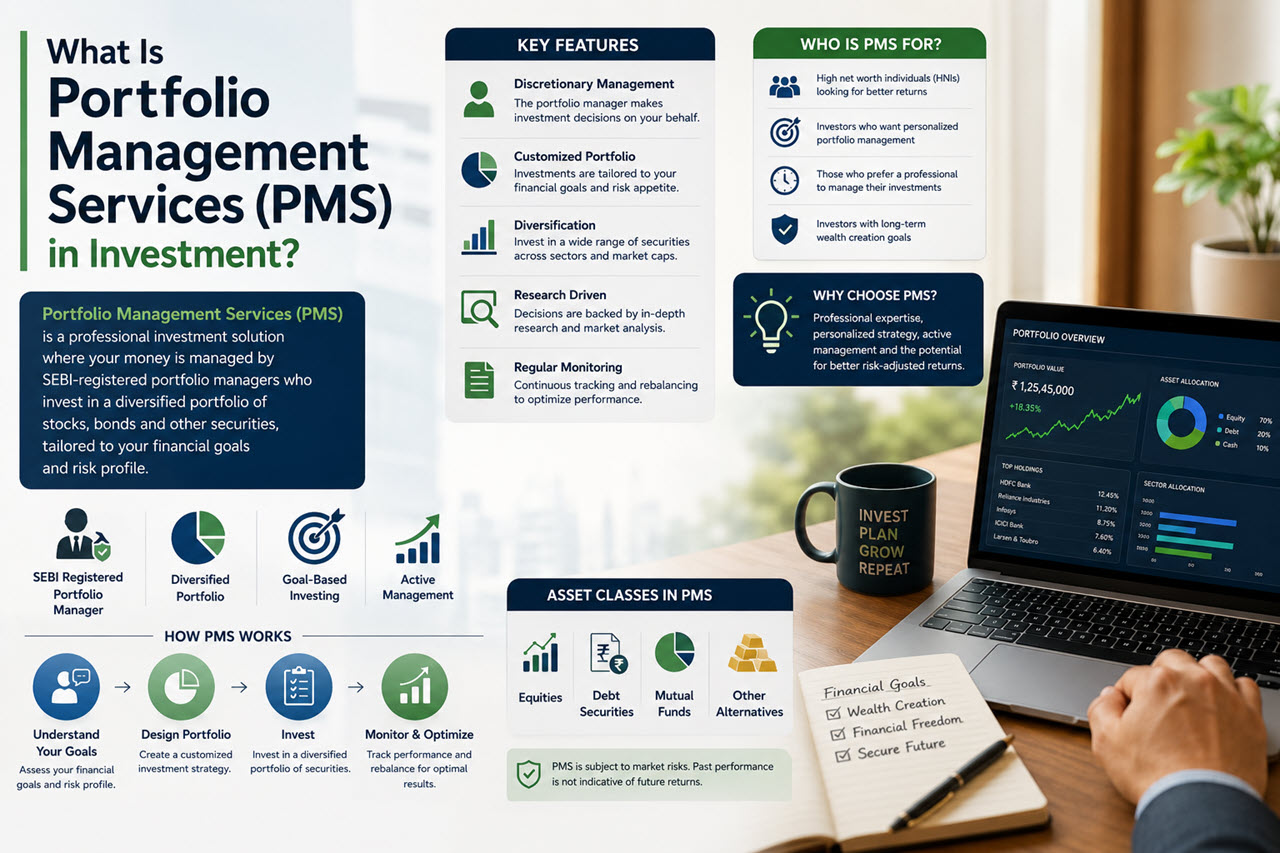
Portfolio Management Services (PMS) is a professional investment service where a portfolio manager handles your money and buys stocks, debt, or other securities on your behalf.
In India, PMS typically offers a more personalized service than a regular mutual fund and is commonly used by high-net-worth investors seeking direct ownership and active management.
Here is the simplest way to understand it: in a mutual fund, you own units of a pooled product. In PMS, you typically own the actual securities in your own Demat account, while the manager makes decisions for you. That is why PMS feels more customized, but it also brings higher risk, higher costs, and a bigger minimum investment.
If you want a quick comparison before going deeper, the difference between a pooled product and a direct portfolio matters a lot. That is why topics like PMS vs mutual funds and trading vs investing are worth reading alongside this guide.
How PMS works in India
PMS is regulated in India and usually offered by registered portfolio managers. You give the manager money, and they build a portfolio based on the agreed strategy, such as large-cap equity, flexi-cap, or a multi-asset approach.
The process usually starts with a risk discussion. The manager studies your goals, time horizon, risk appetite, and tax situation, then creates a portfolio that suits you. After that, the manager continues to track the portfolio and may rebalance it as markets change.
A typical PMS investor might be a salaried professional or business owner with surplus capital of ₹50 lakh, ₹1 crore, or more. Someone like Suresh, a 30-year-old salaried investor, usually starts with SIPs and index funds first, not PMS. That is because PMS suits people who already understand market swings and want a more tailored structure.
PMS vs mutual funds
This is where many beginners get confused. Both PMS and mutual funds aim to grow your money, but they work differently.
| Factor | PMS | Mutual Fund |
|---|---|---|
| Ownership | Direct securities in your name | Units of the fund |
| Customization | Higher | Very limited |
| Minimum investment | High | Low |
| Cost | Higher | Lower |
| Transparency | More detailed holdings | Standard fund disclosures |
| Best for | Wealthier, experienced investors | Most retail investors |
The biggest advantage of PMS is customization. The biggest disadvantage is that you pay more and take more concentration risk. A mutual fund spreads money across many investors and follows a more standardized structure, which is usually easier for beginners.
For most people, a simple index fund or broad ETF is a smarter starting point. If you want to understand that better, read benefits of ETF investing and ETF vs mutual fund.
Minimum amount and fees
PMS in India usually comes with a high entry ticket. The common minimum investment is ₹50 lakh, which immediately makes it unsuitable for many beginners.
Fees also matter a lot. PMS may charge management fees, performance fees, and other expenses, depending on the arrangement. These costs can quietly eat into returns if the portfolio does not perform well.
Let’s say you invest ₹50 lakh and the PMS charges a fixed fee plus performance-linked charges. Even if the portfolio earns a decent return, the net return after fees may look much less attractive than expected. That is why I always say investors should look at net returns, not headline returns.
Types of PMS strategies
PMS is not one single style. Different managers use different strategies, and the right one depends on your goals.
Equity PMS
Equity PMS invests primarily in stocks listed on the NSE or the BSE. It may focus on large-cap companies, mid-cap growth stories, or a mix of both.
This style can deliver strong long-term growth, but it can also fall sharply in bad markets. It suits investors who can stay invested for years and tolerate volatility.
Debt PMS
Debt PMS invests in fixed-income instruments such as bonds and other lower-volatility assets. It is generally less risky than equity PMS, but returns are also lower.
This may appeal to investors who want capital preservation more than aggressive growth. Still, even debt products carry interest rate and credit risk, so they are not risk-free.
Discretionary and non-discretionary PMS
In discretionary PMS, the portfolio manager takes investment decisions independently. In non-discretionary PMS, the manager suggests ideas, but you approve the trades.
Discretionary PMS is more common because it allows quicker execution and a cleaner process. Non-discretionary PMS feels more controlled, but it can be slower and less efficient.
Who should consider PMS?
PMS is not for everyone, and that is the honest answer. It makes sense for investors who already have a large investable surplus, understand market risk, and want more customization than a mutual fund provides.
It also suits investors who want concentrated conviction portfolios, direct stock ownership, or very specific strategy exposure. For example, someone building a long-term family corpus who already holds mutual funds, ETFs, and debt instruments may use a PMS as a satellite allocation.
For a beginner, I would usually not start here. I would first build a base using SIPs, index funds, and a good understanding of market behavior. You can also learn from guides like long-term investment strategies and power of compounding.
Example with simple numbers
Let’s make it real. Suppose Suresh has ₹50 lakh and wants to invest for 10 years.
If he puts that amount into a simple diversified equity product at an assumed 12% annual return, the money can grow meaningfully over time. But if he uses PMS with high fees and a portfolio that goes through sharp ups and downs, the actual experience may feel much harder.
Now compare that with a monthly SIP of ₹10,000 in a mutual fund. That route is slower, but it is easier to start, easier to understand, and far less stressful for most salaried investors. For many beginners, consistency matters more than sophistication.
Risks of PMS
PMS sounds premium, but premium does not mean safer. In fact, PMS can be riskier than mutual funds because the portfolio often holds fewer stocks and can be more concentrated.
The manager may also take active calls that underperform the market. If the strategy goes wrong, the portfolio can lag for a long time. That is why you need a strong time horizon and emotional discipline.
Another important risk is behavior. Investors often expect PMS to beat the market every year, which is unrealistic. The market does not reward impatience, and active strategies can go through long dull periods.
How to evaluate a PMS offer
Before choosing a PMS, ask the right questions. Do not get impressed by fancy presentations or short-term return charts.
Check the investment philosophy, historical performance across market cycles, fee structure, portfolio concentration, and the manager’s risk-management approach. Also ask how often the portfolio churns, because excessive buying and selling can increase costs and tax friction.
A practical thing I always look for is consistency. One flashy year means nothing. I want to see how the strategy behaved during corrections, flat markets, and sector rotations.
Pro Tip: I’ve found that many investors focus only on returns and ignore fees, churn, and downside risk. That mistake usually shows up later, when the portfolio underperforms and the excitement fades.
PMS and taxes
PMS taxation in India follows the nature of the underlying investments. If the portfolio holds equity shares, equity taxation rules may apply; if it holds debt or other assets, different tax rules may apply.
This matters because frequent buying and selling inside PMS can create tax events. Many investors forget that a better gross return does not always mean a better post-tax return. For a long-term investor, tax efficiency is as important as raw performance.
If you are investing in other market-linked products too, it helps to understand how to avoid stock market capital gains tax in a legal and practical way.
Things to Keep in Mind
- High minimum investment: PMS usually suits investors with a large corpus, not someone starting with ₹5,000 or ₹10,000 a month.
- Higher fee pressure: Management fees and performance fees can reduce net returns, especially in average market years.
- Concentration risk: PMS often holds fewer stocks than mutual funds, so one bad call can hurt more.
- Long holding period: PMS works better when you stay invested for years, not months.
- Do not chase recent performance: A strong short-term track record does not guarantee future results.
- Start simpler if needed: For many beginners, mutual funds, index funds, and ETFs are easier first steps.
Frequently Asked Questions
What is Portfolio Management Services in simple words?
PMS is a service where a professional manages a portfolio of stocks or other securities for you. In India, it is usually designed for investors with a larger amount of money and a desire for more personalized investing.
Is PMS better than mutual funds?
Not always. PMS gives more customization and direct ownership, but it also charges more and can be riskier. For most retail investors, mutual funds are simpler and more cost-effective.
How much money do I need for PMS in India?
The common minimum investment is ₹50 lakh. Because of that, PMS is usually meant for wealthy investors, not for someone just starting out with SIPs.
Is PMS risky?
Yes, PMS can be risky because it often holds a concentrated portfolio of stocks. If the manager’s calls go wrong, losses can be sharper than in a diversified mutual fund.
Can beginners invest in PMS?
They can, but I usually do not recommend it at the start. Beginners are better off learning market basics through mutual funds, index funds, and ETFs before moving to PMS.
Does PMS give guaranteed returns?
No, PMS never guarantees returns. It depends on the strategy, market conditions, fees, and the manager’s execution.
Conclusion
PMS is a professional, high-ticket investing service that offers customization, direct ownership, and active management, but it also brings higher fees and concentration risk. For most investors, the best path is to start simple, stay consistent, and focus on long-term wealth creation. I hope you found this article helpful.
You May Also Like
- PMS vs mutual funds
- Benefits of ETF investing
- ETF vs mutual fund
- Long-term investment strategies
- Power of compounding

Ramesh Iyer is the founder of StocksInfo.AI, a Bengaluru-based investor with two decades of market experience, writing plain-language content on stocks, mutual funds, and ETFs for everyday Indian investors. Read more