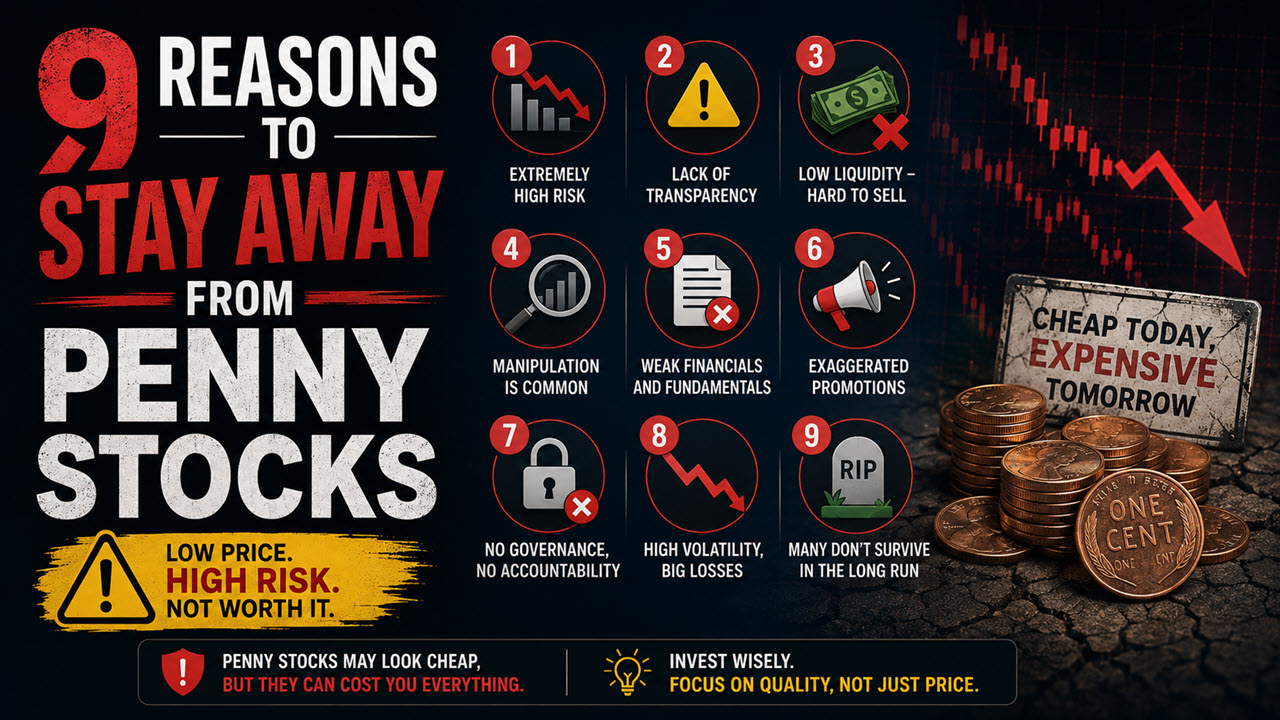
Most investors should stay away from penny stocks because the odds are stacked against them: the businesses are usually weak, the shares are hard to sell, and prices are easy to manipulate. You can make money with penny stocks, but the few big winners you hear about hide a much larger number of investors who lost most of their capital.
This guide explains what counts as a penny stock in India, how the circuit-limit trap works, what the exchanges’ ASM, GSM and ESM surveillance tags mean, and what real SEBI pump-and-dump cases reveal. It ends with a comparison against quality small caps and a checklist for anyone who still wants to buy.
What counts as a penny stock in India?
SEBI and the stock exchanges have no official definition of a penny stock. In everyday use, the term means a listed share trading at a very low price, often below ₹10 or ₹20, issued by a company with a tiny market capitalisation (share price multiplied by the number of shares), typically a few crore to a few hundred crore rupees.
Price alone is a poor test. A ₹5 share of a company worth ₹3,000 crore is not a penny stock in any meaningful sense, while a ₹60 share of a company worth ₹25 crore, with no profits and almost no trading, behaves exactly like one. The features that matter are a very small market cap, thin trading volumes, weak or erratic financials and limited information.
For context, SEBI’s mutual fund categorisation treats every company ranked 251st or lower by full market capitalisation as a small cap. Penny stocks sit at the very bottom of that range, well below the companies that small-cap funds normally hold.
Can you make money with penny stocks?
Yes, some people do. A handful of tiny companies turn around, grow profits and become genuine multibaggers. Others spike for a few weeks on rumours, and anyone who sells near the top makes money. But being right about the stock is not enough. You also have to be able to sell, and you are usually trading against people who know more than you.
Survivorship bias: why the success stories mislead
Survivorship bias means judging an outcome only by the cases that survived. Lists of “penny stocks that turned ₹1 lakh into ₹1 crore” only show the winners. They leave out the companies that were suspended, delisted, merged away for nothing, or that drifted from ₹8 to ₹0.80 and stopped trading.
The same bias shapes what you hear from other investors. People talk about the stock that went up tenfold, not the five that went to near zero. If you picked penny stocks from a screener today, you would be drawing from the whole group, losers included, not from the curated list of past winners.
Reason 1: the businesses are usually weak
Shares usually become very cheap for a reason. Common patterns include years of losses, high debt, shrinking revenue, auditor qualifications, delayed results filings, promoters who have pledged or sold their stake, and businesses that have changed their stated activity several times.
Information is also thin. Large companies are tracked by dozens of analysts and hold detailed earnings calls. A ₹40 crore company may publish only the mandatory filings, with no analyst coverage at all, so errors or misstatements can go unnoticed for a long time.
Reason 2: a low price does not mean cheap
A ₹4 share feels cheaper than a ₹2,000 share, but the price per share says nothing about value. What matters is what you pay for each rupee of earnings or assets, which is what the P/E ratio measures.
Take a hypothetical example. Company A’s share trades at ₹4 and it has 200 crore shares, so its market cap is ₹800 crore. If it earns ₹4 crore a year, its P/E is 800 ÷ 4 = 200. Company B’s share trades at ₹2,000 with 1 crore shares, a market cap of ₹2,000 crore. If it earns ₹200 crore, its P/E is 2,000 ÷ 200 = 10. The “expensive” ₹2,000 share is twenty times cheaper on earnings. Our guide on how to tell if a stock is overvalued covers other valuation checks.
Reason 3: poor liquidity and the circuit-limit trap
Liquidity is how easily you can buy or sell without moving the price. Many penny stocks trade only a few thousand shares a day, so even a modest sell order can push the price down sharply.
The bigger danger is the circuit limit. Exchanges cap how far most stocks can move in a day, using price bands of 2%, 5%, 10% or 20% from the previous close. Small, volatile stocks are often put in the 5% or 2% band. When bad news hits, the stock can hit its lower circuit at the open and stay there: sell orders pile up, buyers vanish, and almost nothing trades. The same can happen the next day, and the day after.
Worked example: stuck at the lower circuit
Suppose Rahul buys 20,000 shares of a penny stock at ₹5, investing ₹1,00,000. The stock is in the 5% band. Negative news comes out and the stock hits the lower circuit five sessions in a row, with very few buyers on any of those days.
- Price after five 5% falls: ₹5 × 0.95 × 0.95 × 0.95 × 0.95 × 0.95 = ₹5 × 0.7738 = ₹3.87
- Value of his holding: 20,000 × ₹3.869 = about ₹77,380
- Paper loss: about ₹22,620, or 22.6%, and he may not have been able to sell a single share along the way
A stop-loss order does not help much here, because it can only execute if someone is willing to buy. The pattern also works in reverse: a stock locked at the upper circuit day after day looks irresistible, but often that is exactly when insiders are selling into the demand.
Reason 4: many penny stocks sit under exchange surveillance
SEBI and the exchanges run several surveillance frameworks that flag unusual stocks and add trading restrictions. Inclusion is not an accusation of wrongdoing against the company, but it tells you the exchange has seen something it wants to cool down. Your broker will usually show a warning when you try to buy such a stock.
| Framework | What triggers it | Typical restrictions |
|---|---|---|
| ASM (Additional Surveillance Measure) | Unusual trading: sharp price moves, high-low variation, client concentration, frequent circuit hits, volume spikes. Comes in short-term and long-term versions. | Higher margins, up to 100% (no leverage); in later long-term stages, tighter price bands and trade-for-trade settlement |
| GSM (Graded Surveillance Measure) | Price rise not backed by fundamentals such as earnings, book value, net worth and P/E | Staged: trade-for-trade settlement, 5% price band, an additional surveillance deposit from buyers, trading only once a week in higher stages, and no upward price movement in the top stage |
| ESM (Enhanced Surveillance Measure) | Main-board companies with market cap below ₹500 crore showing high price volatility; started 5 June 2023 | Stage I: trade-for-trade, 5% (or 2%) price band, 100% margin. Stage II: 2% price band and trading only through periodic call auctions. Minimum stay of three months. |
Trade-for-trade settlement means every trade must be settled by delivery, so you cannot buy and sell the same stock on the same day. Combined with a 2% band and call-auction trading, this can make exiting a position slow and painful. Check the surveillance status on the exchange website or in your broker app before buying.
Reason 5: pump-and-dump schemes target penny stocks
In a pump-and-dump, operators quietly buy a thinly traded stock, push its price up with their own trades and promotional “tips”, then sell to the retail buyers they attracted. Penny stocks are ideal targets because a small amount of money moves the price. Two SEBI orders show how it works in practice.
Sadhna Broadcast: misleading YouTube videos (2022–2025)
SEBI’s interim order of 2 March 2023 found that Sadhna Broadcast’s share price rose 360%, from ₹2.76 on 27 April 2022 to ₹12.68 on 14 July 2022, on volumes largely generated by some of the noticees. In the second half of July 2022, videos on two YouTube channels, The Advisor and Moneywise, falsely claimed the company was going to be taken over by the Adani Group, held a 5G licence and had a ₹1,100 crore movie deal with an American company. The channels had lakhs of subscribers, and the videos were boosted with paid promotion.
The company told BSE on 18 July 2022 that the claims were false, yet the price climbed another 161% to ₹33.15 by 12 August 2022 as retail buyers poured in, while certain promoters and large shareholders sold at inflated prices. In its final order of 29 May 2025, SEBI barred several key persons for five years and dozens of other entities for one year, imposed penalties of up to ₹5 crore, and ordered disgorgement of unlawful gains with 12% annual interest. Actor Arshad Warsi and his wife Maria Goretti, who had traded in the stock, were barred for one year and fined ₹5 lakh each.
Bull Run Telegram channel (2021–2023)
SEBI’s final order of 26 April 2023 dealt with the Telegram channel “@bullrun2017”, which had more than 49,000 subscribers. Its administrators bought small-cap stocks in their own and family members’ accounts, posted buy recommendations without disclosing their holdings, then sold to subscribers who acted on the tips. SEBI calculated unlawful gains of about ₹2.84 crore, ordered disgorgement with interest, barred the administrators until three years after paying it, and imposed a penalty of twice the unlawful gains, about ₹5.69 crore, jointly on the three administrators.
The lesson from both cases is the same. If an anonymous channel is urging you to buy a tiny stock “before it is too late”, ask who is selling to you. Often it is the person making the recommendation. The same instinct explains why chasing tips makes markets feel like a casino, which we discuss in is the stock market like gambling.
Reason 6: delisting, suspension and governance risk
Exchanges suspend companies that repeatedly fail to file results, pay listing fees or meet other listing rules. A suspended share cannot be traded, and if the company is later delisted, small shareholders may find it very hard to get any value out. Weak governance also shows up as related-party transactions that drain cash, sudden changes in auditors and preferential share issues at low prices that dilute existing holders.
Penny stocks vs quality small caps
If the appeal of penny stocks is the chance of high growth, quality small caps offer a similar opportunity with far fewer traps. The table below shows typical differences; individual companies vary.
| Factor | Typical penny stock | Typical quality small cap |
|---|---|---|
| Market cap | A few crore to a few hundred crore rupees | Usually ₹1,000 crore or more |
| Profitability | Losses or tiny, erratic profits | Consistent profits and cash flow |
| Debt | Often high relative to equity | Moderate or low |
| Daily trading volume | Very low; can lock at circuit for days | Enough to buy and sell modest amounts easily |
| Price band and surveillance | Often 2% or 5% band; frequently under ASM, GSM or ESM | Usually wider bands; rarely under surveillance for long |
| Information | Minimal disclosures, no analyst coverage | Regular investor presentations, some analyst coverage |
| Institutional holding | Little or none | Mutual funds and other institutions often hold stakes |
| Manipulation risk | High | Lower |
For most people, the simplest route to small-cap growth is a diversified fund. Our list of small-cap mutual funds in India explains how they work and what risks they carry. If you prefer researching individual companies, our look at small-cap manufacturing stocks shows the kind of data to examine.
If you still want to buy: a due-diligence checklist
If you decide to take the risk, treat it as a small, speculative bet and check the following first.
- Surveillance status: Is the stock under ASM, GSM or ESM, or in the trade-for-trade segment? What is its price band?
- Five years of financials: Look for revenue growth, real profits and positive operating cash flow, not just a single good quarter.
- Debt and dilution: Check debt to equity, and whether the share count has jumped through preferential issues or warrants.
- Promoters: Check promoter holding over several quarters, any pledged shares, and recent promoter selling.
- Auditor: Read the audit report for qualifications or emphasis-of-matter notes, and note any recent auditor resignation.
- Filings and announcements: Are results filed on time? Has the company denied rumours circulating about it?
- Liquidity: Compare average daily traded value with the amount you plan to invest. If your order would be a large share of a day’s volume, you may struggle to exit.
- Source of the idea: If the tip came from an anonymous channel, video or message, assume it may be a pump. SEBI-registered advisers and research analysts must show their registration number.
- Position size: Limit penny stocks to a small slice of your portfolio, an amount you could lose entirely without affecting your goals.
Common mistakes with penny stocks
- Chasing upper circuits: By the time a stock has hit the upper circuit several days running, early buyers are often looking for an exit.
- Averaging down without a reason: Buying more of a falling penny stock increases exposure to a business that may be failing.
- Ignoring exit risk: Planning only the entry, and not how you would sell if the stock is locked at the lower circuit.
For broader habits that protect your capital, see our guide on how to avoid losing money in the stock market.
FAQ
Are penny stocks illegal in India?
No. Penny stocks are ordinary listed shares, and buying them is legal. What is illegal is manipulating their price or spreading false information to induce others to trade, which is what SEBI acted against in the Sadhna Broadcast and Bull Run cases.
Can a penny stock become a multibagger?
It can, if the underlying business genuinely improves. But for every turnaround story there are many companies that stagnate or disappear, and the success lists you see suffer from survivorship bias. Treat any penny stock as a high-risk bet, not a plan.
Why can’t I sell a stock stuck in the lower circuit?
At the lower circuit, the price cannot fall further that day, so sellers queue at that price. A trade only happens when a buyer appears, and in a falling penny stock there may be almost none. Your order stays pending until it is matched or the session ends.
How can I spot a pump-and-dump?
Warning signs include a sudden flood of promotion on social media, claims of takeovers or big contracts that the company has not announced, price targets several times the current price, and a sharp jump in volume in a previously inactive stock. Check the company’s exchange announcements; if it has denied the rumour, stay away.

Ramesh Iyer is the pen name of the founder and editor of StocksInfo.AI, an independent investor in Indian equities, mutual funds and ETFs since 2020. Every article is researched from primary sources such as SEBI, AMFI, NSE and the Income Tax Department, and fact-checked before publishing. About us