

If Monday mornings feel challenging, you’re not alone—and that sentiment might even extend to the stock market. For decades, financial analysts have observed a recurring phenomenon known as the “Monday Effect” or “Weekend Effect.” This pattern suggests that stock returns on Mondays often differ from other weekdays, sometimes showing slightly weaker or negative results.
But is this phenomenon still relevant in 2025? Has algorithmic trading, global integration, and behavioral evolution erased it—or does Monday still hold unique secrets for traders and investors?
This article dives deep into the data, psychology, and trading implications behind the Monday Effect to answer one big question: Are Mondays really good for the stock market?
The Monday Effect Explained
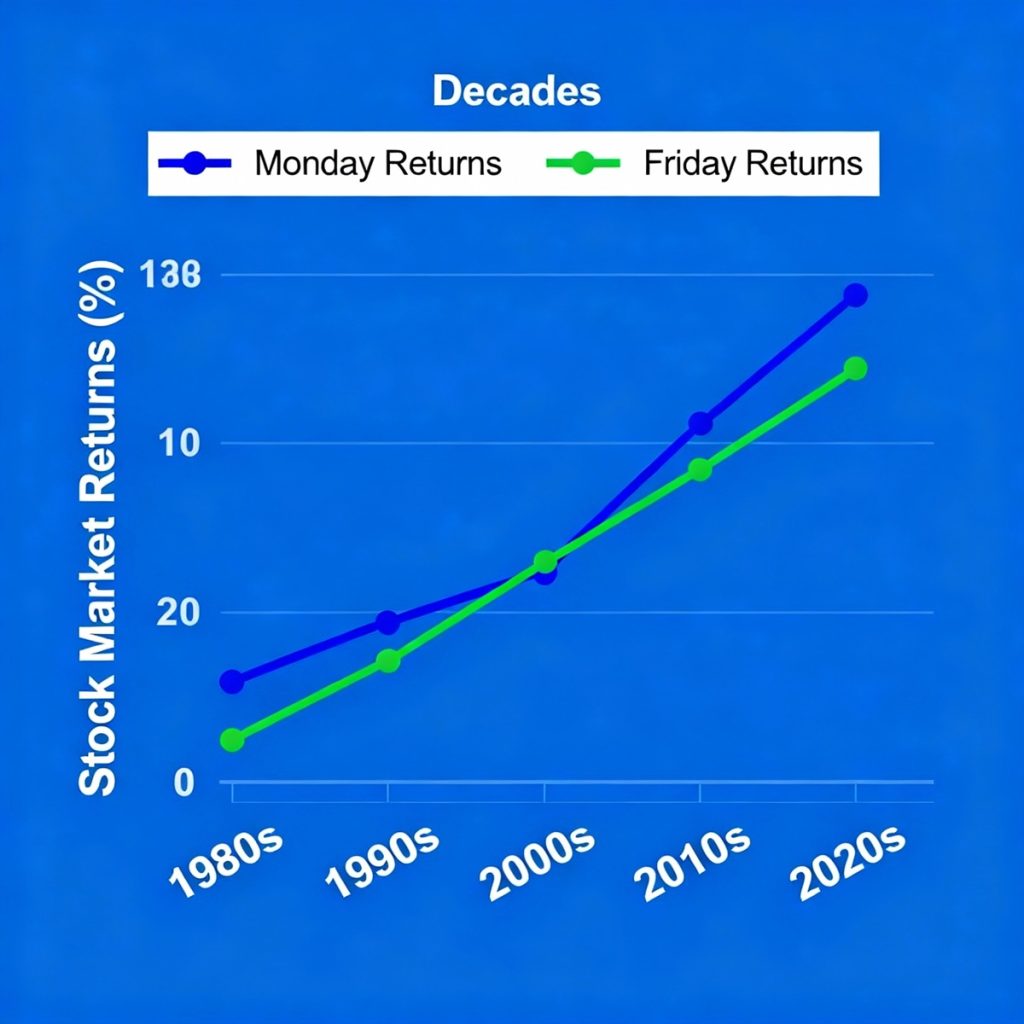
The Monday Effect refers to the theory that stock returns on Monday often mirror or continue the trend from the previous Friday. Historically, markets that ended positively on Friday tended to open higher Monday, while negative closes often carried forward into the new week.
Originally identified by researcher Frank Cross in the 1970s, the effect revealed that Friday returns were generally higher than those on Monday. Over time, the pattern has been referred to as the Weekend Effect, capturing investors’ tendency to be optimistic before the weekend and cautious afterward.
The reasons range from short-selling patterns and corporate news releases on Friday evenings to shifts in investor psychology after a two-day break. While early studies showed consistent results, modern data suggests that the Monday Effect has evolved rather than vanished.
Check out What It Means When a Stock Is Trading 100% Above Its Weekly Average Volume?
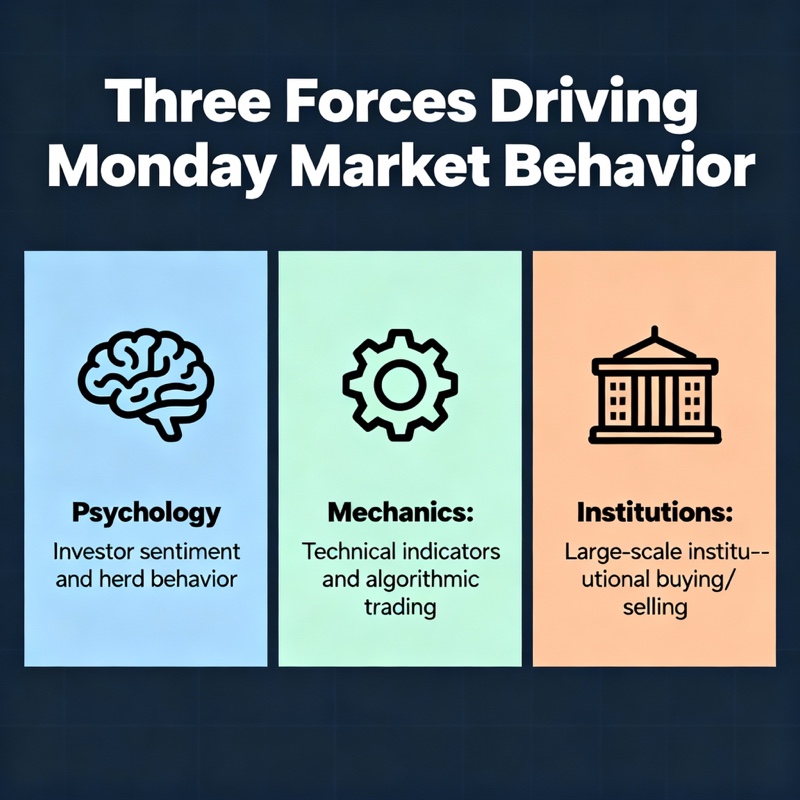
Why Mondays Often Behave Differently
1. Investor Psychology
- Investors spend weekends absorbing news and are more likely to act on fresh emotions Monday morning.
- Negative news released late Friday (to minimize impact) can create anxiety-driven sell orders Monday.
- Weekends create separation between professional and emotional decisions, often leading to cautious re-entry.
2. Market Mechanics
- The backlog of trades and news developments over the weekend causes pent-up reactions.
- Pre-market orders and after-hours sessions amplify early volatility.
- Global movements, especially from Asian or European markets, influence sentiment before domestic openings.
3. Institutional Behavior
- Fund managers often rebalance portfolios or adjust segments early in the week.
- ETF inflows and large-cap adjustments tend to reset on Mondays, enhancing early momentum.
Read Can You Make Money in Intraday Trading?
Data Snapshot: Monday Trends in Global and Indian Markets
Although the Monday Effect isn’t as consistent as it once was, data over time reveals interesting patterns in both global and Indian contexts.
| Market | Average Historical Monday Returns | Recent Trend (2020–2025) | Typical Pattern |
|---|---|---|---|
| U.S. (S&P 500) | Slightly negative in long-term studies | Moderately mixed | Friday’s momentum often carries over to early Monday. |
| India (Nifty 50) | Mixed trends | Positive momentum ahead of festive seasons or earnings weeks | Early volatility followed by stabilization. |
| Europe (FTSE, DAX) | Marginally lower than midweek returns | Narrowed differences post-2020 | Influenced by global news and weekend events. |
In 2025, Nifty 50 exhibited strong bullish behavior heading into the Diwali season, breaking past a 52-week high around 25,700. Analysts projected sustained momentum on Monday, October 20, supported by FMCG and banking stocks. This reflects how broader market optimism often overrides weekday-specific patterns.
The Behavioral Finance Connection
Behavioral finance provides valuable context for why Monday market patterns emerge:
- Loss Aversion: Investors remember Friday losses more vividly, prompting hesitation Monday.
- Anchoring Bias: Monday traders rely too much on Friday’s closing levels to guide early-week moves.
- Mood Theory: The emotional shift from rest to workweek subtly affects risk appetite.
- Herd Behavior: Seeing early weakness prompts others to follow suit, reinforcing self-fulfilling moves.
Key Takeaway: Even small psychological biases can compound across thousands of traders, creating visible short-term anomalies.
Check out Can You Make Money With Day Trading?
Global Perspective: Not Just a Western Concept
The Monday Effect exists—albeit differently—across the globe.
United States
Decades of data show negative or subdued Monday returns in the S&P 500, with traders citing post-weekend corrections as drivers.
However, newer observations highlight that algorithmic execution has diluted such biases by processing weekend sentiment before Monday’s open.
India
The Nifty 50 and Sensex often start with volatility but end flat or slightly positive.
Mondays following strong corporate earnings or festival weeks usually attract heavy inflows, contradicting the traditional theory.
Asia and Europe
Time zone effects amplify global spillovers. Asian markets, opening first after the weekend, often reflect Friday’s U.S. movements, thereby influencing early global sentiment.

Monday as an Opportunity: Trading and Investing Viewpoints
For Short-Term Traders
- Mondays offer volatility pockets ideal for intraday profits.
- Traders can use Friday close vs. Monday open gaps to plan scalp or option plays.
- Backtesting Monday moves using index futures and volume spikes refines strategy timing.
For Swing and Options Traders
- A mild Monday pullback can set up buy-on-dip opportunities midweek.
- Option traders should watch for implied volatility adjustments after weekend time decay.
For Long-Term Investors
- Monday’s movements rarely affect portfolio returns over long horizons.
- Consistent investing through SIPs or automated plans neutralizes weekday effects.
- Monday becomes a reflection point to analyze rather than react to.
Example Strategy Table:
| Trader Type | Approach | Key Insight |
|---|---|---|
| Intraday Trader | Trade early post-open volatility | Use last Friday’s trend and pre-market cues |
| Swing Trader | Watch for dips before recovery | Targets set on weekly charts |
| Long-Term Investor | Ignore day-specific noise | Focus on consistent accumulation |
Read Can You Make Money with Options Trading?
Expert and Modern Market Insights
Experts believe the Monday Effect is more psychological than structural today.
Technological advancements, global data access, and algorithmic systems price in weekend events before markets reopen. Some analysts now view Monday as a predictive signal for the coming week’s tone rather than a bias.
Analysts from leading Indian brokerages in October 2025 projected that despite global uncertainties, robust domestic fundamentals and consumption growth are pushing Nifty towards record highs—even on Mondays.
Bullet Highlights:
- Monday remains a key day for measuring sentiment reset.
- Week beginnings now reflect how traders interpret macro data rather than weekday superstition.
- Smart money often uses Monday to establish positions for the rest of the week.
Common Myths About Mondays
Myth 1: “Markets always fall on Mondays.”
Reality: Mondays may be volatile, but consistent declines are statistically rare in modern markets.
Myth 2: “You should never trade on Mondays.”
Reality: Opportunities often emerge due to sentiment swings and short-term dips.
Myth 3: “A bad Monday means a bad week.”
Reality: Many strong weeks start with soft Mondays that reverse midweek.
Key Investor Takeaways
- Monday’s behavior blends psychology, global influence, and structural resets.
- Historical Monday Effect patterns have weakened due to technology and global integration.
- Traders can view Mondays as information-rich sessions rather than risk days.
- Long-term investors should stay consistent through weekdays and focus on fundamentals.
Practical Tips:
- Track volatility indices (like India VIX) to gauge Monday sentiment.
- Avoid emotional overreactions—stick to preset stop-loss and risk levels.
- Treat Monday as your weekly analysis day to plan for the market’s tone ahead.
Check out Can Everyone Make Money in the Stock Market?
Conclusion: Monday—Myth, Mood, or Opportunity?
The Monday Effect may have originated in a less connected world, but even today, traces remain visible through how investors behave and react. Mondays often carry the emotional residue of weekends and the anticipation of the trading week ahead.
For traders, they present short-term volatility and tactical entry points.
For long-term investors, Mondays are simply another day in the broader cycle of wealth creation.
Ultimately, whether Monday is “good” for the stock market depends on how you use it. For those prepared, data-driven, and patient, Monday isn’t a curse—it’s a reset.
FAQs
Q1: Why do markets often show low momentum on Mondays?
Weekend news and psychological resets cause cautious trading at the week’s start.
Q2: Which day of the week shows higher returns historically?
Studies suggest midweek sessions—especially Tuesday and Wednesday—typically produce better average returns.
Q3: Does the Monday Effect still exist in India?
It appears inconsistently. Indian markets often rally on positive global cues but may correct after volatile Fridays.
Q4: Is Monday a bad day to sell stocks?
Not necessarily, but traders often find stronger liquidity and sentiment-driven premiums midweek.
Q5: What should long-term investors do on Mondays?
Focus on analysis and fundamental reviews—not reactionary trades. Use Mondays to align your portfolio with the week’s macro view.
You may also like:
- Can You Make Money Without Selling Stocks?
- 7 Data Center Stocks in Indian Stock Market for the Long Term
- Can AI Help Me Invest in the Stock Market?

I am an IT professional with more than 17 years of experience in the industry. Over the past five years, I have developed a strong interest in the stock market, investing in both direct stocks and mutual funds. My background in IT has helped me analyze and understand market trends with a logical approach. Now, I want to share my knowledge and firsthand experiences to help others on their investment journey. Read more about us >>