
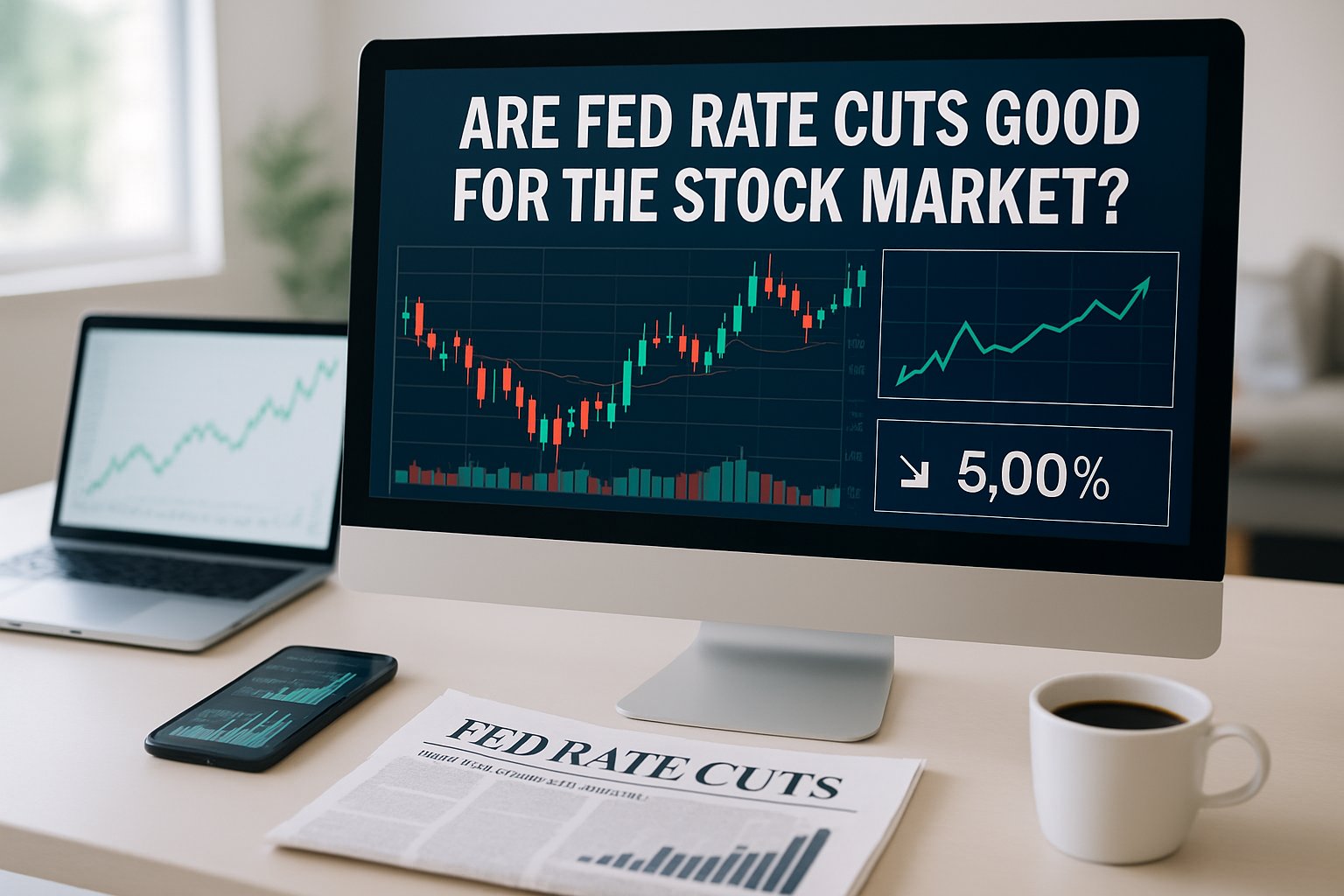
If you’re asking, “Are Fed Rate Cuts Good For The Stock Market?”, the honest answer is: often yes over time, but not always in the way people expect.
The U.S. Federal Reserve (Fed) sets short-term interest rates that influence borrowing costs, spending, and investment around the globe. Those moves ripple through everything from your SIP or 401(k) to Indian mutual funds and U.S. tech stocks.
If your goal is long-term wealth creation through the power of compounding, understanding how rate cuts affect stocks can help you react calmly instead of emotionally.
In this guide, you’ll learn:
- What actually happens when the Fed cuts rates
- When Fed cuts tend to help stocks—and when they don’t
- Which types of stocks and sectors usually benefit
- What rate cuts mean for bonds, cash, and global markets (including India)
- A simple, practical plan for long-term investors
Are Fed Rate Cuts Good For The Stock Market? The Short Answer
Over full market cycles, Fed rate cuts have usually been good for the stock market:
- Lower rates reduce borrowing costs.
- Cheaper credit supports business investment and consumer spending.
- Safer assets like cash and short-term bonds often pay less, so investors look to stocks for better returns.
But that doesn’t mean every cut leads to an instant rally.
When you ask, “Are Fed rate cuts good for the stock market right now?” you need to look at why the Fed is cutting:
- If the Fed is trimming rates to support an already-growing economy, stocks have often done well.
- If the Fed is slashing rates during a crisis or deep recession, stocks can still fall sharply before they recover.
The question “Are Fed rate cuts good for the stock market?” makes the most sense when you think in 12–24 month periods, not in days or weeks.
If you’re still deciding whether U.S. stocks belong in your portfolio at all, start with:
Why You Should Invest in the US Stock Market?
How Fed Rate Cuts Work
To judge whether Fed rate cuts are good for the stock market, you first need to understand what the Fed is actually changing.
The Fed targets the federal funds rate—the interest rate banks charge each other for overnight loans. This short-term rate then influences:
- Home loans and personal loans
- Business loans and credit lines
- Yields on money market funds and many bonds
In simple terms:
- Lower rates → cheaper borrowing
- Higher rates → more expensive borrowing
“Monetary policy is not a panacea. It cannot solve every economic problem.” — Ben Bernanke
That quote is a good reminder: rate cuts are powerful, but they work through the real economy with delays and side effects.
Why The Fed Cuts Rates
The Fed usually cuts rates when it sees rising risks to growth or inflation falling below target:
- To support a slowing economy or reduce the odds of a recession
- To encourage borrowing and investment by companies
- To stimulate consumer spending by lowering EMIs and other interest costs
- To keep financial conditions loose enough for markets and businesses to function smoothly
Rate cuts are a tool, not a magic trick. The real question is how the economy and corporate profits react over time.
Why The Economic Backdrop Matters
The same rate cut can mean very different things depending on the economic backdrop, as explored in J.P. Morgan’s analysis of investment implications of rate cuts across different economic environments. This is one of the biggest reasons the answer to “Are Fed rate cuts good for the stock market?” is “it depends.”
Non-Recessionary “Insurance” Cuts
Sometimes the Fed cuts rates even though:
- GDP is still growing
- Unemployment is relatively low
- Corporate profits are stable or rising
Here, the Fed is “taking out insurance” against future weakness. In these cases, history shows:
- Stocks and bonds have often both done well after the first cut.
- Markets tend to interpret the move as supportive, not desperate.
Recessionary Or Crisis Cuts
Other times, the Fed cuts because:
- Unemployment is rising quickly
- Corporate earnings are falling
- Credit markets are under stress
- A shock (like a financial crisis or pandemic) is already hitting the economy
Here, the Fed is reacting to serious trouble. In these episodes:
- Stocks often fall first, even as rates come down.
- The reason for the cut (recession or crisis) can overwhelm the benefit of cheaper money in the short term.
Historical Stock Performance After Rate Cuts
Looking at past rate-cut cycles gives useful context, and research on Fed rate cut effects using VAR models confirms the nuanced relationship between monetary policy and equity performance.
S&P 500 Performance After The Start Of Cutting Cycles
| Cycle Start | 3-Month Return | 6-Month Return | 12-Month Return | Economic Backdrop |
|---|---|---|---|---|
| 2020 | -20% | +5% | +14% | Recession (Covid-19) |
| 2008 | -13% | -10% | +13% | Great Financial Crisis |
| 1998 | +2% | +11% | +21% | No Recession |
| 1995 | +7% | +15% | +32% | No Recession |
| 1989 | -3% | +8% | +17% | No Recession |
| Average* | +1.2% | +4.9% | +14.1% | Mixed |
Values rounded. Historical market data, for illustration only.
Key points:
- On average, the S&P 500 has gained about 14% in the 12 months after a cutting cycle starts.
- Returns tend to be stronger when there is no recession.
- Short-term (3–6 month) results are mixed and can be negative, especially in crises.
So historically, Fed rate cuts have often been good for the stock market over a year or more—but short-term behavior is far less predictable.
If you’re investing from India and want to understand access options, read:
Can I Invest Directly in the US Stock Market from India?

Which Stocks Tend To Benefit (And Which Don’t)
Whether Fed rate cuts are good for the stock market for you personally depends on what you own in your portfolio.
Large Caps Vs Small Caps
Small-cap stocks (for example, companies like those in the Russell 2000 index):
- Often carry more debt relative to their size
- May face higher borrowing costs in normal times
- Can see a big drop in interest expenses when rates fall
Result: their profits can rise faster when the Fed cuts, and their shares may rally strongly.
Large-cap stocks (such as those in the S&P 500):
- Usually have stronger balance sheets and more stable cash flows
- Often have global revenue streams, not just domestic
- Tend to attract investors when growth slows but doesn’t collapse
Historical data from several rate-cut cycles shows that large caps have often outperformed small caps in the 12 months after the first cut, especially when cuts are linked to slower growth rather than a booming recovery.
So, are Fed rate cuts good for the stock market? They often are—but large, profitable companies have tended to be the more reliable beneficiaries.
Sector View: Growth, Real Estate, Financials, And More
Lower rates don’t treat all sectors equally.
Often Helped:
- Growth and tech stocks
- Their future profits matter a lot, and lower rates increase the present value of those future earnings.
- Many growth companies borrow to fund expansion; cheaper credit helps.
- Consumer discretionary stocks
- Lower EMIs and cheaper credit cards can put more spending power in consumers’ hands.
- Retail, travel, autos, and luxury goods can benefit.
- Real estate
- Lower mortgage rates support housing demand.
- Real estate developers and REITs benefit from cheaper financing.
Often Hurt Or Mixed:
- Banks and some financials
- Falling rates can squeeze net interest margins (the spread between what banks pay on deposits and earn on loans).
- Loan growth can help, but the impact is mixed.
- Certain bond-like stocks
- If inflation fears rise while rates fall, some income-focused sectors can struggle.
Whether Fed rate cuts are good for the stock market also depends on valuation. If popular sectors are already very expensive, cuts can fuel rallies that later correct sharply.
Quick Snapshot: Winners And Potential Losers
| Winners | Why | Potential Losers | Why |
|---|---|---|---|
| Growth stocks | Easier to finance expansion | Bank profits | Narrower interest margins |
| Consumer cyclicals | Benefit from higher spending | Savers & retirees | Lower interest on deposits |
| Real estate | Cheaper mortgage/loan rates | Some bond holders | Prices can fall if inflation expectations rise |
| Emerging markets | Benefit from global liquidity | Currency investors | Dollar may weaken if rates fall sharply |
What Fed Rate Cuts Mean For Bonds And Cash
When people ask, “Are Fed rate cuts good for the stock market?” they often forget the other half of the portfolio: bonds and cash.
The Yield Curve And Bond Strategy
When the Fed cuts short-term rates:
- Short-term yields usually fall quickly.
- Long-term yields (10–20 year bonds) may fall, stay flat, or even rise, depending on inflation expectations and demand for long-term debt.
This can cause the yield curve to steepen, with short-term yields dropping more than long-term yields.
Implications:
- Short-to-intermediate bonds (2–10 years)
- Often see reasonable price gains as yields fall.
- Offer income with less interest-rate risk than long-dated bonds.
- Very long-term bonds (20+ years)
- Can do well in deep recessions when long-term yields collapse.
- In mild slowdowns, they may underperform if investors demand higher long-term yields to compensate for inflation or debt concerns.
For many investors, the “belly” of the curve—short and intermediate maturities—can be a balanced choice in a cutting cycle.
Credit And Corporate Bonds
Even as the Fed cuts, corporate bonds (investment-grade and high-yield):
- Can still offer higher yields than government bonds
- Provide extra income that can cushion price swings
- Require careful selection when credit spreads are already tight
In a moderate-growth environment, credit often delivers better income than simply going long in government bonds. Using diversified bond funds managed by professionals can help with security selection and risk control.
The Risk Of Holding Too Much Cash
Rate cuts directly reduce what you earn on:
- Cash in savings accounts
- Money market funds
- Very short-term T-bills
History shows that over long periods, a diversified 60/40 portfolio (60% stocks, 40% bonds) has usually beaten cash returns. When the Fed is cutting:
- Future cash yields are likely to decline.
- Staying overweight cash can drag down long-term returns.
Cash is still important—for emergencies and near-term goals—but for long-term investing, remaining fully in cash when rates are falling can mean missing the recovery in both stocks and bonds.
Global And India-Specific Effects Of Fed Rate Cuts
Fed policy does not operate in a bubble. When you ask whether Fed rate cuts are good for the stock market, you should also think about global and emerging market effects.
Global Impact And The U.S. Dollar
Fed rate cuts can:
- Put downward pressure on the U.S. dollar, especially if other major central banks keep rates steady or raise them
- Make U.S. financial assets slightly less attractive to foreign investors on a yield basis
- Help U.S. exporters by making their goods more competitive abroad
For international investors:
- A weaker dollar often supports international stock returns when converted back into dollars
- Emerging markets can get a liquidity boost as global investors search for higher returns outside the U.S.
What It Can Mean For India And Indian Investors
For India and other growth markets:
- Lower U.S. rates can encourage foreign investors to move more capital into higher-growth regions like India, supporting local stock markets.
- At the same time, sudden changes in Fed expectations can increase volatility in currencies and local bond markets.
If you’re based in India and looking to participate directly in U.S. markets, here’s a detailed guide: Can I Invest Directly in the US Stock Market from India?
And if you’re still weighing the pros and cons of U.S. exposure overall, read: Why You Should Invest in the US Stock Market?
For Indian investors, Fed policy matters both for:
- U.S. holdings (stocks, ETFs, and funds), and
- Domestic holdings, through its impact on global risk appetite and flows into India.
How Long-Term Investors Should Respond
For long-term investors, the question “Are Fed rate cuts good for the stock market?” should not trigger frantic trading. Instead, it should help guide a calm, repeatable process.
Here’s a practical framework:
- Stay Invested Through Cycles
- History shows markets often recover within a year or two after stressful periods around Fed moves.
- Being out of the market on a handful of strong days can hurt long-term returns.
- Avoid Chasing Short-Term “Fed Trades”
- Markets often price in expected rate cuts before they happen.
- Trying to trade every Fed meeting can lead to overtrading and higher costs.
- Diversify Across Assets And Regions
- Mix stocks, bonds, and possibly alternatives.
- Consider exposure to both U.S. and international markets, including India.
- Favor Quality Companies
- Strong balance sheets, consistent cash flows, and clear competitive strengths tend to handle both high and low rate environments better.
- Use Systematic Investing
- Monthly investing (such as SIPs or dollar-cost averaging) into diversified index funds or ETFs helps smooth entry points.
- Rebalance Periodically
- When stocks rise sharply after rate cuts, your portfolio may become stock-heavy.
- Rebalancing back to your target mix helps keep risk aligned with your goals.
For broad market exposure, many beginners start with index funds or ETFs that track benchmarks like the S&P 500, rather than trying to pick individual winners — and BlackRock’s research on Fed rate cuts and portfolio implications offers a professional framework for structuring that exposure during cutting cycles.
“The stock market is a device for transferring money from the impatient to the patient.” — Warren Buffett
That mindset is especially helpful during turbulent rate-cut cycles.
Risks When Fed Rate Cuts Don’t Help Stocks
Fed rate cuts are not a guarantee of gains. There are real risks and caveats.
1. Cuts During A Deep Crisis
In episodes like 2008 or early 2020, the Fed slashed rates aggressively, yet stocks initially fell hard.
- In 2008, the S&P 500 dropped by about 37% for the year despite major cuts.
- During the Covid-19 shock in early 2020, the S&P 500 plunged sharply even as the Fed cut rates to near zero.
Only after the panic eased and the economic outlook improved did stocks begin a strong recovery.
2. The Lag Effect
Monetary policy works with a delay:
- It can take months for cheaper credit to show up meaningfully in hiring, investment, and spending.
- During that lag, markets can stay volatile, and headlines can look alarming.
3. Overvaluation And Speculation
If stocks are already expensive:
- Rate cuts can feed speculative excess in certain sectors (often high-growth areas).
- These pockets of froth are vulnerable to sharp corrections later, even if the broader economy improves.
If you worry that a sharp rebound after rate cuts might reverse into a steeper decline, this deep dive can help: Will the Stock Market Crash
4. Case Study: The 2020 Pandemic Crash And Recovery
During the Covid-19 crisis in early 2020:
- The Fed slashed rates to near zero and launched major support programs.
- The S&P 500 still plunged in the short term as panic spread.
- Once stimulus took hold and the outlook stabilized, the index rallied more than 60% from the March 2020 lows by mid-2021.
Lesson: It’s not just the rate cut that matters, but also:
- The reason for the cut
- The starting point for valuations
- How quickly the real economy stabilizes
For those interested in short-term trading quirks, not just big-picture cycles, you might also enjoy: Are Tuesdays Really Bad for the Stock Market?
FAQs: Fed Rate Cuts And The Stock Market
1. Do Fed Rate Cuts Mean Stocks Always Rise?
No. While history suggests that Fed rate cuts are often good for the stock market over the following 12 months, returns in the first few months can be:
- Positive, flat, or negative
- Especially weak when cuts happen during recessions or crises
Over longer periods, fundamentals—earnings growth, valuations, and economic health—matter more than any single Fed move.
2. Why Do Stock Prices Sometimes Fall Right After A Rate Cut?
Markets are forward-looking. By the time the Fed actually cuts:
- Traders may have already priced in the cut.
- Investors may interpret the move as a sign that the economy is worse than expected.
If the Fed’s commentary sounds worried about growth, stocks can drop even on the same day as a cut.
3. Which Sectors Usually Benefit The Most?
Sectors that often benefit when rates fall include:
- Technology and growth stocks
- Real estate and housing-related names
- Consumer discretionary (retail, travel, autos)
But sector performance still depends on starting valuations and the broader economic story.
4. Are Fed Rate Cuts Good For The Stock Market In The Short Term?
Sometimes—but not reliably. Over days or weeks:
- Headlines, investor positioning, and surprise elements around the Fed meeting can dominate.
- You might see sharp rallies or steep declines, regardless of the cut size.
Over longer periods (12–24 months), history tilts in favor of Fed rate cuts being good for the stock market, especially in non-recessionary periods.
5. Should Beginners Change Their Plan When The Fed Cuts Rates?
For beginners and long-term investors:
- Stick to your written plan (or create one if you don’t have one yet).
- Keep investing regularly, stay diversified, and review your allocation annually.
- Avoid making big, sudden shifts based solely on a Fed announcement.
Fed policy is important, but discipline and time in the market usually matter more for long-term outcomes.
Conclusion: Focus On Cycles, Not Headlines
Fed decisions move markets, and it’s natural to ask, “Are Fed rate cuts good for the stock market?” The historical record suggests:
- Yes, often—especially over the 12–24 months after cuts begin, and especially when cuts are “insurance” moves in a still-growing economy.
- Not always in the short term—markets can fall after cuts, particularly during recessions and crises.
No matter what the Fed does, long-term investors tend to do better when they:
- Stay invested through different rate cycles
- Diversify across asset classes and regions
- Focus on quality companies and broad market funds
- Rebalance periodically
- Think in years, not days
If your goal is long-term wealth creation, Fed policy is one factor among many. A clear plan, consistent investing, and patience usually matter more than predicting the next move from the Fed.
You may also like:
- Are Lower Interest Rates Good for the Stock Market?
- Start Investing in Stock Market with $100
- Can Everyone Make Money in the Stock Market?

Bijay Kumar is a 12-time Microsoft Most Valuable Professional (MVP) and the founder of StocksInfo.AI, and TSinfo Technologies. With 18+ years of experience in the technology industry and hands-on investing experience in Indian equity markets, mutual funds, and ETFs since 2020, Bijay brings an analytical, data-driven perspective to personal finance. His mission is to make investing knowledge simple, practical, and accessible for every Indian investor. Read more about us >>