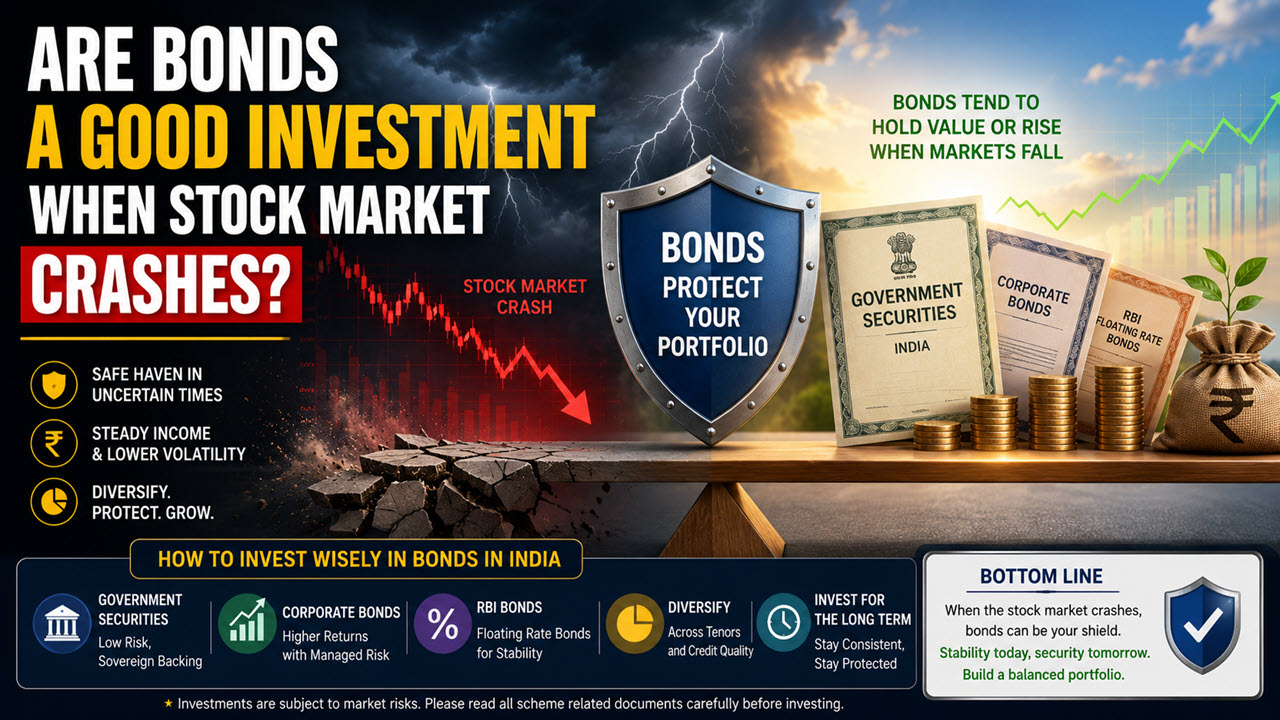
High-quality bonds, such as government securities and gilt or short-duration debt funds, have usually held their value or gained during Indian stock market crashes. That is because investors rush to safety and the RBI tends to cut rates. Lower-rated corporate bonds are different: in a crisis they can fall in value or become impossible to sell, as Franklin Templeton’s 2020 debt fund shutdown showed.
This guide looks at what bonds actually did in the 2008 and 2020 crashes, explains duration risk and credit risk, and compares your options: G-secs, state bonds, corporate bonds, debt funds and RBI Floating Rate Savings Bonds. It also covers how debt is taxed and how to buy G-secs directly from the RBI, and includes a sample allocation by age and goal.
Why good bonds tend to hold up in a crash
A bond pays a fixed interest rate (the coupon) and returns your principal at maturity. Bond prices move opposite to market yields: when yields fall, existing bonds paying higher coupons become more valuable.
In most equity crashes, two things push yields down. Investors sell shares and buy safe government paper, and the RBI cuts rates to support growth. Both lift the price of high-quality bonds just as stocks are falling. That is the cushion people expect from a balanced portfolio.
The cushion is not guaranteed. When a sell-off is caused by rising interest rates or inflation, stocks and bonds can fall together. That happened in 2022, and again in September 2026, when the 10-year G-sec yield climbed above 7% while the Nifty fell for eight straight weeks. For more on how rates move markets, see whether high interest rates are bad for stocks.
What bonds did in the 2008 and 2020 crashes
2008: global financial crisis
The Nifty fell from a January 2008 closing high of 6,287.85 to 2,524.20 in October, a drop of about 60%. It ended the year at 2,959.15, down about 52%. The RBI, which had raised the repo rate to 9% in mid-2008, then cut it from 20 October 2008 onwards, to 5% by 5 March 2009. The 10-year government bond yield fell to about 5.24% by January 2009, so long-dated G-secs and gilt funds made large price gains while stocks collapsed.
Not every debt product was calm. In October 2008, companies and banks rushed to redeem money from liquid and short-term debt funds. On 14 October 2008 the RBI opened a special ₹20,000 crore repo window so that banks could lend to mutual funds facing redemptions.
March 2020: the Covid crash
The Nifty fell from a January 2020 high of about 12,362 to 7,610.25 on 23 March 2020, a drop of roughly 38%. The RBI cut the repo rate by 75 basis points to 4.40% on 27 March and to 4.00% on 22 May 2020. Government bond yields fell: the 10-year yield averaged about 6.7% in March 2020 and below 6% by mid-2020, which helped gilt and high-quality bond funds.
The Franklin Templeton lesson: credit risk
On 23 April 2020, Franklin Templeton Mutual Fund shut six debt schemes holding about ₹25,000 crore, including its Ultra Short Bond, Low Duration, Credit Risk and Short Term Income Plan funds. They held many lower-rated, hard-to-sell corporate bonds. When redemptions surged and the corporate bond market froze, the fund house could not raise cash without selling at distress prices.
Four days later the RBI announced a ₹50,000 crore special liquidity facility for mutual funds. The six schemes were wound up gradually, and by September 2023 they had paid out about ₹27,508 crore, around 109% of their April 2020 value. Investors eventually got their money back, but it was locked up for months or years, during exactly the crash when they might have wanted it. Several of these were funds that sounded safe, such as “ultra short” and “low duration”.
Duration risk vs credit risk
Every bond carries two main risks, and they behave very differently in a crash.
| Duration (interest rate) risk | Credit (default) risk | |
|---|---|---|
| What it is | How much the price moves when yields change | The chance the issuer delays or misses payments |
| Measured by | Modified duration, in years | Credit rating (AAA, AA, A…) |
| Highest in | Long-duration and gilt funds, long G-secs | Credit risk funds, low-rated corporate bonds |
| In a typical crash | Often helps, because rates are cut | Hurts: spreads widen, liquidity dries up |
| In a rate-hike sell-off | Hurts: prices fall as yields rise | Can also hurt if borrowers struggle |
A rough rule: price change ≈ −modified duration × change in yield. Suppose a gilt fund has a modified duration of 6 years. If yields fall by 1 percentage point, its price rises by about 6 × 1% = 6%. If yields rise by 0.5 point, it falls by about 6 × 0.5% = 3%. G-secs carry almost no credit risk, but long ones carry plenty of duration risk.
Your bond options in India
| Option | Issuer / credit risk | Key features | Crash behaviour |
|---|---|---|---|
| G-secs and T-bills | Government of India; sovereign | T-bills up to 364 days; dated G-secs up to 40 years; tradable | Usually the best hedge; long ones swing most |
| SDLs | State governments; near-sovereign | Usually yield a little more than central G-secs of similar maturity | Similar to G-secs, slightly less liquid |
| Corporate bonds | Companies, NBFCs, PSUs; depends on rating | Higher yield for lower rating; sold via brokers and SEBI-registered online bond platforms | AAA PSU bonds hold up; lower-rated bonds can freeze |
| Debt mutual funds | Depends on category | Daily liquidity, diversified, small amounts | Gilt and short-duration funds steady; credit risk funds vulnerable |
| RBI Floating Rate Savings Bonds | Government of India | 7-year lock-in; rate resets every six months | No market price; value doesn’t fall |
Debt mutual fund categories that matter
SEBI divides debt funds into 16 categories. For crash protection, these are the most relevant:
- Overnight and liquid funds: very short maturities, for emergency money and parking cash.
- Short duration funds: portfolio Macaulay duration of 1–3 years; moderate rate sensitivity.
- Corporate bond funds: at least 80% in bonds rated AA+ or above.
- Banking and PSU funds: at least 80% in debt of banks, PSUs and public financial institutions.
- Gilt funds: at least 80% in government securities; no credit risk, but sensitive to rate changes.
- Credit risk funds: at least 65% in bonds rated AA or below (excluding AA+). Higher yield, and the category most exposed in a crash.
RBI Floating Rate Savings Bonds
These bonds pay the National Savings Certificate (NSC) rate plus 0.35 point, reset every 1 January and 1 July. With the NSC at 7.7%, the rate is 8.05% for July–December 2026. Interest is paid every six months and is fully taxable. The minimum investment is ₹1,000, and you buy through authorised banks.
The catch is liquidity. The bonds mature after 7 years and cannot be traded. Early exit is allowed only for investors aged 60 and above, after a lock-in of 4–6 years depending on age, with a penalty. They suit money you are sure you won’t need soon.
How to buy G-secs on RBI Retail Direct
RBI Retail Direct lets individuals hold government securities in a Retail Direct Gilt (RDG) account with the RBI itself. You don’t need a broker, and opening and keeping the account is free.
- Go to rbiretaildirect.org.in or download the RBI Retail Direct app.
- Register with your PAN, Aadhaar-linked mobile number, email and a savings bank account. Complete KYC online.
- Add up to two nominees. Nomination is mandatory.
- Bid in primary auctions of T-bills, dated G-secs or SDLs using non-competitive bidding, which means you accept the auction’s average price. You can also buy and sell existing bonds in the secondary market through the platform.
- Pay through net banking or UPI. Payment gateway charges may apply. The minimum is ₹10,000 for G-secs, SDLs and T-bills.
Non-resident investors eligible under FEMA can also open an account. Floating Rate Savings Bonds are not sold on Retail Direct; buy them through a bank.
How bonds and debt funds are taxed
- Interest from G-secs, SDLs, corporate bonds and Floating Rate Savings Bonds is taxed at your slab rate.
- Debt funds bought on or after 1 April 2023: all gains are taxed at your slab rate, however long you hold. From FY 2025-26, this applies to funds that invest more than 65% in debt and money market instruments.
- Debt funds bought before 1 April 2023: if held for more than 24 months, gains on sales from 23 July 2024 are taxed at 12.5% without indexation. If held for less, they are taxed at your slab rate.
- Listed bonds sold on the market: gains on bonds held more than 12 months are taxed at 12.5% without indexation; shorter holdings are taxed at slab rate. Gains on unlisted bonds and debentures are taxed at slab rate.
Budget 2026 did not change these rules. For investors in the 30% bracket, the after-tax return gap between debt funds and FDs is now small, so pick on liquidity and risk rather than tax.
How much to hold in bonds: a sample allocation
The right mix depends on when you need the money and how well you handle losses. The table below gives illustrative starting points, not personal advice.
| Situation | Equity | Debt | Suitable debt choices |
|---|---|---|---|
| Emergency fund (6 months’ expenses) | 0% | 100% | Savings account, sweep FD, liquid or overnight fund |
| Goal within 3 years | 0–20% | 80–100% | T-bills, money market or short duration funds, FDs |
| Goal in 3–7 years | 40–60% | 40–60% | Short duration, corporate bond, banking and PSU funds |
| Age 25–40, long-term wealth | 70–80% | 20–30% | PPF, gilt or short duration funds, G-secs |
| Age 40–55 | 55–70% | 30–45% | G-secs, SDLs, high-quality debt funds |
| Retired | 20–40% | 60–80% | SCSS, Floating Rate Savings Bonds, G-sec ladder, short duration funds |
Our asset allocation guide covers how to set and adjust your split.
Worked example: a crash with and without bonds
Suppose Rohan has ₹10 lakh split 70:30, with ₹7 lakh in an equity index fund and ₹3 lakh in a short duration debt fund. A crash like February–March 2020 hits: equity falls 38%, and the debt fund gains a hypothetical 2% over the same period.
- Equity: ₹7,00,000 × (1 − 0.38) = ₹4,34,000
- Debt: ₹3,00,000 × 1.02 = ₹3,06,000
- Total: ₹7,40,000, a fall of 26%. With 100% equity, he would have had ₹6,20,000, a fall of 38%.
The bigger benefit is rebalancing. To get back to 70:30, Rohan needs ₹7,40,000 × 70% = ₹5,18,000 in equity, so he moves ₹84,000 from debt into equity at low prices. Debt is then ₹2,22,000. When markets recover, those extra units add to his returns, a quiet form of making money when the market goes down.
Common mistakes
- Chasing yield in the “safe” part of the portfolio. An extra 1–2% from low-rated bonds is the risk that turns up in a crash.
- Judging a fund by its name. “Ultra short” or “low duration” says nothing about credit quality. Check the portfolio’s ratings and SEBI’s risk class.
- Using long-duration funds for short-term goals. A 0.5-point rise in yields can wipe out months of interest.
- Switching to bonds after the crash. By then yields have usually fallen and stocks are cheap: the opposite of what you want. Set your mix before trouble starts. Our explainer on what counts as a stock market crash shows how often falls happen.
- Locking all your debt money into long, non-tradable products. Keep part of it liquid so you can rebalance.
FAQ
Do bond prices go up when the stock market crashes?
High-quality government bonds often do, because investors seek safety and the RBI usually cuts rates. That happened in 2008 and 2020. But when the crash is caused by rising rates or inflation, as in 2022, bonds can fall too.
Are debt mutual funds safe during a crash?
Gilt, liquid, banking and PSU, and high-quality corporate bond funds have generally been stable. Funds holding low-rated bonds carry real risk, as the six Franklin Templeton schemes shut in April 2020 showed.
Is it better to buy G-secs directly or through a gilt fund?
Holding a G-sec to maturity on RBI Retail Direct gives a known return with no expense ratio. A gilt fund gives daily liquidity and professional duration management, but its value moves with yields and it charges fees.
What is the current interest rate on RBI Floating Rate Savings Bonds?
8.05% for 1 July to 31 December 2026, which is the NSC rate of 7.7% plus 0.35 point. The rate is reset each January and July.
How are debt fund gains taxed now?
For units bought on or after 1 April 2023, gains are taxed at your income tax slab rate whatever the holding period. Older units held more than 24 months are taxed at 12.5% without indexation.
Should I sell stocks and buy bonds when a crash starts?
Usually not. Selling after a fall locks in losses, and bonds have often already rallied by then. A fixed allocation that you rebalance tends to work better than reacting to headlines.

Ramesh Iyer is the pen name of the founder and editor of StocksInfo.AI, an independent investor in Indian equities, mutual funds and ETFs since 2020. Every article is researched from primary sources such as SEBI, AMFI, NSE and the Income Tax Department, and fact-checked before publishing. About us