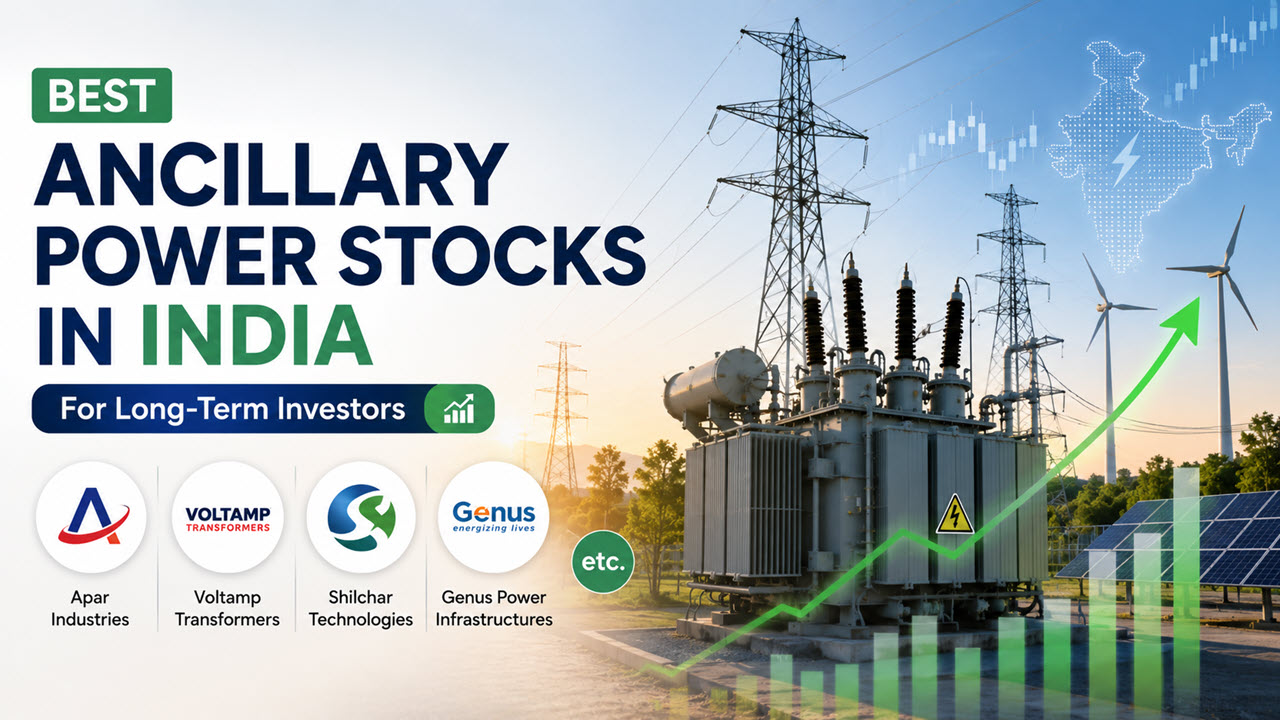
Ancillary power stocks are companies that make the equipment the grid runs on, such as transformers, cables, switchgear, conductors and smart meters, rather than companies that generate or sell electricity. The 10 listed below are examples worth researching because they sit directly in the path of India’s transmission spending, but several already trade at P/E multiples above 75, so the theme carries real valuation risk.
This article explains the demand story first, then the main ancillary segments, then a dated fact file for each company with a comparison table. It closes with the valuation and cyclical risks and a checklist you can use on any stock in this space. This is educational material, not a recommendation to buy or sell any security.
Why the grid is the investment theme
Power demand is rising fast
India met an all-time high peak demand of 270.8 GW on 21 May 2026, and peak demand in April to June 2026 was about 12% higher than a year earlier, helped by heatwaves. The government’s National Electricity Plan (Transmission) is built around a peak demand of 458 GW by 2032, which means the grid has to carry roughly 70% more power at peak within about six years.
Transmission capex: NEP, ISTS and the Green Energy Corridor
The National Electricity Plan (Transmission) for 2023 to 2032, released by the Ministry of Power with the Central Electricity Authority (CEA), puts the total cost at ₹9.15 lakh crore. It plans to expand the network from 4.85 lakh circuit km (ckm) in 2024 to 6.48 lakh ckm in 2032, and transformation capacity from 1,251 GVA to 2,342 GVA. Transformation capacity is the rating of substation transformers, which is why transformer makers care about this number.
The inter-state transmission system (ISTS, the national grid linking states) is planned to carry 280 GW of solar and wind power by 2030. In April 2026 the CEA also published a longer transmission plan for integrating over 900 GW of non-fossil capacity by 2035-36, estimating about ₹7.93 lakh crore of transmission investment between 2026-27 and 2035-36.
State grids are getting money too. The Union Cabinet approved Green Energy Corridor Phase III (GEC-III, announced 1 October 2026) with an outlay of ₹1,86,405 crore: ₹1,36,378 crore for intra-state transmission and ₹50,000 crore for 50 GWh of battery storage, with central support of ₹54,082 crore. It aims to evacuate 135 GW of renewable power by FY 2032-33.
The RDSS smart-meter rollout
Under the Revamped Distribution Sector Scheme (RDSS), 20.33 crore smart meters have been sanctioned: 19.79 crore consumer meters, 52.53 lakh distribution transformer meters and 2.05 lakh feeder meters. As of 30 June 2026, 5.73 crore had been installed under RDSS, about 28% of the target, according to a written reply in Parliament. The scheme’s deadline has been extended by two years to 31 March 2028.
Data centres add a new source of demand
India’s installed data-centre capacity rose to about 1.57 GW by August 2026 from roughly 375 MW in 2020, and official projections put it at 8 GW by 2030. The CEA estimates data-centre electricity demand could reach about 17 GW by 2031-32. Each large campus needs its own substations, transformers, cables and switchgear.
The ancillary segments, in plain terms
- Transformers: step voltage up for long-distance transmission and down for factories and homes. Long lead times have recently given makers pricing power.
- Cables and wires: extra-high-voltage (EHV) cables for substations and cities, plus building wires. Copper and aluminium prices drive revenue swings.
- Switchgear: breakers and gas-insulated substations (GIS) that protect and isolate parts of the grid.
- Smart meters: two-way meters that allow prepaid billing and cut discom losses.
- Transformer oil: the insulating and cooling oil inside every oil-filled transformer.
- Conductors: the overhead aluminium lines strung between transmission towers.
- EPC/T&D: engineering, procurement and construction firms that build transmission lines and substations. Margins are thinner and debt higher than for product makers.
10 ancillary power stocks worth researching
Unless stated otherwise, market cap, P/E and ROCE (return on capital employed, a measure of how much operating profit a company earns on the money invested in it) are as of 1 October 2026 from Screener.in. Borrowings are as of March 2026. Order books are as of 30 June 2026 from company Q1 FY27 results. The order is by segment, not by preference.
1. Hitachi Energy India (transformers, HVDC, grid automation)
The Indian arm of Hitachi Energy supplies power transformers, high-voltage DC (HVDC) systems, substations and grid software. Market cap is about ₹1,39,467 crore, with a P/E of 117 and ROCE of 29.4%. Borrowings are small at ₹86 crore. Its order backlog reached a record ₹32,222 crore at the end of June 2026 after ₹5,097 crore of new orders in the quarter.
2. GE Vernova T&D India (substations, transformers, switchgear)
This is GE Vernova’s listed grid business in India, making GIS substations, transformers and grid automation products. Market cap is about ₹1,08,903 crore, P/E 80.6 and ROCE 77.4%, with borrowings of ₹24 crore. The backlog was ₹20,930 crore in June 2026, slightly lower than in March, as Q1 FY27 order intake fell about 30% year on year to ₹1,140 crore. Private customers made up 77% of the backlog.
3. Siemens Energy India (transmission and generation equipment)
Demerged from Siemens Ltd and listed in 2025, it makes HVDC and substation equipment, transformers, and steam turbines and generators. Its financial year ends in September. Market cap is about ₹1,18,731 crore, P/E 77.8 and ROCE 67.8%, with borrowings of ₹148 crore (September 2025). The order backlog was ₹19,331 crore in June 2026, up 16.4% year on year.
4. CG Power and Industrial Solutions (transformers, switchgear, motors)
CG Power has a Power Systems segment (transformers and switchgear) and an Industrial Systems segment (motors and railway equipment). Market cap is about ₹1,38,484 crore, P/E 109 and ROCE 26.7%, with borrowings of ₹118 crore. The consolidated backlog was ₹18,965 crore in June 2026, up 45% year on year; Power Systems alone accounted for ₹14,434 crore. Its working-capital days have risen from about 31 to about 70 (Screener), which is worth tracking.
5. Apar Industries (conductors, transformer oil, cables)
Apar covers three segments in one company: aluminium conductors, transformer and specialty oils, and power and telecom cables. Market cap is about ₹73,896 crore, P/E 61.3 and ROCE 31.8%. Borrowings rose to ₹956 crore in March 2026 from ₹585 crore a year earlier. The pending conductor order book was ₹10,190 crore in June 2026, with about 57% from exports, so it depends on overseas utilities as well as India.
6. KEI Industries (EHV and HV cables, wires)
KEI makes EHV, HV and LT power cables and house wires, and also does some cable EPC work. Market cap is about ₹43,039 crore, P/E 43.2 and ROCE 20.0%, with borrowings of ₹253 crore. Pending orders were about ₹4,292 crore in Q1 FY27, including ₹793 crore of EHV cable and ₹822 crore of exports.
7. Genus Power Infrastructures (smart meters)
Genus is the most direct RDSS play on this list, manufacturing smart meters and running metering contracts as an advanced metering infrastructure service provider (AMISP). Market cap is about ₹8,519 crore, P/E 13.1 and ROCE 25.3%. Borrowings are much higher than peers at ₹2,302 crore, reflecting the capital the AMISP model needs. The order book was about ₹24,020 crore in June 2026, nearly three times its market cap, and the company has guided for FY27 revenue of ₹6,000 to 6,500 crore. The low P/E shows the market’s doubts about execution pace, debt and discom payments.
8. Transformers & Rectifiers India (power transformers, reactors)
TARIL makes power, furnace and rectifier transformers and reactors for utilities and industry. Market cap is about ₹8,429 crore, P/E 32.6 and ROCE 23.3%, with borrowings of ₹457 crore. Its unexecuted order book hit a record ₹6,630 crore in June 2026, but Q1 FY27 profit fell sharply year on year, and the share price was about 44% below its 52-week high on 1 October 2026.
9. Voltamp Transformers (industrial and distribution transformers)
Voltamp makes oil-filled and dry-type transformers, mostly for industrial and commercial buyers rather than large utilities. Market cap is about ₹10,548 crore, P/E 33.3 and ROCE 23.5%, and it is practically debt-free with borrowings of ₹1 crore. It does not publish an order book in a format comparable with the others, so check its latest investor update directly.
10. Kalpataru Projects International (transmission EPC)
Kalpataru builds transmission lines and substations in India and abroad, alongside buildings, oil and gas and other infrastructure. Market cap is about ₹23,164 crore, P/E 20.8 and ROCE 18.3%. Borrowings are ₹3,543 crore, typical of an EPC business. The order book reached a record ₹66,607 crore in June 2026, of which T&D was ₹29,609 crore (44%).
Comparison table
| Company | Main segment | Market cap (₹ cr) | P/E | ROCE | Borrowings (₹ cr) | Order book, Jun 2026 (₹ cr) |
|---|---|---|---|---|---|---|
| Hitachi Energy India | Transformers, HVDC | 1,39,467 | 117 | 29.4% | 86 | 32,222 |
| CG Power | Transformers, switchgear | 1,38,484 | 109 | 26.7% | 118 | 18,965 |
| Siemens Energy India | HVDC, substations | 1,18,731 | 77.8 | 67.8% | 148* | 19,331 |
| GE Vernova T&D India | GIS, transformers | 1,08,903 | 80.6 | 77.4% | 24 | 20,930 |
| Apar Industries | Conductors, oil, cables | 73,896 | 61.3 | 31.8% | 956 | 10,190 (conductors) |
| KEI Industries | Cables, wires | 43,039 | 43.2 | 20.0% | 253 | 4,292 |
| Kalpataru Projects | T&D EPC | 23,164 | 20.8 | 18.3% | 3,543 | 66,607 |
| Voltamp Transformers | Transformers | 10,548 | 33.3 | 23.5% | 1 | Not comparable |
| Genus Power | Smart meters | 8,519 | 13.1 | 25.3% | 2,302 | 24,020 |
| Transformers & Rectifiers | Transformers, reactors | 8,429 | 32.6 | 23.3% | 457 | 6,630 |
Source: Screener.in (prices, market cap, P/E, ROCE as of 1 October 2026; borrowings as of March 2026, *Siemens Energy India as of September 2025) and company Q1 FY27 results for order books.
The valuation risk, in numbers
The Nifty 50 traded at a trailing P/E of roughly 19 to 20 in late September 2026. Four of the ten companies above trade at more than 75 times earnings, and two above 100. If you need a refresher on what the multiple means, see our guide to the P/E ratio explained.
The multiples have also expanded a lot. On Screener’s five-year charts, CG Power’s P/E was about 20 in October 2021 and about 109 now, against a five-year median of about 83. Apar’s P/E was about 10 in October 2021 against a five-year median of about 29 and around 60 today. Much of the past return came from investors paying more for each rupee of profit, which cannot repeat forever.
Prices have already shown how fast sentiment can turn. On 1 October 2026, Transformers & Rectifiers was about 44% below its 52-week high (₹281 against ₹501), GE Vernova T&D about 25% below (₹4,253 against ₹5,650), KEI about 24% below and Hitachi Energy India about 19% below (₹31,290 against ₹38,800).
Worked example: what a P/E of 100 asks of a company
Suppose Arjun puts ₹1,00,000 into a hypothetical stock trading at a P/E of 100. Its earnings then grow an impressive 25% a year for five years, so earnings rise by 1.25 to the power 5, which is about 3.05 times.
- If the P/E stays at 100: the price also rises 3.05 times, so ₹1,00,000 becomes about ₹3,05,000, a 25% annual return.
- If the P/E falls to 40 (still about double the Nifty): price multiple = 3.05 × 40 ÷ 100 = 1.22, so ₹1,00,000 becomes about ₹1,22,000. That is only about 4.1% a year, less than a fixed deposit, despite earnings tripling.
Another way to see it: a P/E of 117 equals an earnings yield (earnings divided by price) of about 0.85%. Our article on how to tell if a stock is overvalued covers more checks of this kind.
Other risks: cyclicality and execution
- Capex cycles turn. Power equipment orders tend to come in waves tied to government plans and utility budgets. After the last big transmission push, many Indian electrical equipment makers went through years of weak orders and poor margins. A slowdown in tendering, like GE Vernova T&D’s 30% fall in Q1 FY27 order intake, can show up quickly.
- Commodity costs. Copper, aluminium, steel (CRGO) and oil prices can hurt fixed-price contracts.
- Payment delays. State discoms are often slow payers, which shows up as rising receivables and debt, especially for smart-meter and EPC companies.
- Capacity additions. Many transformer and cable makers are expanding at the same time. Today’s tight supply can turn into overcapacity.
Because these stocks move together, holding several of them is less diversified than it looks. Our guide to asset allocation explains how to cap exposure to a single theme, and how to avoid losing money in the stock market covers common behaviour traps.
Checklist for evaluating an ancillary power stock
- Order book to revenue: divide the order book by trailing 12-month revenue. Above 2 gives good visibility, but check how much is low-margin or long-dated.
- Order inflow trend: compare the latest quarter’s new orders with a year earlier. Falling inflow usually shows up in revenue a year or two later.
- Margin direction: are operating margins rising because of pricing power, or falling as competition and costs catch up?
- Working capital and cash flow: compare operating cash flow with net profit over three years, and watch receivable days.
- Debt: check borrowings against equity and whether debt is rising faster than revenue.
- Customer mix: private, central PSU, state discom and export customers carry very different payment and pricing risks.
- Valuation against history: compare today’s P/E with the company’s own five-year median and with the Nifty, and run the worked example above with your own growth assumptions.
- Parent and promoter factors: for MNC subsidiaries, check royalty payments and related-party transactions; for promoter-led firms, check pledging and holding changes.
For smaller names in the same supply chain, see our list of small-cap manufacturing stocks. Our piece on long-term investment strategies covers holding a theme over many years.
FAQ
What are ancillary power stocks?
They are companies that supply equipment and services to the power sector rather than generating or distributing electricity themselves. Examples include makers of transformers, cables, conductors, switchgear, smart meters and transformer oil, and EPC firms that build transmission lines.
Why are transformer stocks in India so expensive?
Demand has outrun supply, order books are at records and margins have improved, so investors expect several years of fast profit growth. The risk is that these expectations are already in the price: a P/E above 100 needs earnings to grow fast for years just to justify today’s price.
How will the RDSS smart-meter deadline extension affect meter companies?
The extension to March 2028 gives more time to install the roughly 14.6 crore sanctioned meters still pending as of June 2026. It spreads revenue over a longer period but also signals slow execution by discoms, which can delay payments and raise borrowing for AMISP contractors.
Is a big order book a reason to buy a stock?
No. An order book shows future revenue, not future profit or what the stock is worth. Transformers & Rectifiers had a record order book in June 2026 while its quarterly profit fell and its share price was far below its high.

Ramesh Iyer is the pen name of the founder and editor of StocksInfo.AI, an independent investor in Indian equities, mutual funds and ETFs since 2020. Every article is researched from primary sources such as SEBI, AMFI, NSE and the Income Tax Department, and fact-checked before publishing. About us