

Can you actually make money with day trading, or is it just another stock market myth? For many Indian investors, the idea of earning daily income from the stock market, rather than waiting years like a long-term investor, is very tempting—especially when they see profit screenshots on social media.
Yes, you can make money with day trading. A few traders even build serious wealth from it. But most people do not. Studies from different markets consistently show that 80–90% of active day traders lose money over time.
This guide breaks down how day trading really works, what separates the small winning group from the majority who lose, and how Indian investors should think about day trading compared with other ways of buying and selling stocks.
What Is Day Trading?

Day trading is the practice of buying and selling financial instruments—stocks, currencies, futures, options, or crypto—within the same trading day. You open and close all positions before the market shuts, so you don’t carry any overnight risk from news or gaps.
Key points:
- You focus on intraday price movements, not long-term fundamentals.
- Trades can last from a few seconds to a few hours.
- Positions are squared off by the end of the day.
In contrast, long-term investors hold positions for months or years based on business quality, earnings growth, and valuations. Day traders mainly react to price, volume, and news, not balance sheets and annual reports.
If you want to go deeper into the shorter-term style itself, you might also like to read: Can You Make Money In Intraday Trading?
Can You Really Make Money With Day Trading?
So, can you make money with day trading in a consistent way, or are most success stories just rare exceptions?
The Reality Behind The Question
- A small minority of disciplined traders do make steady returns.
- A large majority either lose steadily or blow up their accounts in a few months or years.
- Many people only hear the success stories and miss the thousands of quiet failures. This is classic survivorship bias.
Why do so many lose?
- They jump in before they understand how markets work.
- They treat day trading like a lottery rather than a skill-based profession.
- They ignore risk management and trade sizes that are too big for their capital.
- They let emotions like fear and greed override their trading plan.
- They keep switching strategies after a few losses instead of testing one approach properly.
Can you make money with day trading if you are disciplined, patient, and well prepared? Yes.
Will everyone make money from it? Almost certainly not.
“The stock market is a device for transferring money from the impatient to the patient.” — Warren Buffett
For a broader perspective on this, read: Can Everyone Make Money In The Stock Market?
How Day Trading Works In Practice
To judge whether you can make money with day trading, it helps to know what a normal trading day looks like for an active trader.
The Core Mechanics
Most day traders:
- Focus on liquid stocks (often large caps) or index derivatives like Nifty and Bank Nifty futures, where it’s easy to enter and exit.
- Watch live charts on 1-minute, 5-minute, or 15-minute timeframes.
- Use tools such as:
- Moving averages
- Relative Strength Index (RSI)
- Candlestick patterns
- Volume spikes and breakouts
- Follow news and events such as:
- Quarterly results
- RBI or Fed announcements
- Macro data that can move markets
(see: Are Lower Interest Rates Good For The Stock Market?)
Margin And Position Size
Most brokers in India allow intraday margin in equities and F&O. That means:
- You can take a position larger than the cash you actually have by using margin.
- Your gains and losses both get magnified.
- A move of 1–2% against you in a margined position can wipe out a large portion of your capital if your position is too big.
- If losses cross certain limits, your broker may square off your position to protect the margin.
Margin is one of the main reasons new traders lose quickly. They see higher potential returns and forget that the downside grows just as fast.
Essential Requirements Before You Start Day Trading
Can you make money with day trading if you start tomorrow with a small account and no preparation? Almost certainly not. Before you place even one real trade, you should have four things in place.
1. Foundational Knowledge
You should clearly understand:
- How orders work: market, limit, stop-loss.
- How to read candlestick charts and basic patterns.
- What drives intraday moves (news, liquidity, trapped positions, large institutions).
- How technical indicators can help and mislead.
If you’re still new to the market itself, it may be better to start by learning more about simple buying and selling stocks as an investor before trying intraday trading. Free guides on StocksInfo.ai and other educational resources can help build this base.
2. Capital And Regulations
You don’t need a huge account to place a day trade, but you do need enough to:
- Survive losing streaks without blowing up.
- Respect basic risk rules (like risking only 1–2% of capital per trade).
Regulatory points to know:
- India (SEBI)
- Intraday margin in equities typically requires at least 20% of trade value as upfront margin, as per SEBI rules.
- All intraday positions must be squared off before market close. If you don’t, your broker will usually close them automatically.
- US Markets (for those trading via international brokers)
- The Pattern Day Trader (PDT) rule requires at least $25,000 equity in a margin account if you make more than three day trades in five business days.
Rules can change, so always check the latest SEBI and broker guidelines. Having more capital does not guarantee profits, but having too little capital almost guarantees that one bad stretch will knock you out.
3. Tools And Technology
Serious day traders depend on:
- A reliable trading platform with real-time data.
- Fast order execution and minimal downtime.
- Charting tools with indicators, drawing tools, and watchlists.
- A stable, high-speed internet connection (ideally with a backup).
Without these, you may not even get the price you see on your screen, especially in fast markets.
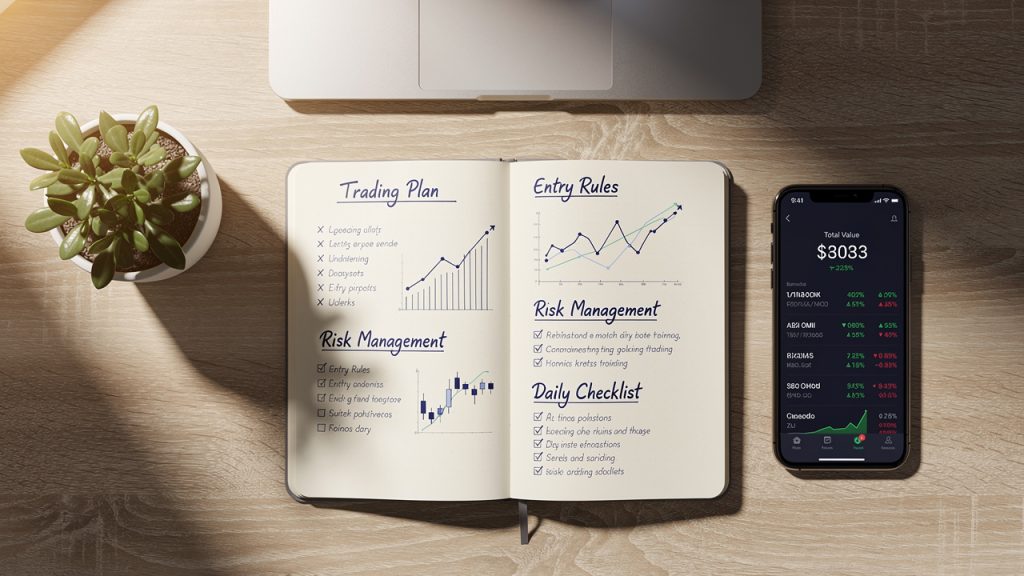
4. A Written Trading Plan
Can you make money with day trading if you decide everything “on the spot”? Very unlikely.
Your trading plan should spell out:
- What setups you trade (for example, breakout above previous day’s high with strong volume).
- Exact entry rules and exit rules.
- Your maximum risk per trade and per day.
- The time of day you will avoid trading (e.g., first 5 minutes, last 15 minutes).
Write this plan down and keep it simple. This is what protects you from your own impulses.
Popular Day Trading Strategies (For Learning, Not Blind Copying)
Many beginners ask: “Which strategy should I use so I can make money with day trading?” The truth: no strategy works all the time, and any approach must be tested and matched to your risk tolerance.
Here are common styles you’ll hear about:
- Scalping
Taking many tiny trades aiming for very small moves. Holds may last seconds or a few minutes. Needs low costs and very fast execution. - Trend Following
Trading in the direction of the dominant intraday trend. For example, buying pullbacks in a strong uptrend or selling rallies in a clear downtrend. - Momentum Trading
Focusing on stocks that move sharply with high volume after news, breakouts, or gap openings. The idea is to “ride the wave” until momentum slows. - Range Trading
Identifying clear support and resistance zones and buying near support, selling near resistance, as long as the stock respects that range. - News-Based Trading
Reacting to earnings, policy announcements, or sector news. This style is highly volatile and can be dangerous if you are slow or undisciplined.
Before risking money on any of these, test them with paper trading or a demo account over a large sample of trades. Keep notes on which setups actually work for you.
Risk Management: What Keeps Professionals In The Game
Can you make money with day trading over many years without strict risk management? Almost never. The traders who survive focus first on how much they can lose, not on how much they can win.
Core principles:
- Use A Stop-Loss On Every Trade
Decide in advance where your trade idea is invalid and place a stop-loss. Do not move it away from the price just to avoid taking a loss. - Risk Only 1–2% Of Capital Per Trade
If you have ₹2,00,000 and risk 1% per trade, your maximum loss per trade is ₹2,000. That way, even 5–6 losing trades in a row will hurt, but not destroy you. - Size Positions Based On Risk, Not Greed
Choose your quantity so that:
Distance from entry to stop-loss × quantity ≈ your planned risk per trade. - Avoid Overtrading
Once you cross your daily loss limit, stop. Trading to recover losses usually ends with even bigger losses.
“Rule No. 1: Never lose money. Rule No. 2: Never forget rule No. 1.” — Warren Buffett
Can you make money with day trading if you respect these ideas? Your odds improve a lot, though profits still depend on your edge and discipline.
Psychology: The Main Reason Most Day Traders Fail
Markets are not just numbers; they reflect human behavior in real time. Two emotions dominate:
- Greed – holding winners too long, chasing moves you missed, trading too large.
- Fear – cutting winners too early, skipping valid setups, panicking when trades move slightly against you.
To handle the mental side:
- Accept that losses are part of the business.
- Use a trading journal to record:
- Setup
- Reason for entry
- Reason for exit
- Your emotional state
- Review your journal weekly to spot repeated mistakes.
- Take breaks after big wins or losses to reset your mind.
- Create a simple pre-market and post-market routine so you are not reacting blindly.
“You don’t need to know what is going to happen next in order to make money in the markets.” — Mark Douglas
Traders who last treat day trading like a serious profession, not a casino. They keep expectations realistic and continuously refine both their method and their mindset.
Step-By-Step: How To Start Day Trading In India
If, after understanding the risks, you still want to see whether you can make money with day trading, follow a structured approach.
- Educate Yourself Thoroughly
Learn market basics, technical analysis, and risk concepts. Articles on StocksInfo.ai, good books on trading, and credible courses can help build a strong base. - Open The Right Accounts
- A Demat account to hold securities.
- A trading account with a SEBI-registered broker, linked to your bank account.
Confirm charges, margin policies, and platform quality before you start.
- Practice On A Demo Or Small-Size Account
Many brokers offer virtual trading or low-ticket trading in the beginning. Use this to:- Test your strategy.
- Learn the platform.
- Experience emotional swings without putting heavy capital at risk.
- Write And Test A Simple Trading Plan
Start with one or two basic setups that you understand well. Avoid constantly changing systems after a few losses. Track at least a few dozen trades before judging your approach. - Start Small And Scale Slowly
Begin with quantities so small that a loss will not disturb your sleep. Increase size only after you have consistent results over many trades and you are following your rules. - Review Your Performance Regularly
Track your:- Win rate
- Average profit
- Average loss
- Maximum drawdown
Day Trading Vs Other Ways To Make Money From Markets
Can you make money with day trading? Yes, but it isn’t the only—or even the easiest—way to grow wealth from markets.
Longer-Term Investing
Instead of chasing intraday moves, many investors prefer:
- Buying quality businesses or themes, such as data center stocks in India.
- Holding for years to benefit from earnings growth and compounding.
If your goal is long-term wealth rather than daily income, this route is usually more forgiving and less stressful than intraday trading. Systematic investment plans (SIPs) and diversified stock portfolios are common tools here.
You can explore more about long-term stock investing here: Are Stocks A Good Way To Make Money?
Swing And Positional Trading
You can also trade moves that last from a few days to a few weeks:
- Swing trading focuses on shorter-term trends without staring at screens all day. To learn more patterns and setups, see swing trading candlestick patterns.
- Positional trading holds for weeks or months based on bigger technical or fundamental views.
Swing and positional trading often mean:
- Fewer trades.
- Lower transaction costs.
- Less emotional pressure compared with pure day trading.
Unlisted Shares And Alternative Ideas
Experienced investors sometimes also look beyond the regular exchanges:
- The market for unlisted shares offers exposure to companies before they list.
- You can compare them with the listed shares here: Benefits Of Investing In Unlisted Shares Over Listed Stocks
- If you already hold such shares, you can learn How To Check The Value Of Your Unlisted Shares.
These approaches are not replacements for basic market knowledge or risk control, but they show that “can you make money with day trading?” is only one of many questions you can ask as an investor.

Is Day Trading Right For You?
Day trading is not automatically good or bad. The better question is: Is it right for your goals, personality, and financial situation?
You might consider day trading only if:
- You can set aside capital you can afford to lose.
- You have the time to watch markets and refine your method.
- You enjoy fast decision-making and can handle stress.
- You are willing to treat it like a great skill that may take years to develop.
You might avoid day trading and focus on other approaches if:
- You prefer a calmer, long-term path to wealth.
- You cannot watch markets actively during the day.
- You are uncomfortable with frequent wins and losses.
Can you make money with day trading? Yes—but it demands respect, patience, and continuous learning. It is a profession, not a shortcut.
FAQs
What Is The Minimum Capital Required For Day Trading?
There is no official universal minimum for day trading in India, but you should have enough to:
- Risk only a small portion of capital per trade (for example, 1–2%).
- Comfortably meet broker and SEBI margin requirements.
Practically, many traders start with ₹50,000–₹1,00,000 or more so they can size trades sensibly and cover losses and costs. If you plan to trade US stocks under the Pattern Day Trader (PDT) rule, you typically need at least $25,000 in a margin account to make frequent day trades.
Can Someone Start Day Trading Without Prior Experience?
They can open an account and place trades, but it’s usually a bad idea. Can you make money with day trading if you know nothing about charts, order types, or risk? Very unlikely.
A better path is to:
- Study market basics and technical analysis.
- Practice with a demo or very small trades.
- Build and test a simple trading plan before committing serious capital.
How Much Can You Realistically Earn Per Month With Day Trading?
There is no fixed number. Returns depend on your:
- Skill level
- Strategy
- Discipline
- Capital
- Market conditions
Some experienced traders might aim for single-digit percentage returns per month on average, knowing that some months will be flat or negative. Many beginners, however, lose money. It’s safer to focus on protecting capital and improving your process than chasing a specific monthly income figure.
Is Day Trading Legal In India And Worldwide?
Yes, day trading is legal in India when done through SEBI-registered brokers and within exchange and regulatory rules. It is also legal in most other major markets. You must:
- Follow margin and settlement rules.
- Square off intraday positions on time.
- Report and pay taxes correctly on your trading profits or business income.
Why Do Most Day Traders Lose Money?
Most day traders lose money because they:
- Start trading before they are ready.
- Ignore risk rules and trade sizes that are too large.
- Let emotions guide them instead of a tested plan.
- Overtrade or try to “win back” losses quickly.
- Misuse margin and get forced out by large losses.
Can you make money with day trading if you avoid these traps, manage risk carefully, and keep learning? Your chances improve, but it still takes time, patience, and serious effort.
You may also like:

Bijay Kumar is a 12-time Microsoft Most Valuable Professional (MVP) and the founder of StocksInfo.AI, and TSinfo Technologies. With 18+ years of experience in the technology industry and hands-on investing experience in Indian equity markets, mutual funds, and ETFs since 2020, Bijay brings an analytical, data-driven perspective to personal finance. His mission is to make investing knowledge simple, practical, and accessible for every Indian investor. Read more about us >>