
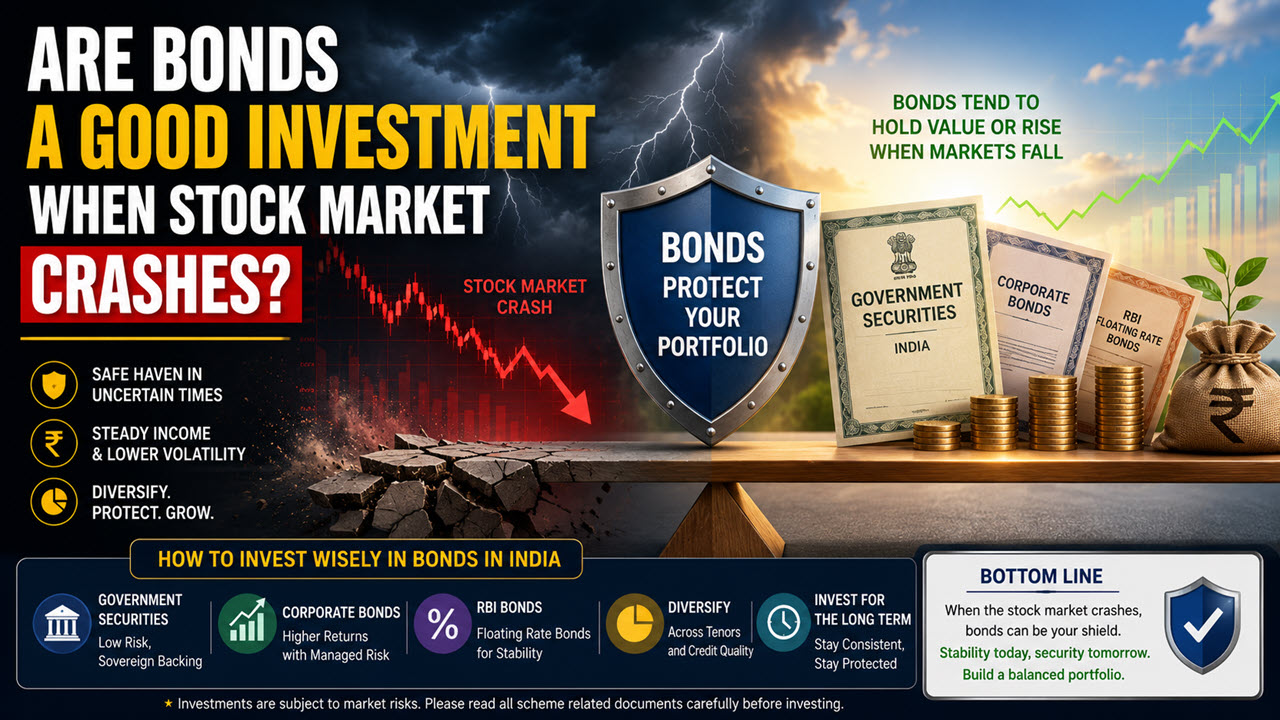
When the NSE and BSE screens turn red for days, most new investors feel the same panic. I remember checking my portfolio during a sharp fall, seeing equity mutual funds and direct shares drop together, and wondering whether I should stop my SIP or move everything into “safe” investments.
That is when many salaried investors first look at bonds. You may already invest ₹5,000 or ₹10,000 monthly through a mutual fund SIP for retirement, your child’s education, or a future house. But when stocks fall, the real question becomes: are bonds a good investment when the stock market crashes, or are they simply another product that sounds safe?
This guide will help you understand how bonds behave during market crashes, where they fit in an Indian portfolio, and how to use them without making emotional decisions.
Are Bonds a Good Investment When Stock Market Crashes?
Yes, bonds can be a good investment when stock markets crash, but they are not a magic shield. Their main job is to reduce the ups and downs in your overall portfolio, preserve capital for near-term goals, and give you money to deploy when good equity opportunities appear.
A bond is a loan you give to a government, company, or other institution. In return, the issuer promises to pay interest and return your principal amount on a stated maturity date. For example, if you buy a ₹10,000 government bond with a fixed interest rate, the government pays interest as per the bond terms and returns your ₹10,000 at maturity.
Stocks represent ownership in a business. Their prices can fall sharply when investors fear slower growth, weak earnings, high interest rates, or recession. Bonds work differently because their returns mainly come from interest payments and repayment of principal.
During a crash, many investors move money away from risky assets such as stocks, small-cap funds, and speculative shares. They often prefer relatively safer instruments, especially Government Securities, high-quality corporate bonds, or debt mutual funds. This movement can support bond prices, particularly when interest rates also decline.
However, not every bond rises during every crash. A low-quality corporate bond can fall if investors worry that the company may struggle to repay debt. So, “bond” does not automatically mean “safe.”
Pro Tip: In my experience, investors make the biggest mistake when they buy bonds only after panic begins. I prefer deciding my equity-debt mix before a crash, because a portfolio built during calm markets is easier to hold when headlines become frightening.
Why Stocks and Bonds React Differently
To understand whether bonds help during a crash, you need to know why stocks and bonds behave differently.
A company’s stock price depends on expected future profits, investor confidence, valuations, and demand in the market. When the outlook turns weak, even strong companies listed on the NSE or BSE can see their share prices decline.
A bondholder does not own the company. The bondholder is a lender. As long as the issuer continues paying interest and repays the principal, the investor receives the expected cash flows.
Here is a simple example.
Suresh is 30 years old and works in Bengaluru. He invests ₹10,000 every month:
- ₹7,000 in an equity mutual fund SIP
- ₹2,000 in an index fund
- ₹1,000 in a debt fund
If the stock market falls 20%, his equity investments may also show a large temporary loss. His debt fund may remain relatively stable, depending on the bonds it holds and interest-rate movement. The debt allocation will not erase the equity loss, but it can reduce the total damage.
Suppose Suresh has ₹5 lakh invested:
| Investment type | Allocation | Fall during a market crash | Estimated value after fall |
|---|---|---|---|
| Equity funds and stocks | ₹4,00,000 | 20% | ₹3,20,000 |
| Debt or bond investments | ₹1,00,000 | 0% | ₹1,00,000 |
| Total portfolio | ₹5,00,000 | 16% overall | ₹4,20,000 |
If he had invested the full ₹5 lakh in equity, the portfolio would have fallen to ₹4 lakh. The ₹1 lakh debt allocation gave him stability and, more importantly, funds to invest in equity after prices became more attractive.
You can learn more about handling declines in this guide on how to take advantage of a stock market correction.
How Interest Rates Affect Bonds
The relationship between interest rates and bond prices confuses many beginners. You do not need advanced finance knowledge to understand the main idea.
When interest rates fall, prices of existing bonds usually rise. When interest rates rise, prices of existing bonds usually fall.
Imagine you own a bond paying 8% interest. Later, new bonds start offering only 6% because interest rates fell. Your older 8% bond becomes more attractive, so another investor may pay more to buy it from you. That pushes its market price up.
Now consider the reverse. You own an 8% bond, but new bonds offer 9%. Buyers may not pay full price for your older 8% bond. Its market value may fall until its effective return becomes competitive.
This matters during a stock market crash because crashes sometimes happen alongside economic slowdown. If the Reserve Bank of India cuts interest rates to support growth, high-quality bonds may benefit. But do not assume this always happens immediately.
High inflation, rising government borrowing, or rising interest rates can hurt bond prices even while equities struggle. That is why bonds reduce portfolio risk, but they do not guarantee positive returns every day.
For more context on the interest-rate environment, read whether lower interest rates are good for the stock market and how high interest rates affect the stock market.
Types of Bonds Indian Investors Can Consider
Indian investors have several ways to add bonds or debt exposure to a portfolio. The best choice depends on your goal, time horizon, risk tolerance, and need for liquidity.
Government Securities
Government Securities, often called G-Secs, are bonds issued by the Government of India. They carry very low default risk because the government backs them. Their market prices can still move when interest rates change, especially for long-duration bonds.
These can suit investors who want relatively strong credit quality and have a clear holding period. Long-term G-Secs can fluctuate more than many people expect, so do not treat them like a savings account.
Treasury Bills
Treasury Bills, or T-Bills, are short-term government instruments. They usually mature within one year. Instead of paying regular interest, they are generally issued at a discount and redeemed at face value.
For example, you may buy a T-Bill for ₹98 and receive ₹100 at maturity. The difference represents your return. T-Bills can suit money you may need within a few months, but always match the maturity with your actual goal date.
Corporate Bonds
Corporate bonds are loans to companies. They may offer higher interest than government bonds because companies carry more repayment risk.
A highly rated corporate bond may look attractive during a crash because of its higher yield. But this is also when investors should become extra careful. A weak company can face cash-flow pressure when the economy slows. Higher interest often signals higher risk, not a free extra return.
Do not buy a corporate bond only because it advertises 10% or 11% returns. Check the issuer’s financial strength, credit rating, maturity, liquidity, and whether you understand the product fully.
Debt Mutual Funds
A debt mutual fund pools money from many investors and invests it in bonds, Treasury Bills, money-market instruments, and other fixed-income securities. Its NAV, or Net Asset Value, is the per-unit price of the mutual fund. NAV can move daily based on interest rates, bond prices, accrued interest, and credit events.
Debt funds can make diversification easier for beginners. However, they also carry interest-rate risk, credit risk, and liquidity risk. A long-duration debt fund may fall when rates rise, while a credit-risk fund may face trouble if lower-rated issuers struggle.
Choose the category based on your goal rather than chasing the debt fund that gave the highest recent return.
Bond ETFs
An ETF, or exchange-traded fund, is a fund you buy and sell on the stock exchange like a share. A bond ETF invests in a basket of bonds or government securities. You need a Demat account, a digital account that holds shares and ETFs electronically, and a trading account, which lets you place buy and sell orders on the exchange.
Bond ETFs can offer transparent holdings and convenient access, but you should check trading volumes and the difference between the market price and the fund’s NAV. Learn the basics through this guide on ETF investing tips for Indian investors and this explanation of ETF versus mutual fund investing.
When Bonds Help Most in a Crash
Bonds help most when you use them for the right purpose. They work best as part of a plan, not as a reaction to a scary market day.
Protecting Near-Term Goals
If you need money in the next one to three years for a home down payment, school fees, wedding expenses, or business needs, keeping all of it in equity is risky. A sudden market fall just before the goal can force you to sell at a loss.
For such goals, high-quality debt products, fixed deposits, short-term government securities, or suitable short-duration debt funds may make more sense than equity. Your priority is capital protection, not maximum return.
Reducing Portfolio Volatility
Diversification means spreading money across different investments so one fall does not damage your entire portfolio. Stocks, bonds, gold, and cash may react differently under the same economic conditions.
A 30-year-old investor with stable income and a 20-year retirement horizon may keep a larger equity allocation. A person nearing retirement may need a larger debt allocation because they have less time to recover from a crash.
There is no perfect allocation for everyone. But having both equity and debt usually makes it easier to stay invested.
Creating Rebalancing Money
Rebalancing means bringing your portfolio back to its planned allocation. This is one of the most practical benefits of bonds during a crash.
Suppose Suresh plans a 70% equity and 30% debt portfolio. He starts with ₹7 lakh in equity and ₹3 lakh in debt. A large fall reduces equity to ₹5.6 lakh while debt remains close to ₹3 lakh. Equity now represents about 65% of the portfolio.
He can move a controlled portion from debt to equity and restore the 70:30 mix. This forces him to buy equity when prices are lower, without guessing the exact market bottom.
When Bonds May Not Protect You
Bonds can reduce risk, but they have their own risks. Treating every debt investment as fully safe can create unpleasant surprises.
Rising Interest Rates
Long-duration bonds often react sharply to changing interest rates. If rates rise after you buy a long-term bond fund, its NAV can decline. This can surprise investors who expected debt funds to behave like fixed deposits.
If you want lower volatility, consider matching the bond duration with your investment horizon. Money needed soon should not sit in long-duration products.
Credit Risk
Credit risk is the possibility that a borrower delays or fails to repay interest or principal. Government securities have very low default risk, but corporate bonds differ widely in quality.
During an economic downturn, companies with heavy debt can become riskier. Do not reach for extra yield without understanding why it exists. A 1% higher expected return is not worth losing a meaningful part of your capital.
Inflation Risk
A bond may give stable interest, but inflation can reduce the buying power of that money. If inflation averages 6% and your post-tax return is close to 5%, your real wealth may not grow much.
That is why long-term investors usually need some equity exposure. Quality stocks and equity mutual funds offer a better chance of beating inflation over long periods, though they also fluctuate more.
Liquidity Risk
Some bonds do not trade actively. You may struggle to sell them quickly at a fair price before maturity. Bond ETFs can also have thin trading volumes on the exchange.
If easy access to money matters, use products with suitable liquidity and avoid locking all your emergency money into long-maturity instruments.
A Simple Bond Strategy for Beginners
If you are new to investing, do not complicate your portfolio with too many debt products. Start with your goals and time horizon.
Step 1: Build Emergency Money First
Keep at least three to six months of essential expenses in easily accessible, low-risk options. If your household expenses are ₹50,000 monthly, aim for roughly ₹1.5 lakh to ₹3 lakh as an emergency reserve.
This money is not for chasing returns. It protects you from selling equity or redeeming investments during a market crash because of a job loss, medical bill, or urgent family expense.
Step 2: Match Investments With Goals
Use a simple time-based approach:
- Goals within three years: Focus mainly on low-risk debt products, T-Bills, fixed deposits, or suitable short-duration options.
- Goals between three and seven years: Combine debt and equity according to your flexibility and comfort with market falls.
- Goals beyond seven years: Equity mutual funds, index funds, and selected stocks can play a larger role, while debt provides stability.
A SIP, or Systematic Investment Plan, lets you invest a fixed amount in a mutual fund regularly. A ₹5,000 monthly SIP continues buying more units when NAV falls and fewer units when NAV rises. You can understand the numbers using a SIP calculator for monthly investments.
Step 3: Set an Equity-Debt Allocation
Suresh may choose 75% equity and 25% debt because he has a stable salary, emergency savings, and a 20-year retirement goal. Someone with a five-year goal may choose 40% equity and 60% debt.
Your allocation should reflect your ability to handle a fall. If a 25% portfolio drop will make you sell everything, your equity allocation is probably too high.
Step 4: Rebalance Once or Twice a Year
Do not rebalance every week. Review your allocation once or twice a year, or when it moves sharply away from your target.
During a crash, use the debt portion deliberately. You can move a small planned amount into broad equity funds or an index fund, which tracks a market index such as the Nifty 50. Avoid trying to invest all your debt money on one day because no one knows the exact bottom.
Step 5: Stay Away From Panic Decisions
A stock market crash creates noise. Social media posts may push “guaranteed” debt products, penny stocks, options trades, or unlisted shares as quick opportunities.
Unlisted shares are shares of companies not traded on the NSE or BSE. They can offer opportunities, but they involve lower liquidity, less price transparency, and different risks. Read this guide on the risks of investing in unlisted shares in India before committing money meant for stable goals.
Bonds Versus Equity During a Crash
| Factor | Bonds and debt products | Equity investments |
|---|---|---|
| Main purpose | Stability, income, capital preservation | Long-term wealth creation |
| Crash behaviour | Often less volatile, but depends on rates and credit quality | Can fall sharply in the short term |
| Return potential | Usually moderate | Higher over long periods, with higher risk |
| Best use | Near-term goals and portfolio balance | Goals more than seven years away |
| Main risks | Interest-rate risk, credit risk, inflation risk | Market risk, valuation risk, business risk |
| Investor action in a crash | Hold, review quality, rebalance carefully | Continue planned SIPs and avoid panic selling |
Do not think of bonds and equity as competing choices. They solve different problems. Equity helps you grow money over the long term. Bonds help you avoid selling equity at the wrong time.
If you want to build a stronger long-term approach, read these practical long-term investment strategies for Indian investors.
Things to Keep in Mind
- Do not sell equity in panic: A crash creates temporary losses unless you sell; keep long-term money invested according to your plan.
- Choose quality over yield: A high interest rate on a corporate bond may signal higher credit risk, especially during an economic slowdown.
- Match duration with your goal: Avoid long-duration bonds for money you need soon because interest-rate changes can reduce their market value.
- Keep emergency money separate: Do not depend on shares, equity funds, or volatile bond funds for sudden expenses.
- Review allocation, not headlines: Check your equity-debt ratio periodically and rebalance only when your plan requires it.
- Avoid chasing the market bottom: Invest gradually through SIPs or planned rebalancing instead of betting everything on one crash-day purchase.
Frequently Asked Questions
Are bonds safe when the stock market crashes in India?
High-quality government bonds and short-term debt products are generally less volatile than equity during a stock market crash. However, bond prices can still fall when interest rates rise, and corporate bonds carry credit risk. Safety depends on the issuer, maturity, and product category.
Should I move all my money from stocks to bonds during a crash?
No. Moving everything after stocks already fall can lock in losses and damage your long-term wealth plan. Keep equity for long-term goals and use bonds or debt products for stability, near-term needs, and planned rebalancing.
Do bond mutual funds lose money when interest rates rise?
Yes, debt mutual funds can lose value when interest rates rise because existing bonds become less attractive than newly issued higher-rate bonds. Long-duration funds usually react more sharply than short-duration funds. Check the fund’s duration before investing.
Is a debt mutual fund better than a fixed deposit during a market crash?
It depends on your goal. A fixed deposit gives more certainty if you hold it to maturity, while a debt mutual fund can offer flexibility and diversification but may see NAV fluctuations. Do not choose only based on recent returns.
Can I invest in bond ETFs without a Demat account?
No, you need a Demat account and a trading account to buy bond ETFs on the NSE or BSE. If you prefer investing without exchange trading, debt mutual funds may offer a simpler route. Always check the ETF’s liquidity before placing an order.
How much of my portfolio should be in bonds?
There is no fixed answer. A young investor with a stable income and a long horizon may hold 20% to 30% in debt, while someone close to a financial goal may need a much higher allocation. Base the decision on your goal timeline, emergency fund, and ability to tolerate losses.
Bonds can support your portfolio during a market crash by reducing volatility, protecting near-term money, and giving you funds for disciplined rebalancing. Start with a simple equity-debt mix, stay consistent with your SIPs, and focus on long-term goals instead of daily market noise. I hope you found this article helpful.
You May Also Like
- How to avoid a stock market crash panic
- Are stock market crashes good for long-term investors?
- Best ETFs for Indian investors
- How to recover from a big loss in the stock market
- The power of compounding in stock market investing

Ramesh Iyer is the founder of StocksInfo.AI, a Bengaluru-based investor with two decades of market experience, writing plain-language content on stocks, mutual funds, and ETFs for everyday Indian investors. Read more